Section 1 of 10Particles in a solid
Particles in a solid
Arrangement
- Arrangement the particles are very close together in a regular pattern.
Motion
- Motion the particles vibrate about fixed positions.
Forces
- Forces strong forces between particles hold them in place, which gives a rigid shape and a fixed volume.
Section 2 of 10Particles in a liquid
Particles in a liquid
Arrangement
- Arrangement the particles are close together with no gaps but are not in a regular pattern.
Motion
- Motion the particles slide past each other, so the liquid can flow and change shape.
Forces
- Forces the particles have enough energy to move past each other but not to escape, so the volume is fixed.
Compression
- Compression a liquid is hard to compress because its particles are already close together.
Section 3 of 10Particles in a gas
Particles in a gas
Arrangement
- Arrangement the particles are widely separated, about 10 times further apart in each direction than in a liquid.
Motion
- Motion the particles move randomly at high speeds in straight lines until they collide.
Forces
- Forces the particles have overcome the forces holding them together, so a gas flows and fills its container.
Compression
- Compression a gas is easily compressed because of the large spaces between the particles.
Section 4 of 10Comparison of the three states
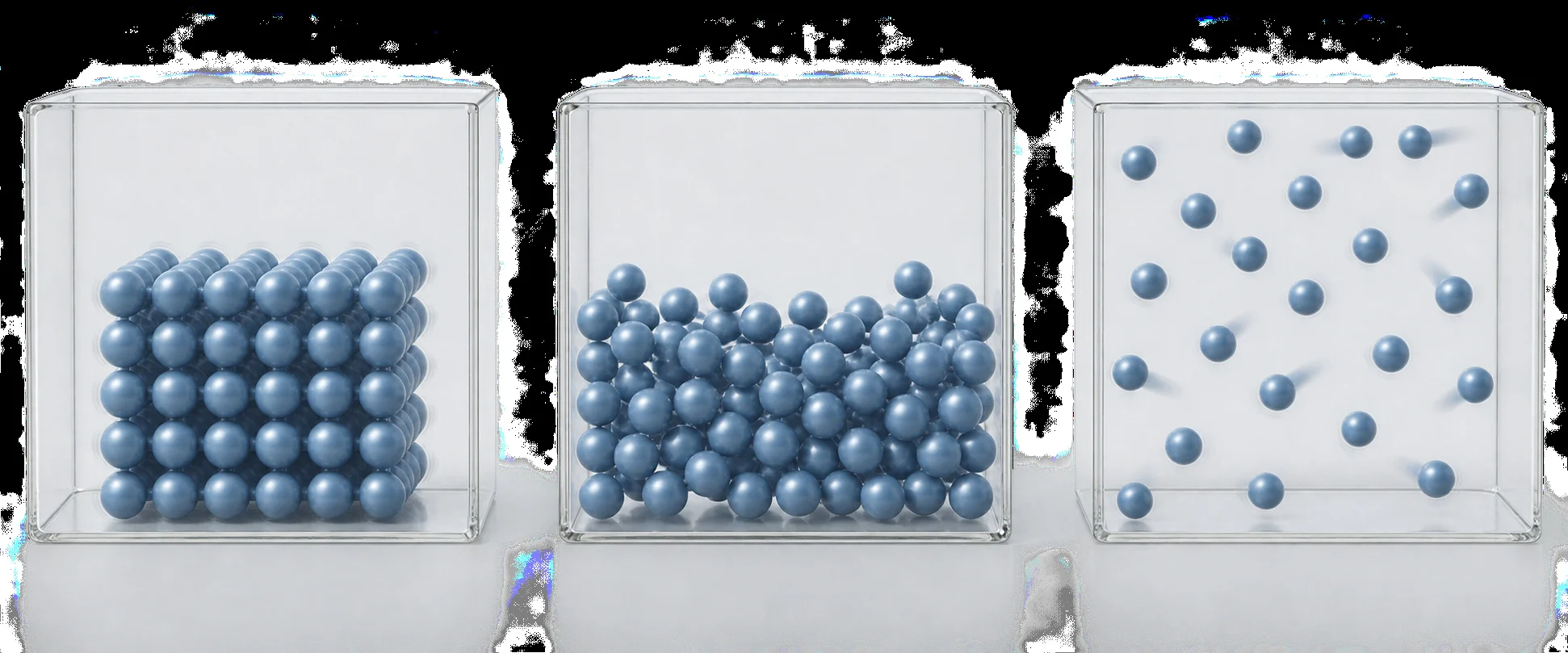
| Property | Solid | Liquid | Gas |
|---|---|---|---|
| Arrangement | Regular pattern | Random | Random |
| Separation | Very close | Close | Widely spaced |
| Movement | Vibrate about fixed positions | Move around each other | Move quickly in all directions |
| Energy | Lowest | Higher | Highest |
Section 5 of 10Temperature and particle energy
Temperature and particle energy
Constant motion
- Constant motion particles are in constant motion at any temperature.
Temperature
- Temperature raising the temperature increases the average kinetic energy and speed of the particles.
Absolute zero
- Absolute zero the temperature at which particles have the least possible kinetic energy, which is −273 °C.
Diffusion
- Diffusion it is faster at higher temperature and faster in gases than in liquids.
Section 6 of 10Gas pressure
Gas pressure
Cause
- Cause gas pressure is produced by the particles colliding with the walls of the container.
Momentum
- Momentum each collision changes the momentum of a particle, and the change of momentum per second gives a force on the wall at right angles to it.
Pressure
- Pressure pressure is this force per unit area, p = F ÷ A.
Faster particles
- Faster particles they hit the walls more often and with greater force, so the pressure is larger.
Section 7 of 10Brownian motion
Brownian motion
Brownian motion the random, erratic movement of microscopic particles suspended in a liquid or gas.
Observation
- Robert Brown saw pollen grains moving randomly in water under a microscope, and smoke particles in air behave the same way.
Cause
- Cause the visible particles are struck by huge numbers of much smaller, lighter, faster molecules of the fluid.
- At any moment more molecules hit one side than the other, giving a small resultant force in a random direction.
Evidence
- Evidence the motion shows that the invisible molecules exist and are in constant random motion.
Section 8 of 10More from the specification
More from the specification
Particle model
- Particle model matter consists of particles, with solids having fixed positions, liquids a definite volume but no fixed shape, and gases neither
Kelvin scale
- Kelvin scale absolute temperature in kelvin equals Celsius plus 273, with zero kelvin being the lowest possible temperature
Gas pressure
- Gas pressure a balloon is inflated by particle collisions with its walls, and at constant temperature pressure is inversely proportional to volume
Substance made of atoms and molecules
- Substance made of atoms and molecules the arrangement and energy of these particles explains density and the measured properties of solids, liquids and gases
Kelvin
- The SI unit of absolute temperature.
Inversely proportional
- When one quantity doubles, the other halves.
p1V1
p1V1 p2V2
What the symbols mean: p1, V1 = pressure and volume before · p2, V2 = after; only for a fixed mass of gas at constant temperature
Section 9 of 10Key terms
| Term | Meaning |
|---|---|
| Kinetic particle model | The idea that all matter is made of particles in constant motion. |
| Brownian motion | The random movement of microscopic particles caused by collisions with fluid molecules. |
| Gas pressure | The force per unit area caused by particles colliding with a surface. |
| Absolute zero | The lowest possible temperature, −273 °C, where particles have least kinetic energy. |
| Diffusion | The spreading of particles from a region of high concentration to low concentration. |
Section 10 of 10Exam technique
1
Saying particles in a solid do not move — they vibrate about fixed positions.
2
Drawing liquid particles with gaps like a gas — liquid particles are touching.
3
Saying gas pressure is caused by particles hitting each other — it is caused by collisions with the container walls.
4
Saying the pollen grains in Brownian motion are the moving molecules — the visible grains are pushed by invisible fast molecules.