Section 1 of 8Particles in a gas
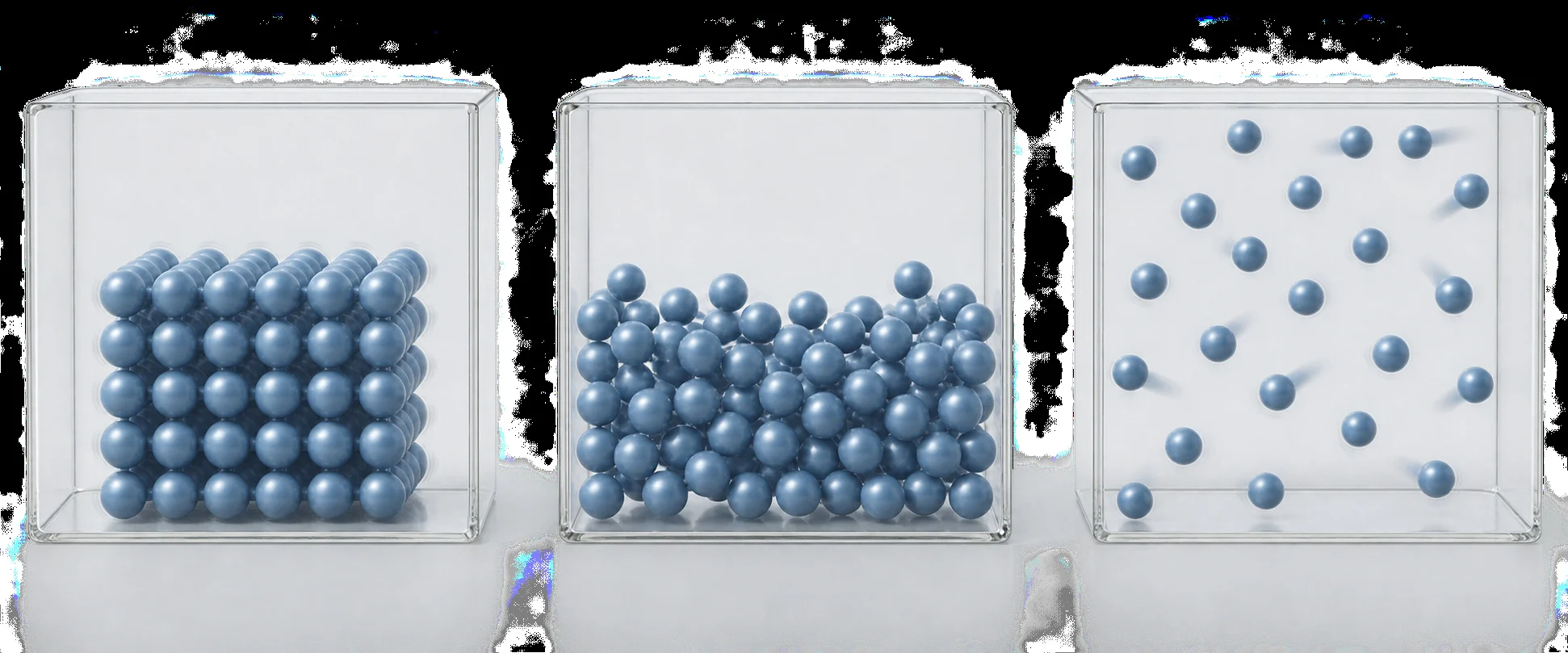
Constant random motion
- Constant random motion Gas molecules travel at high speed in all directions and change direction only when they collide.
- They collide with each other and with the walls of their container.
Temperature and energy
- Temperature and energy Temperature tells us the average kinetic energy of the molecules.
- A hotter gas has faster molecules; a cooler gas has slower ones.
Section 2 of 8How pressure arises
1
Each molecule hits the wall and rebounds, which changes its momentum.
2
The wall therefore pushes on the molecule, and the molecule pushes back on the wall with an equal force.
3
The enormous number of impacts each second gives a steady total force on the wall.
4
Pressure = force ÷ area (p = F ÷ A), measured in pascals, Pa.
Section 3 of 8Heating a gas at constant volume
1Temperature rises
- Temperature rises Molecules gain kinetic energy and their average speed increases.
2Wall impacts change
- Wall impacts change They strike the walls more often and with more momentum each time.
3Force per area grows
- Force per area grows The total force on each square metre of wall goes up.
4Pressure increases
- Pressure increases Cooling the gas reverses every step, so the pressure falls.
Section 4 of 8Linking the variables
| Condition | Change | Result for pressure |
|---|---|---|
| Volume fixed | Temperature increases | Pressure increases |
| Volume fixed | Temperature decreases | Pressure decreases |
| Temperature fixed | Volume decreases | Collisions per second rise, so pressure increases |
Section 5 of 8Pressure and volume at constant temperature
Fixed mass of gas, constant temperature
Volume decreased
- Volume decreased The same molecules are squeezed into a smaller space, so they reach each part of the wall more often and the pressure rises.
Volume increased
- Volume increased Molecules have further to travel between collisions with the walls, so impacts are less frequent and the pressure falls.
Speed unchanged
- Speed unchanged Because the temperature is constant, the average speed of the molecules does not change;
- only the collision frequency does.
Everyday links
- Everyday links Pumping up a bicycle tyre squashes more air into the same volume, so the pressure inside the tyre goes up.
Section 6 of 8Worked example: pressure from force and area
1
Question: a gas pushes on a piston of area 0.020 m2 with a force of 600 N. Find the pressure.
2
Write the equation: p = F ÷ A.
3
Substitute the values: p = 600 ÷ 0.020.
4
Calculate: p = 30 000 Pa, which is 30 kPa.
5
Check the units: newtons divided by square metres gives N/m2, and 1 N/m2 is 1 pascal.
Section 7 of 8Key terms
| Term | Meaning |
|---|---|
| Pressure | Force acting per unit area of a surface, in pascals (Pa). |
| Kinetic energy | The energy a particle has because it is moving. |
| Random motion | Movement in unpredictable directions that keeps changing after collisions. |
| Constant volume | The container cannot expand or shrink, so the space available stays the same. |
| Collision frequency | The number of times per second that molecules hit a given area of the container wall. |
| Fixed mass of gas | A sample in which no gas enters or leaves, so the number of molecules stays the same. |
Section 8 of 8Exam technique
1
Saying heated molecules expand. The molecules stay the same size; they move faster.
2
Describing pressure as molecules hitting each other. Pressure comes from collisions with the container walls.
3
Mentioning only more frequent collisions. Faster molecules also hit harder, giving a larger force per collision.
4
Forgetting to convert the area into square metres before using p = F ÷ A.