Section 1 of 9Energy without temperature change
1Energy supplied
- Energy supplied A heater transfers energy to a solid at its melting point.
2Bonds overcome
- Bonds overcome The energy is used to separate particles, raising potential energy.
3Temperature steady
- Temperature steady Average kinetic energy is unchanged, so the thermometer reading holds.
4State changes
- State changes Once everything has changed state, the temperature can rise again.
Section 2 of 9Two latent heats
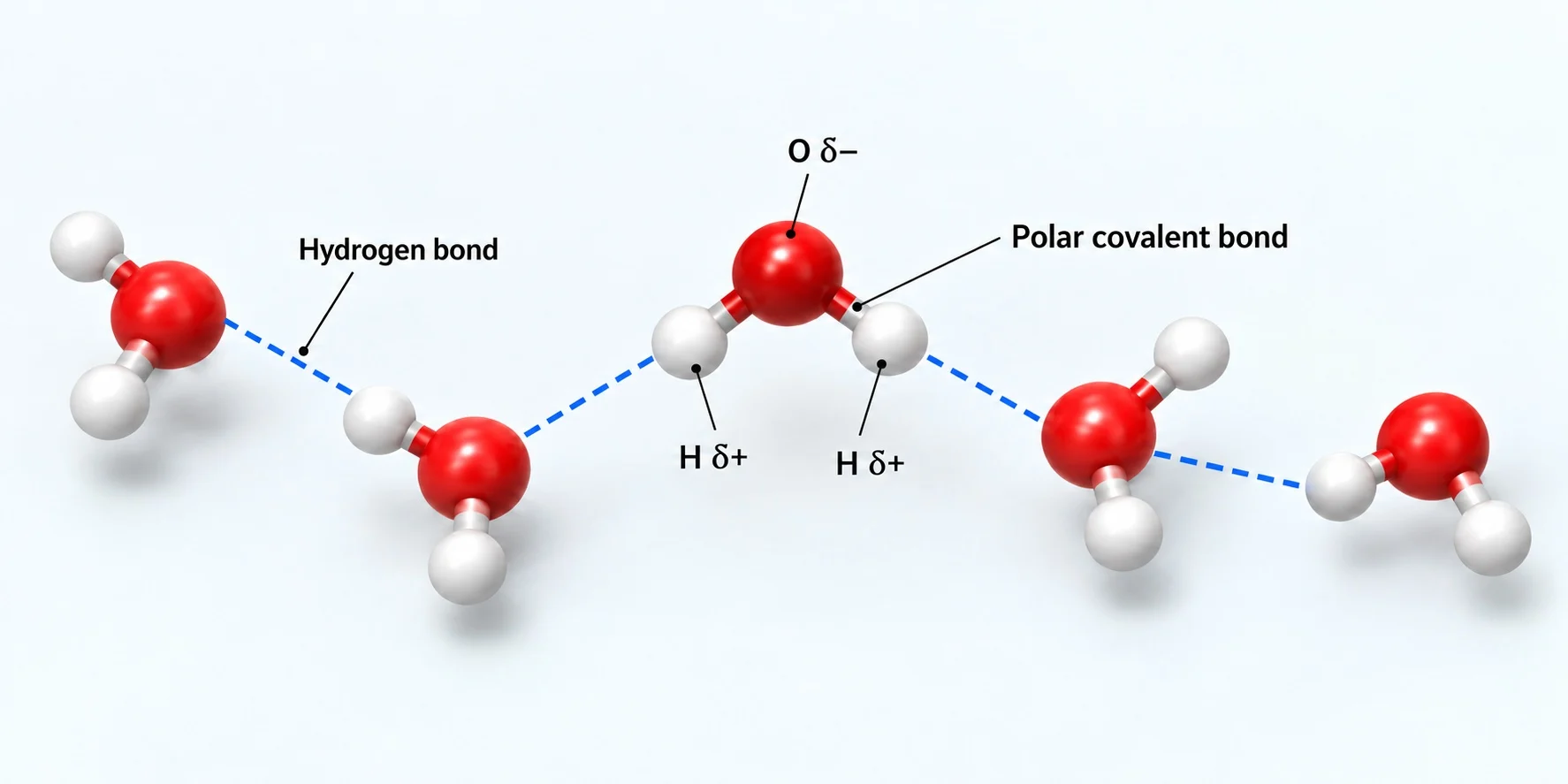
Specific latent heat of fusion
- Specific latent heat of fusion Energy needed to change 1 kg of a substance between solid and liquid with no change in temperature.
Specific latent heat of vaporisation
- Specific latent heat of vaporisation Energy needed to change 1 kg of a substance between liquid and gas with no change in temperature.
- For a given substance it is much larger than the value for fusion.
Section 3 of 9The equation
| Quantity | Symbol | Unit |
|---|---|---|
| Energy for change of state | E | joules, J |
| Mass | m | kilograms, kg |
| Specific latent heat | L | J/kg |
| Equation | E = m × L | Rearranged: L = E ÷ m |
Section 4 of 9Worked example
1
Question: how much energy melts 0.50 kg of ice? Take L for fusion of water as 334 000 J/kg.
2
Write the equation: E = m × L.
3
Substitute: E = 0.50 × 334 000.
4
Answer: E = 167 000 J (167 kJ).
Section 5 of 9Why vaporisation needs more energy
Melting
- Melting Particles only move from fixed positions to touching, flowing arrangements.
- Most attractive forces remain.
Boiling
- Boiling Particles move from touching to widely separated, so all attractive forces are overcome.
- The gas also pushes back the atmosphere as it expands, which needs extra energy.
Cooling direction
- Cooling direction Condensing and freezing release exactly the same amount of energy per kilogram as boiling and melting absorb.
Section 6 of 9Worked example: boiling water
1
Question: how much energy is needed to turn 0.20 kg of water at 100 °C into steam? The specific latent heat of vaporisation of water is 2 260 000 J/kg.
2
Write the equation: E = m × L.
3
Substitute: E = 0.20 × 2 260 000.
4
Calculate: E = 452 000 J, or 452 kJ.
5
Compare with melting the same mass of ice: 0.20 × 334 000 = 66 800 J, so boiling needs about seven times more energy.
Section 7 of 9Choosing the right equation
| Situation | Temperature change? | Equation to use |
|---|---|---|
| Warming a solid, liquid or gas | Yes | ΔE = m × c × Δθ |
| Melting or freezing at the melting point | No | E = m × L (fusion) |
| Boiling or condensing at the boiling point | No | E = m × L (vaporisation) |
Section 8 of 9Key terms
| Term | Meaning |
|---|---|
| Latent heat | Energy absorbed or released during a change of state at constant temperature. |
| Fusion | The change between solid and liquid. |
| Vaporisation | The change from liquid to gas. |
| Joule per kilogram | Unit of specific latent heat, J/kg. |
| Specific latent heat of fusion | Energy needed to melt 1 kg of a solid at its melting point without a temperature change. |
| Specific latent heat of vaporisation | Energy needed to boil 1 kg of a liquid at its boiling point without a temperature change. |
Section 9 of 9Exam technique
1
Using the specific heat capacity equation during a change of state; there is no temperature change so use E = m × L.
2
Leaving the mass in grams. Convert to kilograms first.
3
Mixing up fusion and vaporisation values; boiling needs far more energy than melting.
4
Using the value for fusion when the question describes boiling, or the other way round.