Section 1 of 8Surface area to volume ratio
Small organisms
- Small organisms A single-celled organism has a large surface area compared with its volume,
- so substances diffuse in and out quickly enough across its cell membrane to meet its needs.
- The distance from the surface to the centre of the cell is tiny, so no transport system is needed.
Large organisms
- Large organisms As size increases, volume grows faster than surface area,
- so the ratio falls and diffusion alone cannot supply every cell quickly enough.
- Cells deep inside the body are too far from the outside to receive oxygen or food by diffusion alone.
Consequence
- Consequence Multicellular organisms need specialised exchange surfaces plus a transport system,
- such as the blood, to carry substances to and from every cell.
Section 2 of 8Worked example: cubes as models of organisms
| Cube side | Surface area (6 × side2) | Volume (side3) | Surface area : volume |
|---|---|---|---|
| 1 cm | 6 cm2 | 1 cm3 | 6 : 1 |
| 2 cm | 24 cm2 | 8 cm3 | 3 : 1 |
| 3 cm | 54 cm2 | 27 cm3 | 2 : 1 |
| 4 cm | 96 cm2 | 64 cm3 | 1.5 : 1 |
Section 3 of 8Reading the cube model
Pattern
- Pattern Doubling the side of a cube multiplies its surface area by four but its volume by eight, so the ratio halves.
- Real organisms behave the same waythe bigger the body, the less surface there is for each unit of volume.
Biological meaning
- Biological meaning A tiny organism can rely on diffusion across its skin,
- while a large animal needs lungs, a heart and blood vessels to move materials efficiently.
Section 4 of 8Features of a good exchange surface
| Feature | Why it helps |
|---|---|
| Large surface area | More space for particles to cross at once, so the overall rate of diffusion is higher |
| Thin membrane | A short diffusion distance, so particles cross quickly |
| Good blood supply | Keeps a steep concentration gradient by carrying substances away as soon as they arrive |
| Ventilation (in animals) | Brings fresh air or water to the surface, maintaining the gradient |
Section 5 of 8Examples in organisms
Exchange surfaces
Alveoli in lungs
- Alveoli in lungs Millions of tiny air sacs with walls one cell thick, wrapped in capillaries, exchange oxygen and carbon dioxide with the blood.
Villi in the small intestine
- Villi in the small intestine Finger-like folds give a huge area for absorbing digested food into a rich blood supply;
- each villus has a thin wall and its own capillary network.
Root hair cells
- Root hair cells Long extensions increase the surface for absorbing water by osmosis and mineral ions by active transport.
Gills in fish
- Gills in fish Thin filaments with many folds take oxygen from water that flows over them, and water flows in the opposite direction to the blood.
Section 6 of 8Gas exchange in the alveolus
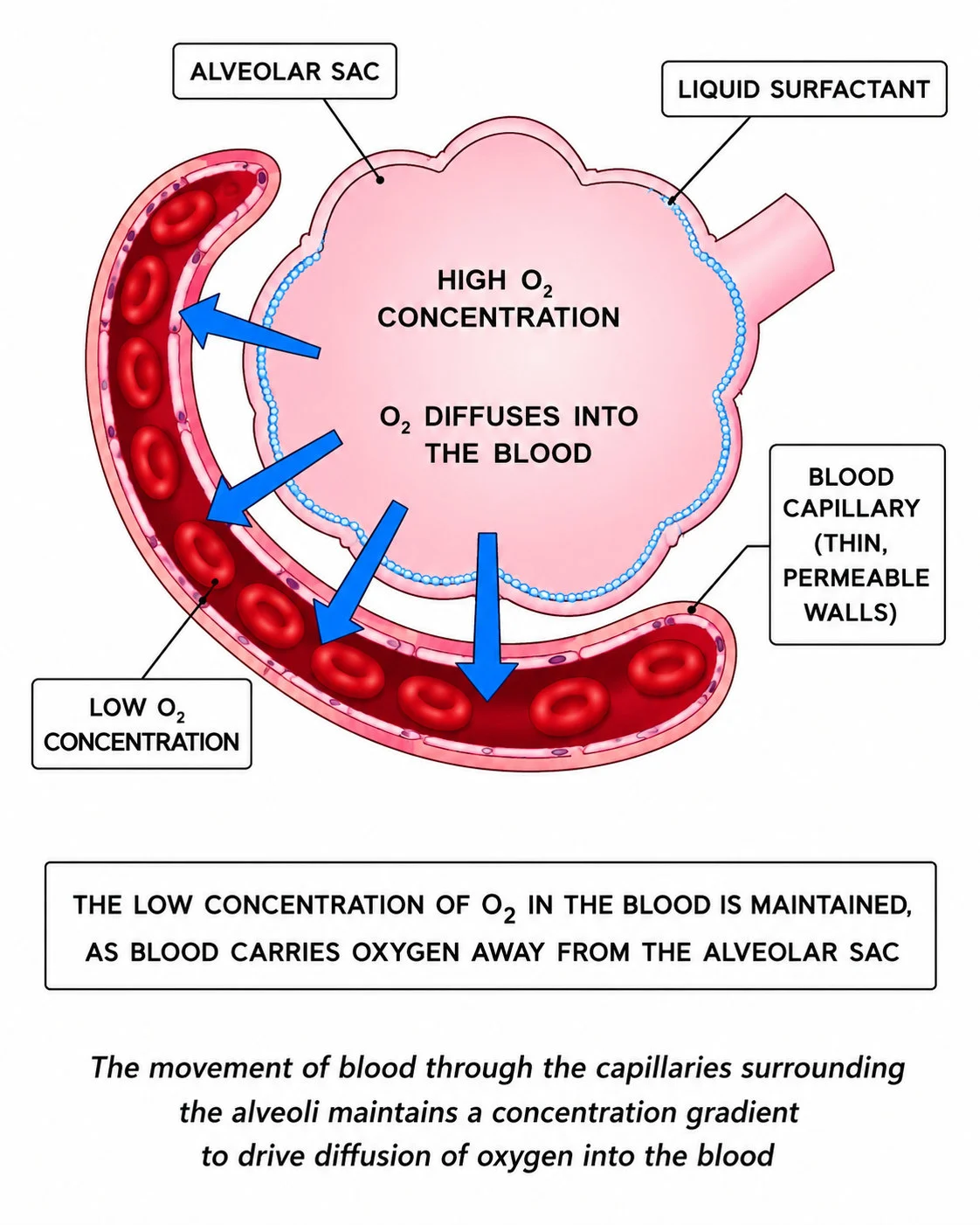
1
Inhaled air fills the alveolus, giving a high oxygen concentration compared with the blood arriving in the capillary.
2
Oxygen diffuses across the thin alveolar wall and capillary wall into the blood, where it binds to haemoglobin.
3
Carbon dioxide diffuses the opposite way, from the blood into the alveolus, because its concentration is higher in the blood.
4
Blood flow removes oxygen quickly and breathing out removes carbon dioxide, keeping both gradients steep.
Section 7 of 8Key terms
| Term | Meaning |
|---|---|
| Diffusion | Net movement of particles from a high to a low concentration. |
| Concentration gradient | The difference in concentration between two regions. |
| Alveoli | Tiny air sacs in the lungs where gas exchange takes place. |
| Villi | Small projections lining the small intestine to increase absorption. |
| Surface area to volume ratio | How much surface an organism has for each unit of its volume. |
Section 8 of 8Exam technique
1
Saying bigger organisms have a bigger surface area to volume ratio; it gets smaller.
2
Forgetting that a good blood supply maintains the concentration gradient.
3
Describing diffusion as needing energy; it is passive.
4
Writing that alveoli are thick-walled; their walls are one cell thick.