2.1.5Transport Over Larger Distances
The Human Digestive System
5 min read 9 parts Lesson 6 of 20 1 quiz
Section 1 of 9The gut and its purpose
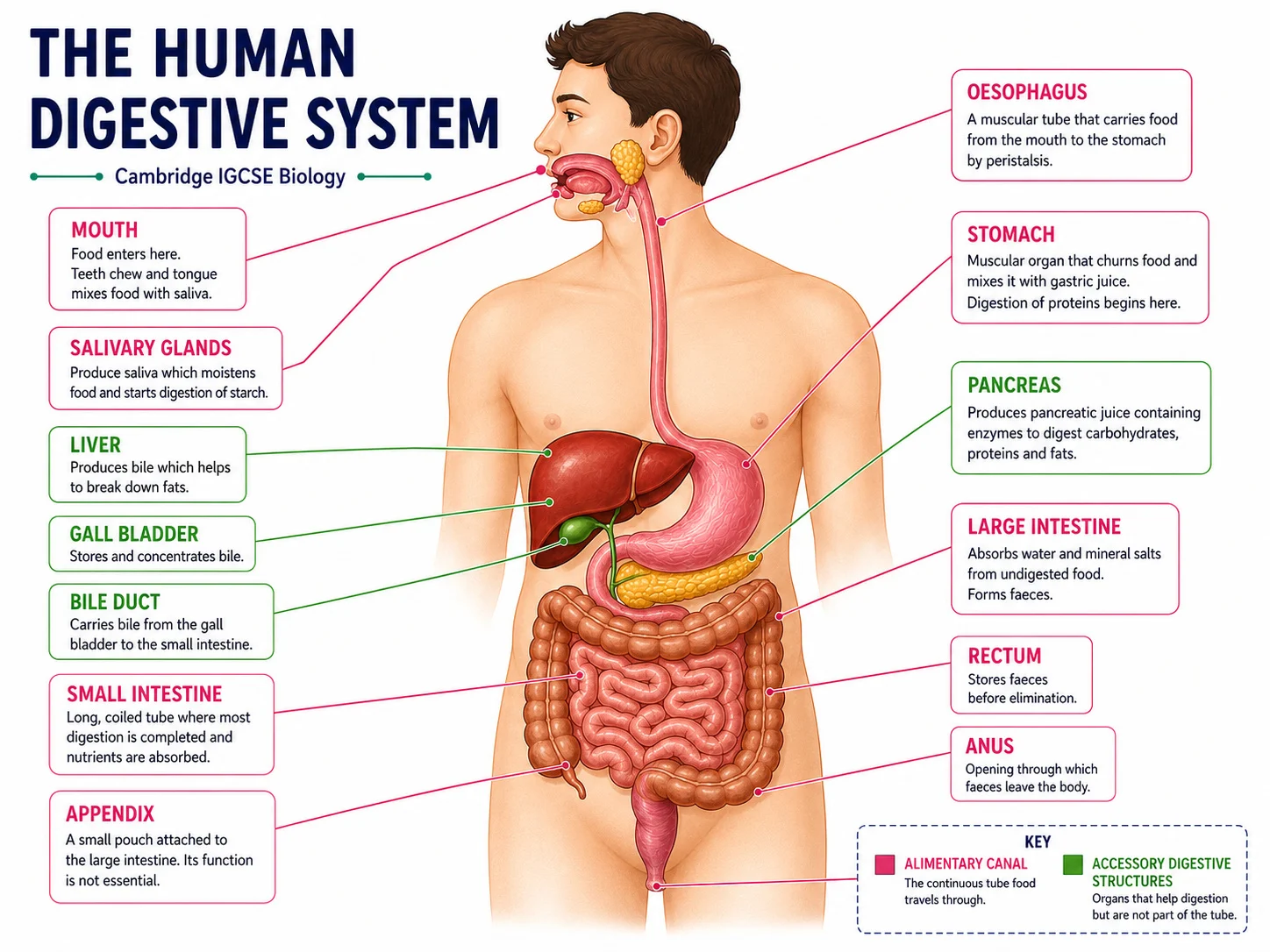
The digestive system is a long muscular tube, the gut, together with associated glands. Its job is to digest large insoluble food molecules into small soluble ones, and to absorb these into the blood. The food moves along the gut by peristalsis, waves of muscular contraction that push food forward.
Section 2 of 9Journey of a meal
The liver and pancreas are not part of the gut tube but contribute secretions.
Section 3 of 9Enzymes and where they are made
| Enzyme | Made in | Substrate and products |
|---|---|---|
| Amylase (carbohydrase) | Salivary glands, pancreas, small intestine | Starch to sugars (maltose, then glucose) |
| Protease | Stomach, pancreas, small intestine | Proteins to amino acids |
| Lipase | Pancreas, small intestine | Lipids (fats and oils) to fatty acids and glycerol |
The pancreas releases amylase, protease and lipase into the small intestine through a duct.
Section 4 of 9Bile
Bile is made in the liver and stored in the gall bladder until it is released into the small intestine.
Section 5 of 9Absorption in the small intestine
The inner wall of the small intestine is folded into millions of villi.
Section 6 of 9Going further
Several of the organs deserve more detail, since examiners like to ask what would happen if one failed.
The length of the system is also a useful fact.
When answering a question about the journey of food, always give organs in the correct order, say what happens in each, and link enzymes to the substrate and the pH. A list of organs alone scores few marks.
Remember too that the liver and pancreas connect to the small intestine by ducts, so bile and pancreatic juice enter just after the stomach.
Section 7 of 9Exam-style questions
Describe the two functions of bile. [2]2 marks
It neutralises stomach acid, providing alkaline conditions for the enzymes [1]; it emulsifies fat, increasing the surface area for lipase [1].
Name the organ that makes bile and the organ that stores it. [2]2 marks
Made in the liver [1]; stored in the gall bladder [1].
Explain why fat is digested faster when bile is present. [3]3 marks
Bile salts emulsify fat into small droplets [1], increasing the surface area [1], so lipase can break down the fat to fatty acids and glycerol faster [1].
Section 8 of 9Key terms
| Term | Meaning |
|---|---|
| Peristalsis | Waves of muscle contraction that move food along the gut. |
| Amylase | Enzyme that digests starch. |
| Protease | Enzyme that digests protein. |
| Lipase | Enzyme that digests fats. |
| Bile | Alkaline fluid that neutralises acid and emulsifies fat. |
| Emulsify | Break fat into small droplets. |
| Villus | Projection of the small intestine wall that absorbs food. |