2.2.4Transport Over Larger Distances
Chlorophyll and Other Plant Pigments
5 min read 10 parts Lesson 14 of 20 Unit quiz
Section 1 of 10Pigments in a leaf
| Pigment | Colour | Role |
|---|---|---|
| Chlorophyll a | Blue-green | Main pigment; absorbs light for photosynthesis |
| Chlorophyll b | Yellow-green | Absorbs other wavelengths and passes energy on |
| Carotenoids | Orange and yellow | Absorb blue light and protect chlorophyll from damage |
| Xanthophylls | Yellow | Capture extra light and protect from excess energy |
Section 2 of 10Where chlorophyll is found
Chloroplasts
- Chloroplasts Chlorophyll sits in the thylakoid membranes inside chloroplasts, concentrated in palisade cells.
Light energy
- Light energy It absorbs light, mostly red and blue, and the energy drives photosynthesis.
Section 3 of 10Why leaves are green
1White light arrives
- White light arrives Sunlight contains all colours.
2Red and blue absorbed
- Red and blue absorbed Chlorophyll absorbs these wavelengths most strongly.
3Green reflected
- Green reflected Little green light is absorbed, so it is reflected or transmitted.
4We see green
- We see green Reflected green light reaches our eyes.
Section 4 of 10Autumn colours
1
In autumn, shorter days and lower temperatures trigger the plant to stop making chlorophyll.
2
Existing chlorophyll breaks down and its nutrients are reclaimed by the tree.
3
The green colour fades, revealing yellow and orange carotenoids that were always present.
4
Some leaves also make red pigments, giving reds and purples.
Section 5 of 10Why several pigments
Accessory pigments
Wider range of light
- Wider range of light Each pigment absorbs different wavelengths, so more of the spectrum is used.
Protection
- Protection Carotenoids guard against damage from strong light.
Section 6 of 10Pigments and photosynthesis rate
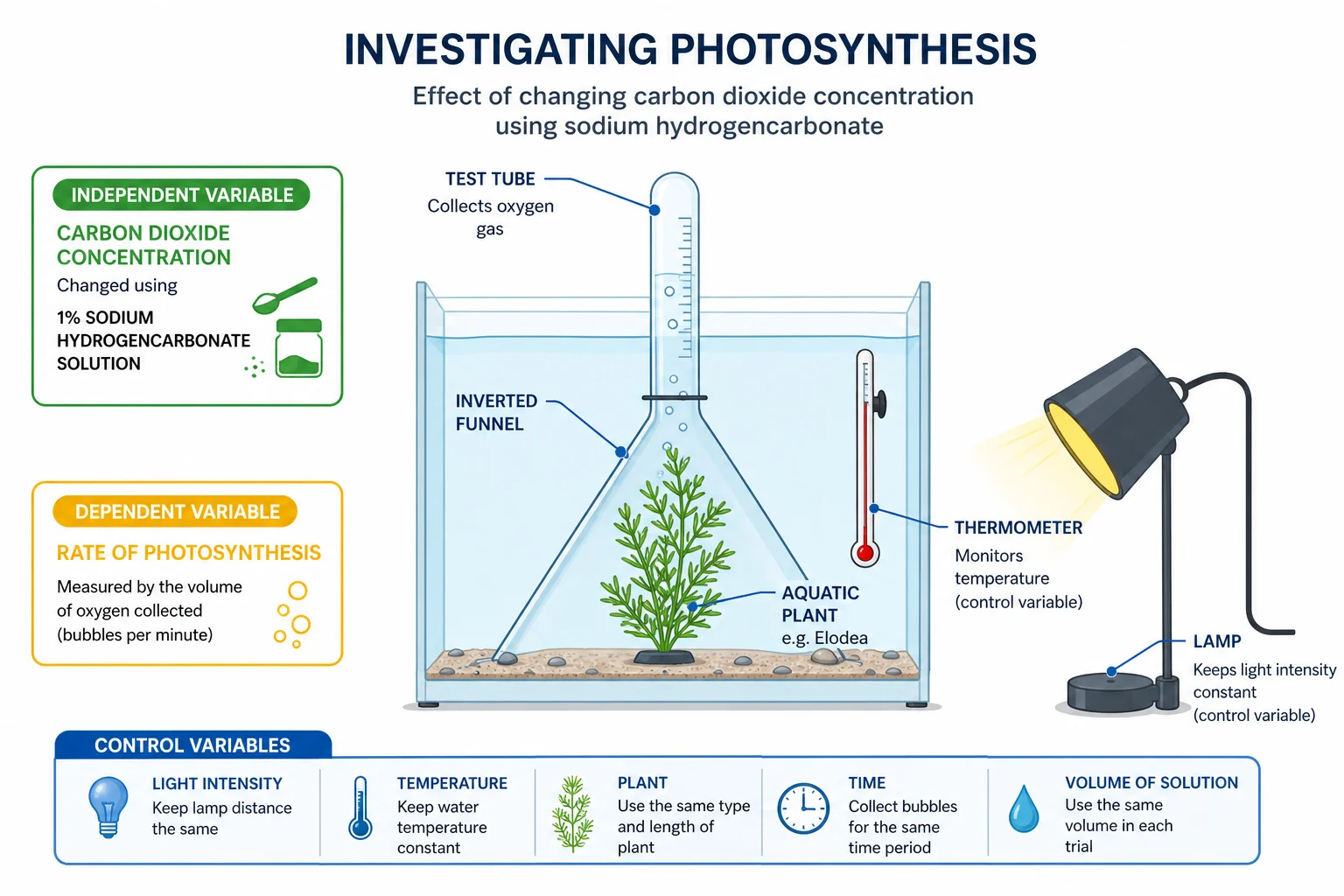
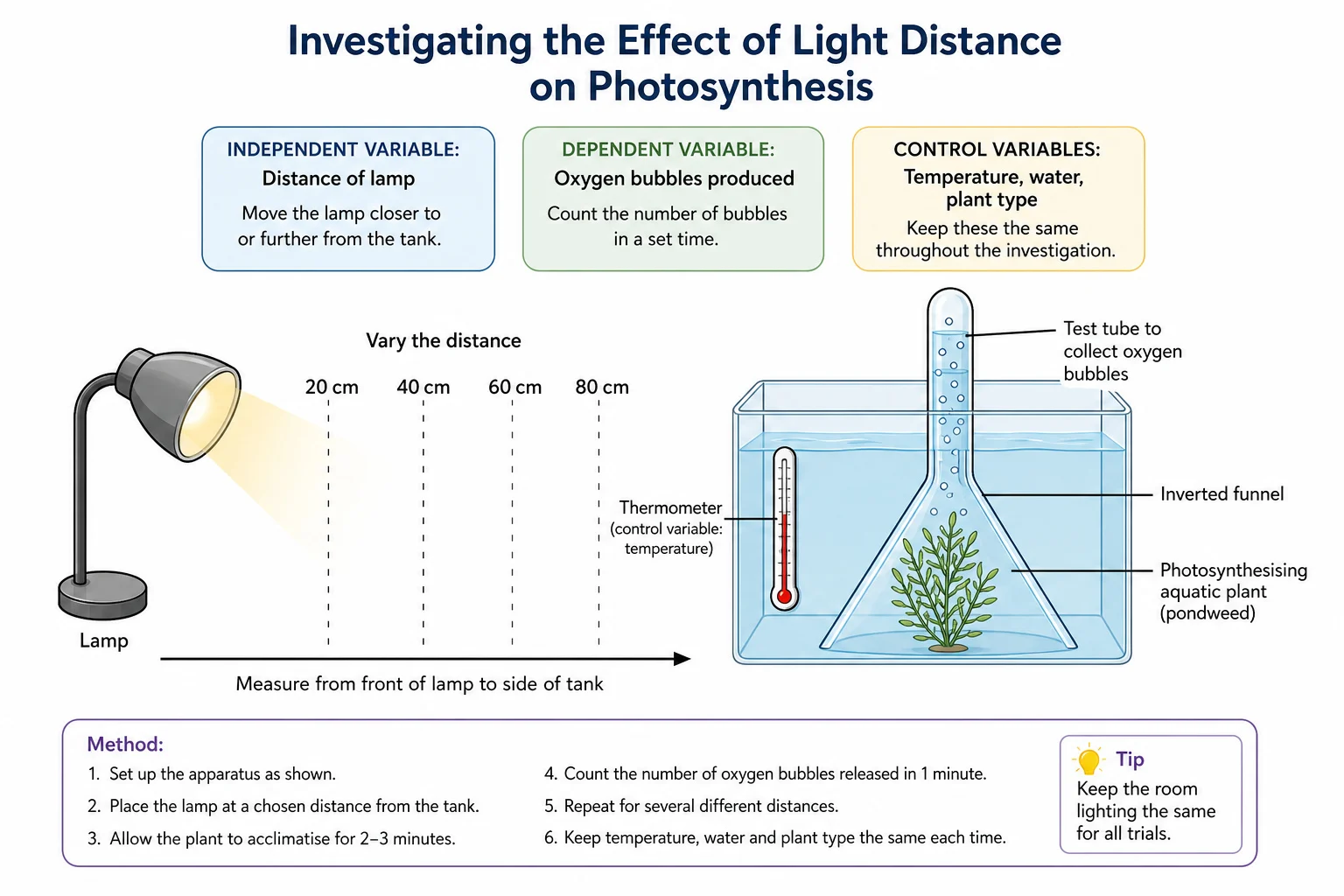
Action spectrum
- Action spectrum A graph of photosynthesis rate against wavelength shows peaks in blue and red light, matching chlorophyll absorption.
Green light
- Green light Photosynthesis is slowest in green light because little is absorbed.
Practical link
- Practical link Paper chromatography can separate the pigments from a leaf extract so each can be identified.
Section 7 of 10Practical link: separating the pigments
1
Grind a few leaves with a little propanone to dissolve the pigments, then filter or decant the green extract.
2
Place a concentrated spot of extract on a pencil start line on chromatography paper and let it dry.
3
Stand the paper in a shallow layer of solvent below the start line and let the solvent rise by capillary action.
4
Remove the paper before the solvent reaches the top, mark the solvent front and measure the distance moved by each pigment.
5
Calculate Rf = distance moved by pigment ÷ distance moved by solvent, and compare with known values to identify each pigment.
Section 8 of 10Exam context: reading an absorption graph
| Feature on graph | What it shows | Explanation |
|---|---|---|
| High peak in blue (about 430-450 nm) | Strong absorption | Blue light is used efficiently for photosynthesis |
| High peak in red (about 640-680 nm) | Strong absorption | Red light is used efficiently for photosynthesis |
| Low point in green (about 500-570 nm) | Weak absorption | Most green light is reflected, so leaves look green |
| Action spectrum follows absorption | Rate is highest where absorption is highest | Absorbed light energy drives the reaction |
Section 9 of 10Key terms
| Term | Meaning |
|---|---|
| Chlorophyll | Green pigment that absorbs light for photosynthesis. |
| Carotenoid | Yellow or orange accessory pigment in leaves. |
| Chloroplast | Organelle in which photosynthesis occurs. |
| Absorption spectrum | A graph showing which wavelengths a pigment absorbs. |
| Accessory pigment | A pigment other than chlorophyll a that absorbs extra wavelengths and passes the energy on. |
Section 10 of 10Exam technique
1
Saying chlorophyll absorbs green light best; it reflects most of it.
2
Thinking autumn leaves make new yellow pigments; the yellow was hidden by green.
3
Placing chlorophyll in the mitochondria instead of chloroplasts.
4
Describing leaves as green because they absorb green light; they reflect it.
Biology 0610 & 9700 Exam Model
Limiting Factors Master
Photosynthesis: Limiting Factors & Graph Plateau
6CO2 + 6H2O → C6H12O6 + 6O2 (Light & Chlorophyll required)
- Limiting Factor Definition: Something present in the environment in such short supply that it restricts life processes.
- Graph Plateau: When rate levels off as light intensity increases, light is no longer the limiting factor; CO2 concentration or temperature has become limiting.
- High Temperature Drop: Beyond optimum temp (~40°C), enzymes (e.g. RuBisCO) denature, permanently decreasing rate.