2.2.7Transport Over Larger Distances
Factors Affecting The Rate Of Photosynthesis
5 min read 9 parts Lesson 17 of 20 1 quiz
Section 1 of 9Photosynthesis equation
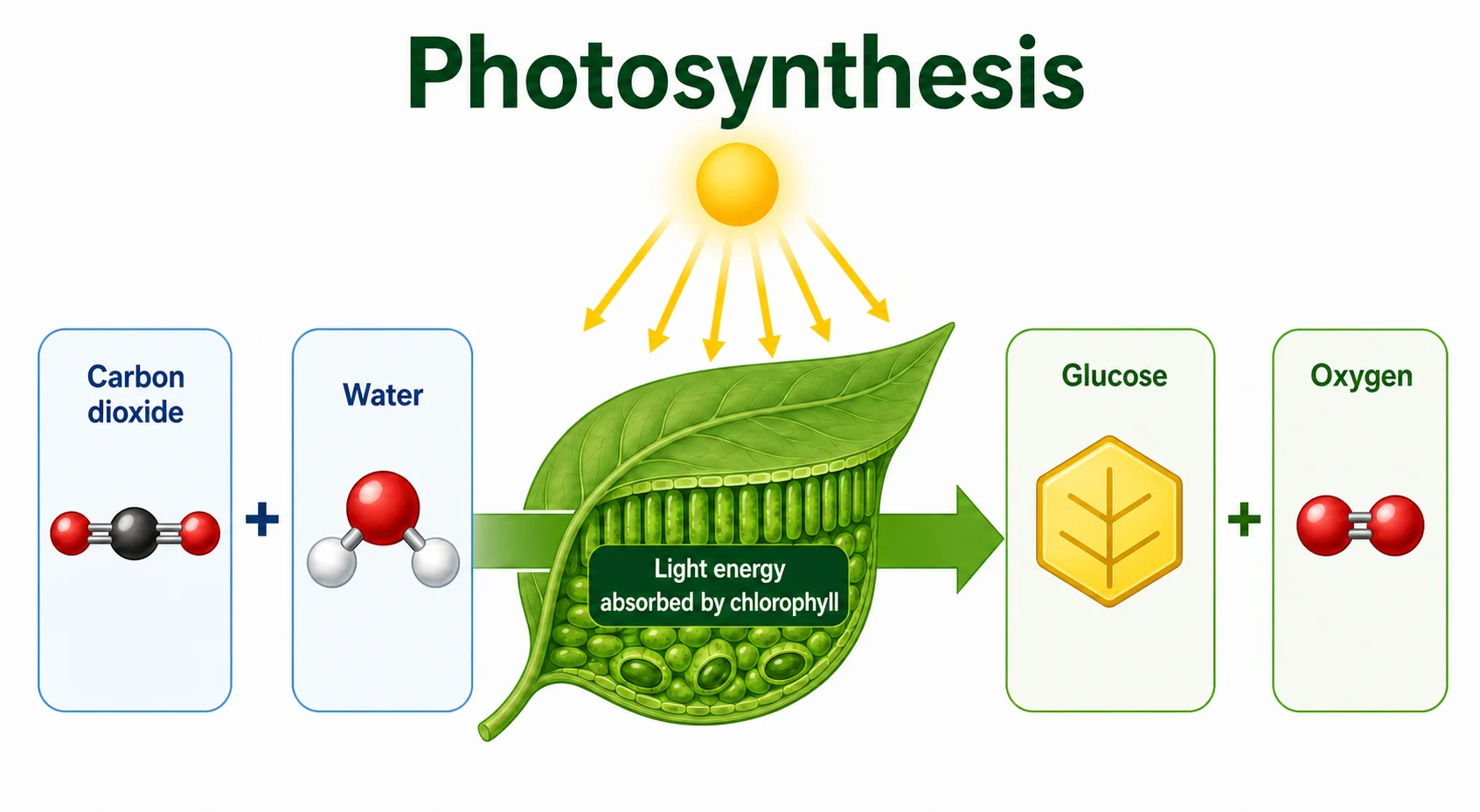
Word equation
- Word equation Carbon dioxide + water → glucose + oxygen, using light energy absorbed by chlorophyll.
Symbol equation
- Symbol equation 6CO2 + 6H2O → C6H12O6 + 6O2
Energy change
- Energy change The reaction is endothermic because it takes in light energy.
Section 2 of 9The three main factors
| Factor | Effect at low levels | Why |
|---|---|---|
| Light intensity | Rate rises as light increases | More energy is available to drive the reaction |
| Carbon dioxide concentration | Rate rises as CO2 increases | More raw material for glucose production |
| Temperature | Rate rises up to an optimum | Enzyme activity and collisions increase |
| Temperature too high | Rate drops sharply | Enzymes denature above about 45 °C |
Section 3 of 9Limiting factors
1Shortest supply
- Shortest supply The factor in shortest supply sets the maximum rate.
2Rate rises
- Rate rises Increasing that factor increases the rate.
3Plateau
- Plateau A graph levels off when a different factor becomes limiting.
4Change the new limiter
- Change the new limiter Only increasing the new limiting factor will raise the rate further.
Section 4 of 9Economics for growers
Greenhouse control
Artificial light
- Artificial light Lamps lengthen the day and raise light intensity.
Heating
- Heating Keeping the temperature near the optimum speeds growth.
Carbon dioxide enrichment
- Carbon dioxide enrichment Paraffin heaters or gas supplies increase CO2.
Cost balance
- Cost balance Increase conditions only while extra yield is worth the cost.
Section 5 of 9Inverse square law (HT only)
1
As a lamp moves away, light intensity falls in proportion to 1 ÷ distance2.
2
Doubling the distance reduces the intensity to one quarter.
3
Because rate tracks light, photosynthesis rate drops in the same pattern when light is limiting.
4
Use this to predict results in lamp-distance experiments.
Section 6 of 9Reading a limiting factor graph
Rising section
- Rising section On the steep part of the curve the factor being changed is limiting, so increasing it gives a proportional increase in rate.
Plateau
- Plateau When the line is flat, adding more of the factor makes no difference because another factor,
- such as carbon dioxide or temperature, is now limiting.
Temperature curve
- Temperature curve The rate rises to an optimum near 25-35 °C, then falls rapidly as enzymes denature, so the graph is a hump rather than a plateau.
Section 7 of 9Worked example: lamp distance
| Lamp distance (cm) | Relative intensity (1 ÷ d2) | Prediction for rate |
|---|---|---|
| 10 | 1 ÷ 100 = 0.0100 | Highest rate |
| 20 | 1 ÷ 400 = 0.0025 | One quarter of the intensity at 10 cm |
| 40 | 1 ÷ 1600 = 0.000625 | One sixteenth of the intensity at 10 cm |
Section 8 of 9Key terms
| Term | Meaning |
|---|---|
| Limiting factor | A variable that, in short supply, restricts the rate of a process. |
| Light intensity | How bright the light is. |
| Optimum temperature | The temperature at which the rate is greatest. |
| Denature | Permanent loss of an enzyme's shape and function. |
| Endothermic | A reaction that takes in energy from the surroundings. |
Section 9 of 9Exam technique
1
Saying temperature keeps raising the rate forever; enzymes denature when too hot.
2
Not naming the limiting factor when a graph levels off.
3
Thinking more light helps if CO2 is the limiting factor.
4
Mixing up inverse and direct proportion with distance.
5
Forgetting that chlorophyll must absorb the light for the energy to be used in photosynthesis.
Marked practiceQuizzes for this lesson
Biology 0610 & 9700 Exam Model
Limiting Factors Master
Photosynthesis: Limiting Factors & Graph Plateau
6CO2 + 6H2O → C6H12O6 + 6O2 (Light & Chlorophyll required)
- Limiting Factor Definition: Something present in the environment in such short supply that it restricts life processes.
- Graph Plateau: When rate levels off as light intensity increases, light is no longer the limiting factor; CO2 concentration or temperature has become limiting.
- High Temperature Drop: Beyond optimum temp (~40°C), enzymes (e.g. RuBisCO) denature, permanently decreasing rate.