Section 1 of 9Why plant disease matters
Plants are the producers in almost every food chain, and the main source of food for people.
- or by pests such as aphids,
- and the symptoms can be similar to those caused by a lack of mineral ions.
Section 2 of 9Identifying plant diseases
Gardeners and farmers identify a disease from symptoms on leaves, stems and roots, such as stunted growth, spots, patches of decay, abnormal growths, malformed leaves, discolouration and the presence of pests. Methods include:
Accurate identification matters because each pathogen needs a different treatment: a fungicide does not work against a virus, and an insecticide does not work against a fungus.
Section 3 of 9Mineral ion deficiencies
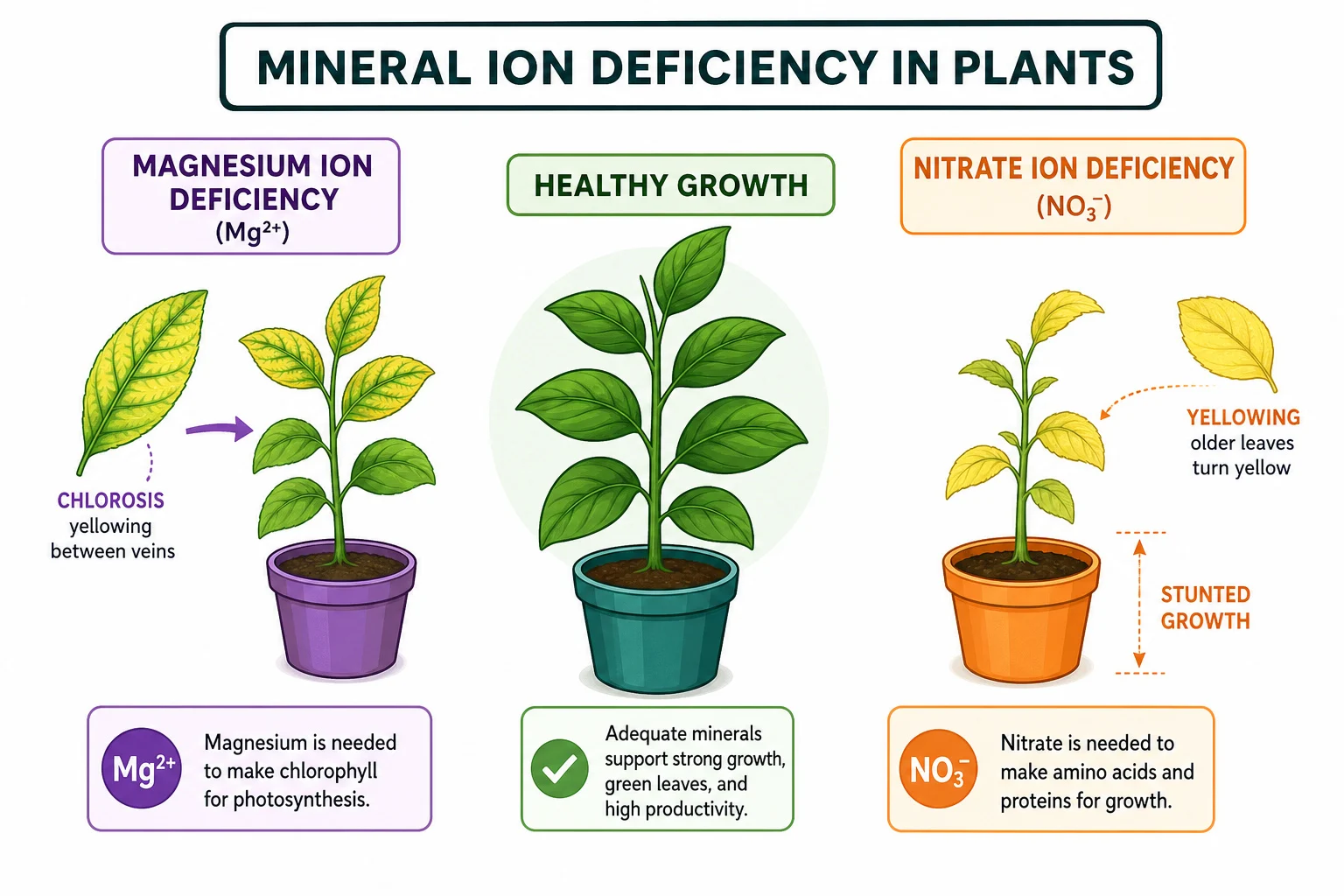
| Ion | Used for | Deficiency symptom |
|---|---|---|
| Nitrate | Making amino acids and proteins, so growth | Stunted growth and older leaves turn yellow |
| Magnesium | Making chlorophyll | Chlorosis: leaves yellow between the veins, especially older leaves |
Both deficiencies reduce photosynthesis. They are treated by adding fertiliser containing nitrate or magnesium, or by checking the soil. Pale leaves can also be caused by disease, so growers compare several features, such as which leaves are affected.
Section 4 of 9Physical and chemical defences

Plants cannot move away from attackers, so they have defences. Physical barriers include the waxy cuticle on leaves, tough cellulose cell walls, and layers of dead cells such as bark, which stop entry of pathogens.
- and compounds that produce an unpleasant taste.
Mimicry is another strategy: some plants imitate the appearance of other species or of unhealthy leaves, for example looking as if they already have caterpillar eggs, so that insects avoid them.
Section 5 of 9Controlling disease in crops
Section 6 of 9Interpreting evidence about plant disease
To decide whether a symptom is due to a mineral deficiency or a pathogen, an investigator can grow similar plants in a solution that lacks one mineral and one with all minerals, and compare them.
Plants also gain protection from the way they are grown.
When answering a question on identification, say what you would look for, such as the colour and position of the discolouration, whether it affects old or young leaves, and whether pests are visible, and then say how you would confirm it.
Section 7 of 9Exam-style questions
A gardener notices that the leaves of a tomato plant are yellow between the veins. Suggest a cause and how the problem could be confirmed. [3]3 marks
Magnesium deficiency [1], because magnesium is needed to make chlorophyll [1]. Confirm by growing plants with and without magnesium in the culture solution and comparing, or by adding magnesium fertiliser to see if the leaves recover [1].
Describe two physical defences of plants against pathogens. [2]2 marks
The waxy cuticle on leaves prevents entry of pathogens and water [1]. Cell walls made of cellulose and layers of dead cells in bark form a barrier [1]. (Accept thorns or hairs for animals.)
Explain why crop rotation helps to control plant disease. [2]2 marks
Many pathogens infect only one type of plant [1]. If a different crop is grown each year, the pathogen in the soil cannot reproduce so the number of pathogens falls [1].
Section 8 of 9Key terms
| Term | Meaning |
|---|---|
| Chlorosis | Yellowing of leaves caused by a lack of chlorophyll. |
| Nitrate | A mineral ion used by plants to make amino acids and proteins. |
| Magnesium | A mineral ion used by plants to make chlorophyll. |
| Cuticle | A waxy layer on the leaf surface that acts as a barrier. |
| Crop rotation | Growing different crops in a field in successive years. |
| Mimicry | Resembling another organism or object to avoid attack. |
| Fungicide | A chemical that kills fungi. |