3.1.3Interactions with the Environment
Treatments For Cardiovascular Disease
5 min read 6 parts Lesson 4 of 27 1 quiz
Section 1 of 6How coronary heart disease develops
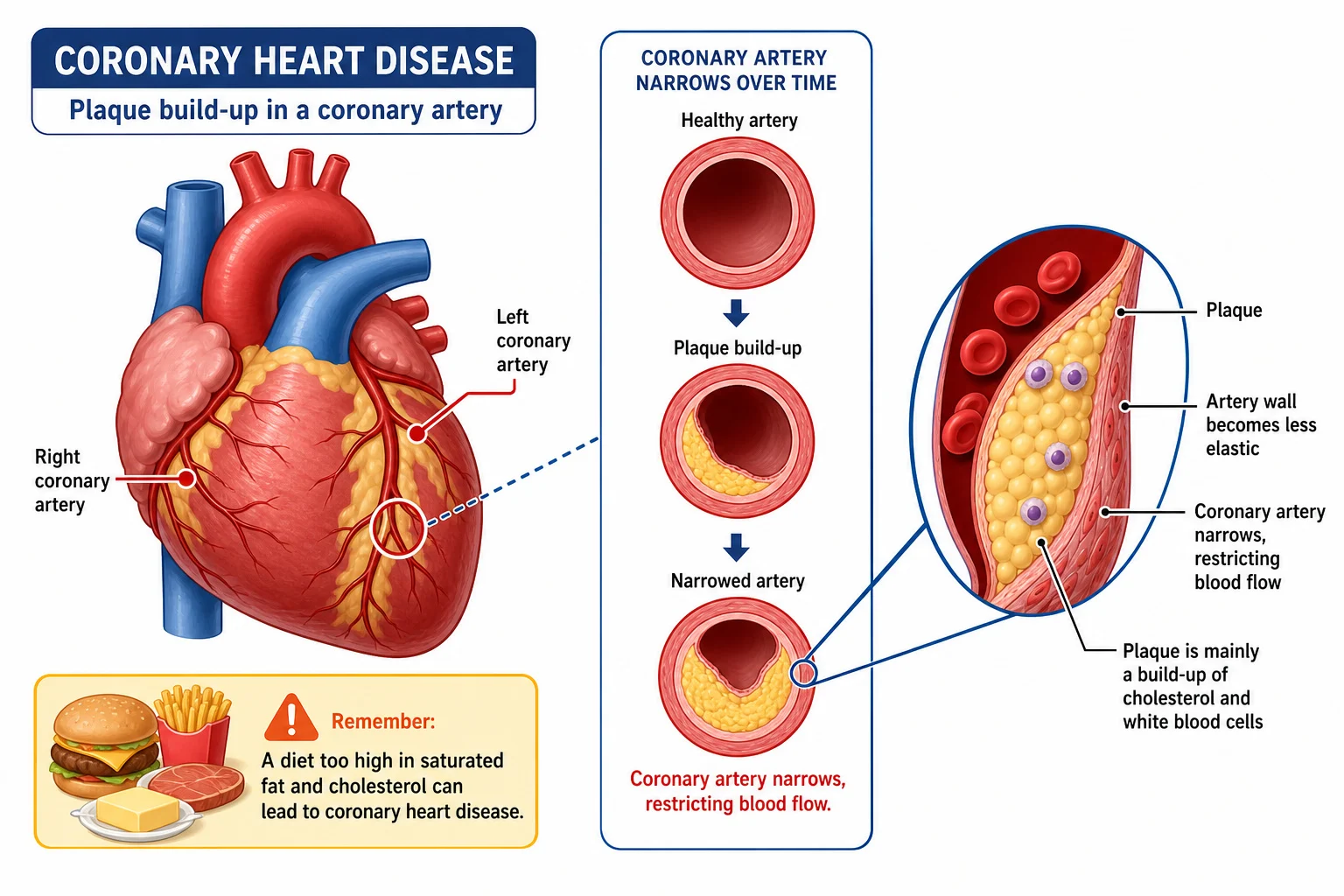
1Fatty plaque forms
- Fatty plaque forms Fatty material collects inside the coronary arteries that supply the heart muscle.
2Lumen narrows
- Lumen narrows The channel through the artery gets smaller, so less blood passes through.
3Less oxygen arrives
- Less oxygen arrives Heart muscle cells receive too little oxygen and glucose for aerobic respiration.
4Symptoms appear
- Symptoms appear Partial blockage can cause chest pain called angina;
- complete blockage can cause a heart attack.
Section 2 of 6Fitting a stent
1
A thin tube is fed through an artery, usually starting in the groin, up to the blocked coronary artery.
2
A tiny balloon at the tip is inflated inside the narrowed section.
3
The balloon pushes a mesh tube, the stent, against the artery wall, widening the lumen.
4
The balloon and tube are withdrawn, leaving the stent in place to hold the artery open.
Section 3 of 6Treatment options compared
| Treatment | How it helps | Advantages | Disadvantages |
|---|---|---|---|
| Stent | Keeps the artery wide so blood flows freely | Quick, fairly simple procedure; lasts a long time; lowers heart attack risk | Surgical risk; a blood clot can form on the stent |
| Statins | Lower blood cholesterol, slowing plaque build-up | Reduce the chance of heart disease; easy to take as a tablet | Must be taken for life; may cause side effects such as muscle pain; slow to work |
| Lifestyle change | Healthier diet, exercise and stopping smoking | No drug cost; improves general health | Needs long-term commitment |
Section 4 of 6Other ideas to know
Blood supply to the heart
- Blood supply to the heart Coronary arteries branch from the aorta and run over the outside of the heart, supplying cardiac muscle with oxygenated blood.
Why a blockage is dangerous
- Why a blockage is dangerous Starved cells cannot release enough energy and that part of the heart muscle may die.
Choosing a treatment
- Choosing a treatment Doctors weigh up the patient's condition, the risks, the cost and how long the effect will last.
Section 5 of 6Key terms
| Term | Meaning |
|---|---|
| Coronary artery | A blood vessel that carries oxygenated blood to the heart muscle. |
| Plaque | A fatty deposit that builds up on the inside of artery walls. |
| Lumen | The hollow space inside a blood vessel through which blood flows. |
| Stent | A small mesh tube inserted into an artery to keep it open. |
| Statin | A drug that lowers the level of cholesterol in the blood. |
Section 6 of 6Exam technique
1
Saying the coronary arteries supply the whole body. They only supply the heart muscle itself.
2
Writing that statins unblock arteries. They lower cholesterol and slow further build-up.
3
Forgetting the drawback of stentsclots (thrombosis) can still form.
4
Saying heart muscle needs blood only for oxygen. It also needs glucose and the blood removes carbon dioxide.