Section 1 of 9Why waste is a growing problem
As the human population rises and standards of living improve, more waste is produced.
- and the same material can move between these.
- (for example, rain washes air pollutants into rivers)
- so waste management is closely tied to the conservation of living things.
Section 2 of 9Water pollution
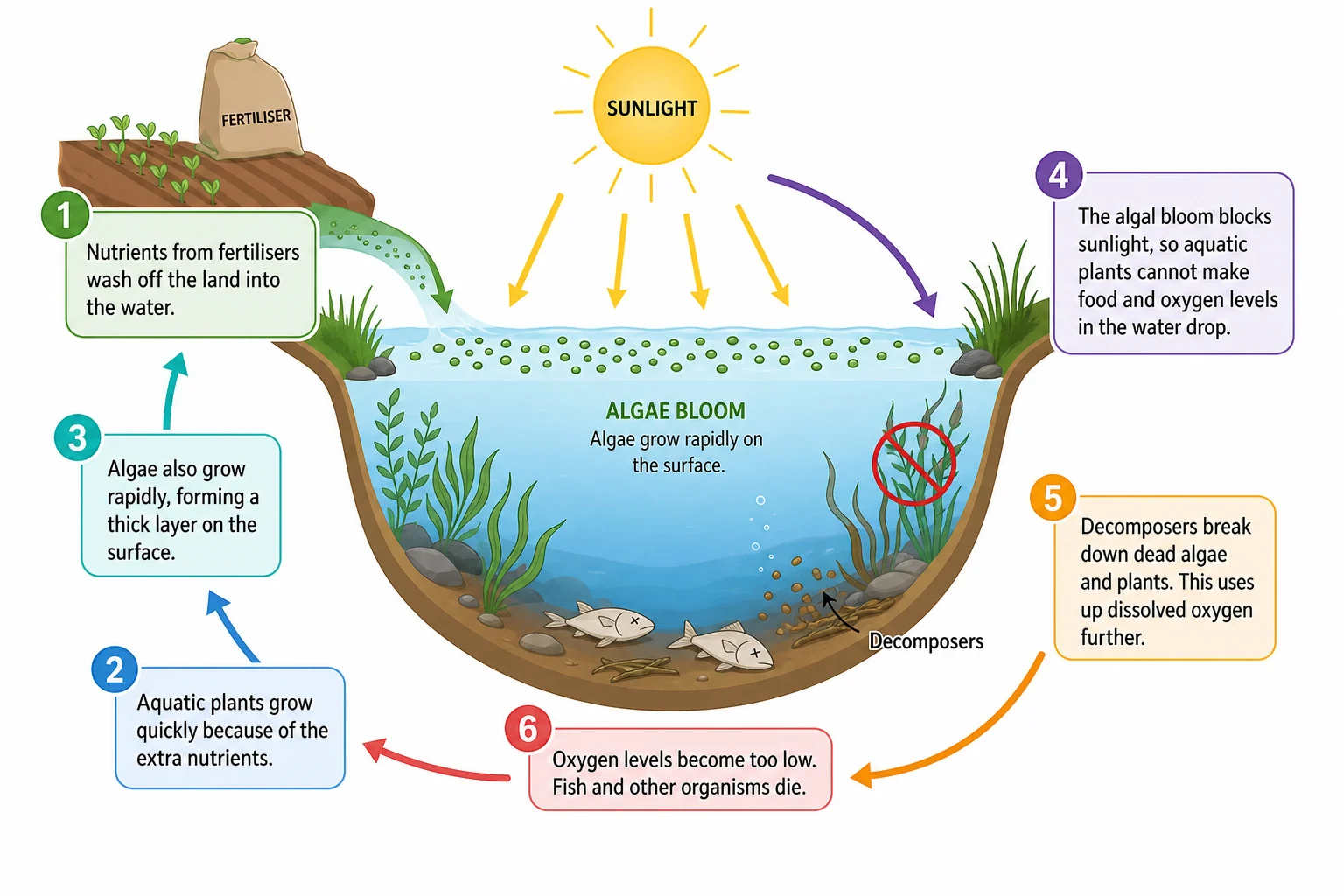
Water can be polluted by sewage, by fertiliser run-off from fields and by toxic chemicals from industry.
- The algae block light, plants below the surface die, and bacteria decomposing the dead material use up oxygen.
- Fish and other aquatic animals then suffocate.
- This process is called eutrophication.
Sewage is treated before being released to remove solids and kill microorganisms, but treatment is expensive and not available everywhere.
Section 3 of 9Land pollution
Household and industrial waste is often buried in landfill sites. Landfill takes up land that could be habitat or farmland, and toxic chemicals can leach into soil and groundwater. Decomposing material also releases methane, a greenhouse gas. Toxic chemicals used in farming and mining can stay in soil for years and harm soil organisms, which reduces fertility.
Reducing, reusing and recycling materials lowers the amount sent to landfill and reduces the resources extracted from natural habitats.
Section 4 of 9Air pollution
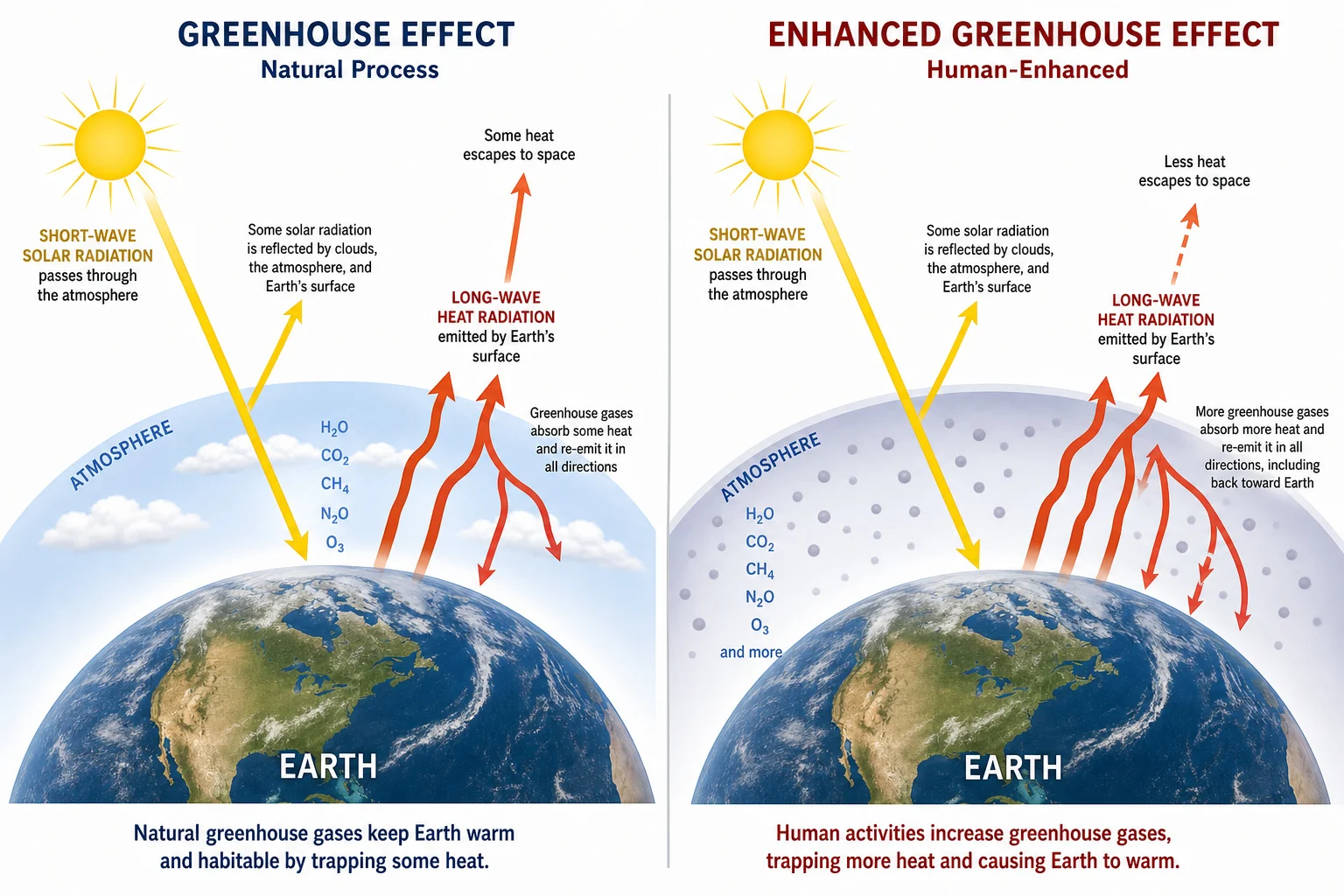
Burning fossil fuels releases carbon dioxide, which contributes to global warming, and smoke (particulates) and sulfur dioxide. Sulfur dioxide and nitrogen oxides dissolve in rain to form acid rain, which damages trees, acidifies lakes and kills sensitive organisms. Smoke particles can damage lungs and reduce light reaching leaves.
| Pollutant | Source | Effect on living things |
|---|---|---|
| Sulfur dioxide | Burning fossil fuels | Acid rain, damaged trees and lakes |
| Carbon dioxide | Combustion, respiration | Enhanced greenhouse effect |
| Nitrates and phosphates | Fertilisers, sewage | Eutrophication of water |
| Methane | Landfill, livestock | Enhanced greenhouse effect |
Section 5 of 9Reducing the effects
Laws limit what can be released, factories fit filters and scrubbers, farmers can apply fertiliser more carefully and sewage is treated. Individuals can recycle, compost and use less energy. Each measure costs money, so governments balance environmental protection against economic cost and jobs.
Section 6 of 9Linking waste to food chains and human health
Pollutants can reach people as well as wildlife.
- It decays extremely slowly, so it accumulates in soil and oceans.
- It breaks into small pieces that are swallowed by animals such as seabirds and turtles, which can block the gut.
- Because it does not decompose, burying it in landfill uses space for centuries.
- In landfill, buried food and paper decompose by anaerobic microorganisms, giving methane.
- In a compost heap with air and moisture, aerobic decay by bacteria and fungi gives carbon dioxide and a useful soil improver.
- Composting garden waste therefore reduces landfill and replaces the peat or fertiliser that would otherwise be bought.
- and the success of such measures can be judged from data on how much waste is collected each year.
Section 7 of 9Exam-style questions
Describe how fertiliser run-off from a field can kill fish in a nearby lake. [4]4 marks
11. Nitrates/phosphates from fertiliser are washed into the lake [1].22. They cause rapid growth of algae (algal bloom) [1].33. Algae block light, so submerged plants die [1].44. Bacteria decompose dead plants and use up oxygen, so fish suffocate [1].Explain why the concentration of a toxic chemical is highest in the top predator in a food chain. [3]3 marks
The toxin is not broken down or excreted [1]. Each consumer eats many organisms from the level below, so the toxin accumulates [1]. The concentration therefore increases at each trophic level, being greatest in the top predator [1].
Give two ways landfill harms the environment. [2]2 marks
Takes up land that could be habitat/farmland [1]; toxic chemicals leach into soil and water [1]; methane released (any two).
Section 8 of 9Key terms
| Term | Meaning |
|---|---|
| Pollution | The release of harmful substances into the environment. |
| Eutrophication | Excess nutrients in water causing algal growth, oxygen depletion and death of aquatic organisms. |
| Landfill | Burying waste in the ground. |
| Acid rain | Rain made acidic by dissolved sulfur dioxide and nitrogen oxides. |
| Fertiliser | A substance containing minerals such as nitrates added to soil to improve plant growth. |
| Toxin | A poisonous substance. |
| Sewage | Waste water and human waste from homes and industry. |