Section 1 of 9What a compound is
Chemically joined
- Chemically joined A compound contains two or more different elements joined by chemical bonds.
- Water, H2O, joins hydrogen and oxygen.
Fixed ratio
- Fixed ratio The elements are always in the same proportion.
- Carbon dioxide is always one carbon to two oxygen, whichever way it is made.
- This is why a compound has a fixed formula, whereas a mixture can be made in any proportion.
New properties
- New properties A compound has very different properties from its elements.
- Sodium is a reactive metal and chlorine a poisonous gas, but sodium chloride is safe to eat.
Section 2 of 9Making and breaking compounds
1Elements react
- Elements react Atoms of different elements form bonds in a chemical reaction, usually with a change in energy.
2Compound forms
- Compound forms The product has a fixed formula and its own set of properties.
3Chemical means to separate
- Chemical means to separate Compounds can only be split using chemical reactions such as electrolysis or heating.
- For example, passing electricity through molten sodium chloride splits it into sodium and chlorine.
Section 3 of 9Types of bonding
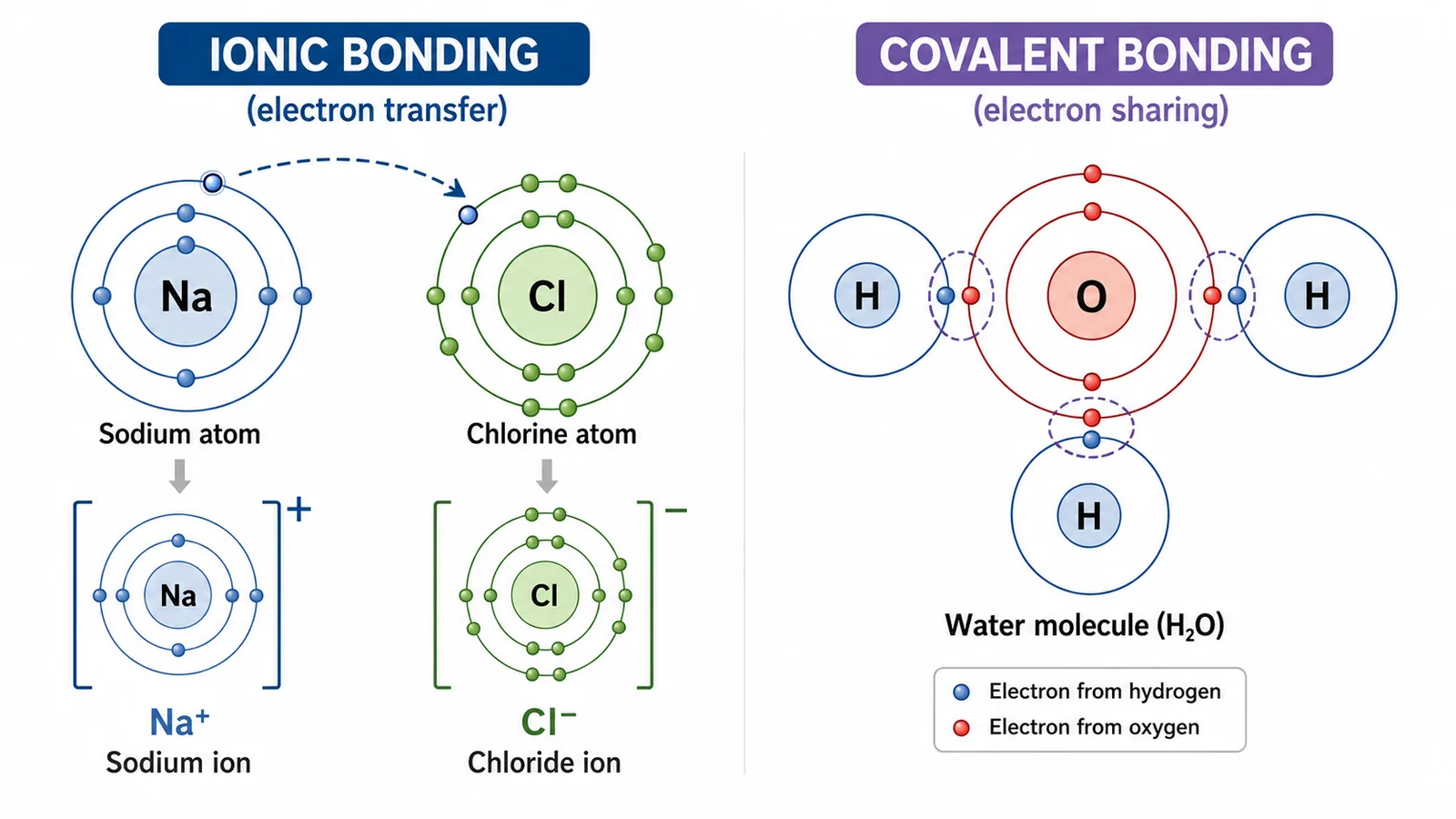
| Bonding | Between | Example |
|---|---|---|
| Ionic | Metal and non-metal; electrons transferred | NaCl, MgO |
| Covalent | Non-metals; electrons shared | H2O, CO2, CH4 |
Section 4 of 9Naming compounds
Two elements
- Two elements A compound of a metal and a non-metal ends in -ide, so sodium and chlorine form sodium chloride.
Oxygen present
- Oxygen present Compounds containing oxygen and another element end in -ate, for example copper sulfate and calcium carbonate.
Number of atoms
- Number of atoms Prefixes such as di- and tri- show numbers of atoms in covalent compounds, so CO2 is carbon dioxide.
Section 5 of 9Reading formulae
1
Identify each element symbol in the formula.
2
Read the small number after a symbol as the number of atoms of that element.
3
If there is no number, there is one atom.
4
A number in brackets multiplies everything inside: Ca(OH)2 has 1 Ca, 2 O and 2 H.
5
Add up the atoms to find the total, for example H2SO4 has 7 atoms.
Section 6 of 9Compound or mixture
| Feature | Compound | Mixture |
|---|---|---|
| Bonding | Chemically bonded | Not chemically bonded |
| Composition | Fixed ratio | Any ratio |
| Separation | Chemical reaction | Physical methods |
| Properties | Different from elements | Keep properties of the parts |
Section 7 of 9Worked example: iron and sulfur
Iron + sulfur
As a mixture
- As a mixture Iron filings and yellow sulfur powder can be stirred together in any ratio.
- A magnet pulls the iron out, so the two are not bonded.
Heated together
- Heated together On strong heating they react, glowing, to form iron(II) sulfide: Fe + S → FeS.
As a compound
- As a compound The black solid is not attracted to a magnet and has different properties from both elements.
Fixed formula
- Fixed formula Every sample of iron(II) sulfide has one iron atom for every sulfur atom.
Section 8 of 9Key terms
| Term | Meaning |
|---|---|
| Compound | A substance of two or more elements chemically bonded in a fixed ratio. |
| Formula | A way of showing the atoms in a substance using symbols and numbers. |
| Ionic bond | The electrostatic attraction between oppositely charged ions. |
| Covalent bond | A shared pair of electrons between two atoms. |
| Molecule | A group of atoms joined by covalent bonds. |
| Mixture | Two or more substances that are together but not chemically combined. |
Section 9 of 9Exam technique
1
Calling a mixture of iron and sulfur a compound before they have reacted.
2
Believing a compound keeps the properties of its elements.
3
Reading CO as carbon and oxygen in any ratio; the ratio is fixed.
4
Counting only the first element after a bracket.
5
Saying that compounds can be separated by filtration or distillation.