2.1.1Bonds, Structure and Properties of Matter
Chemical bonds
5 min read 7 parts Lesson 2 of 20 Unit quiz
Section 1 of 7Why atoms bond
1Incomplete outer shell
- Incomplete outer shell Most atoms do not have a full outer shell of electrons, so they are not stable on their own.
2Electrons move or are shared
- Electrons move or are shared Atoms rearrange their outer electrons when they react.
3Full outer shell
- Full outer shell Having a full outer shell makes the atoms more stable.
4A bond results
- A bond results The strong attraction that holds the particles together is called a chemical bond.
Section 2 of 7The three types of bonding
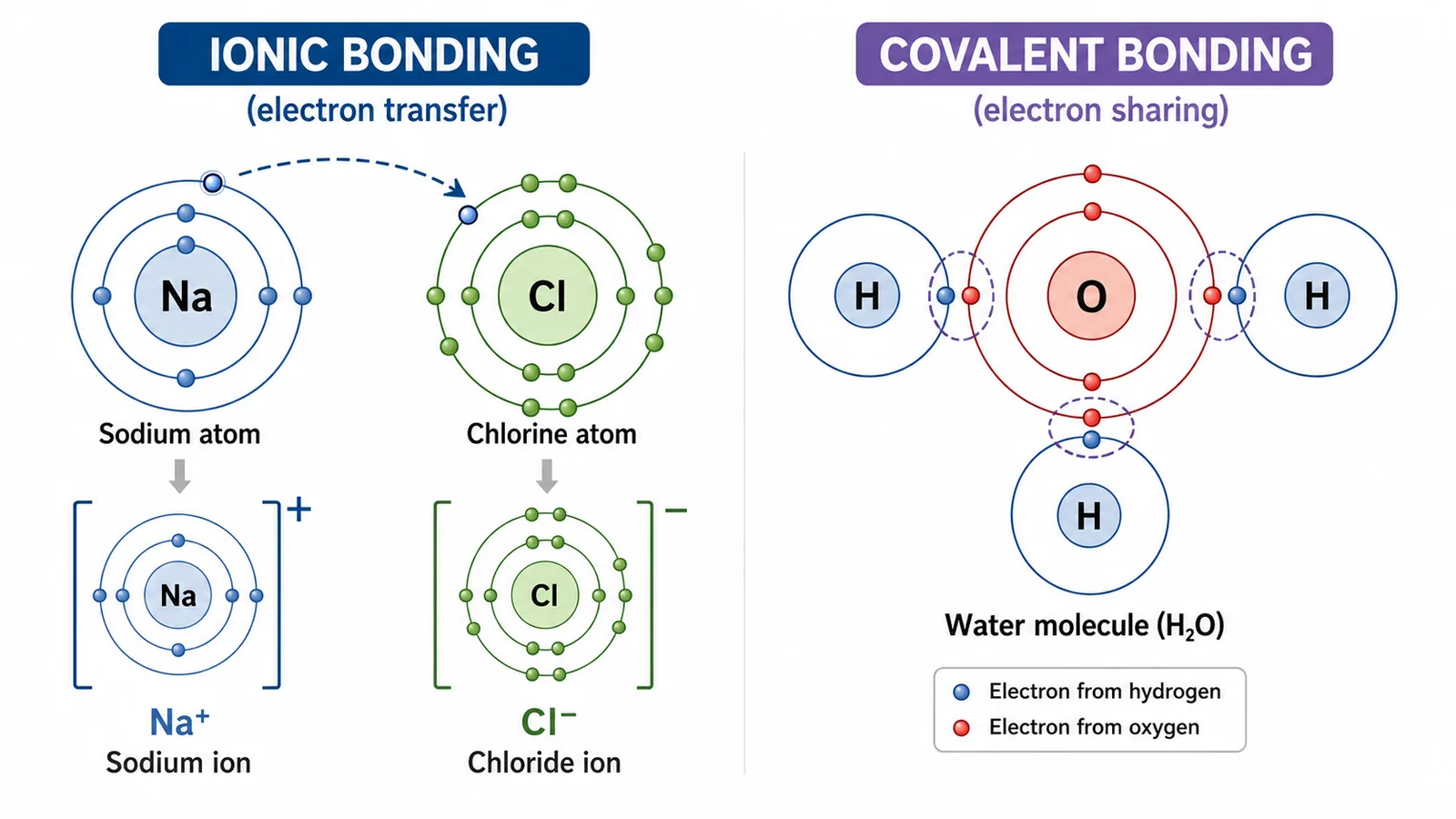
Chemical bonding at GCSE
Ionic bonding
- Ionic bonding Occurs between a metal and a non-metal.
- Electrons are transferredthe metal loses electrons to form positive ions and the non-metal gains them to form negative ions.
- Oppositely charged ions attract each other by electrostatic forces.
Covalent bonding
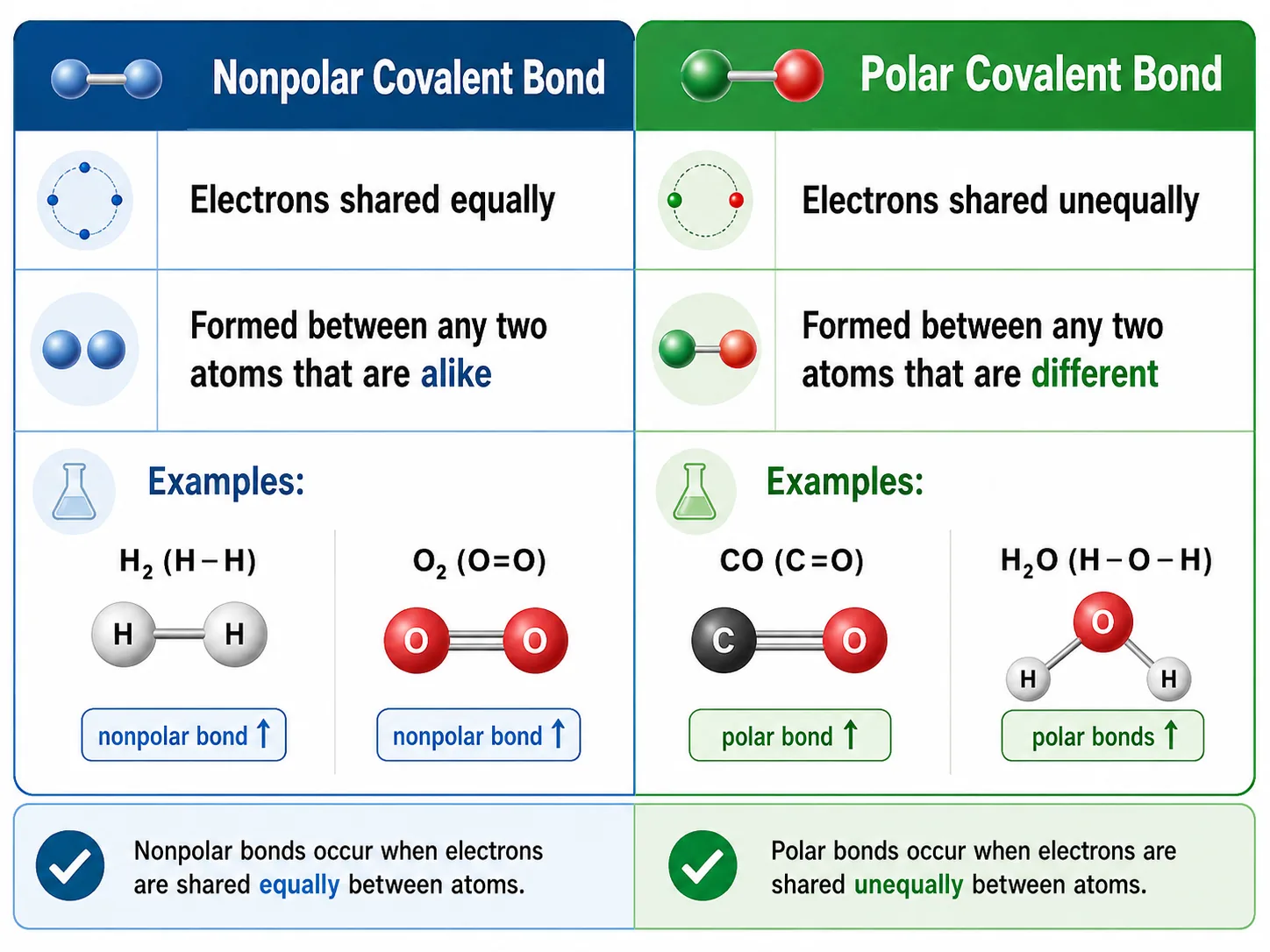
- Covalent bonding Occurs between non-metal atoms.
- Pairs of electrons are shared between the atoms, so both reach a full outer shell.
Metallic bonding
- Metallic bonding Occurs in metals and alloys, which are mixtures of metals.
- Outer electrons are delocalised and the metal ions are held by attraction to them.
Section 3 of 7Comparison
| Bond type | Between | What happens to electrons | Result |
|---|---|---|---|
| Ionic | Metal + non-metal | Transferred | Giant lattice of oppositely charged ions |
| Covalent | Non-metal + non-metal | Shared in pairs | Small molecules or giant covalent structures |
| Metallic | Metal atoms only (or alloys) | Outer electrons delocalised | Giant lattice of positive ions in a sea of electrons |
Section 4 of 7Deciding which bond is present
1
Decide whether each element in the substance is a metal or a non-metal using the Periodic Table.
2
If it contains a metal and a non-metal, the bonding is ionic.
3
If it contains only non-metals, the bonding is covalent.
4
If it contains only metal atoms, or a mixture of metals, the bonding is metallic.
Section 5 of 7Forces between molecules

Not chemical bonds
- Not chemical bonds Intermolecular forces are attractions between separate molecules.
- No electrons are shared or transferred, and no new substance forms.
- They are much weaker than chemical bonds, about a tenth of the strength.
Section 6 of 7Key terms
| Term | Meaning |
|---|---|
| Chemical bond | A strong force of attraction that holds atoms or ions together in a substance. |
| Ionic bond | The electrostatic attraction between oppositely charged ions. |
| Covalent bond | A shared pair of electrons between two atoms. |
| Metallic bond | The attraction between positive metal ions and delocalised electrons. |
| Electrostatic force | The force of attraction between opposite charges. |
| Alloy | A mixture of a metal with other elements, often other metals. |
Section 7 of 7Exam technique
1
Saying that ionic bonds involve sharing electrons. Ionic bonding is transfer, covalent is sharing.
2
Describing intermolecular forces as chemical bonds. They are much weaker and no electrons are shared.
3
Claiming covalent bonds occur between a metal and a non-metal. That combination gives ionic compounds.
4
Writing that the bond in an ionic compound is the transfer itself. The bond is the electrostatic attraction between the ions that results.
5
Forgetting that the purpose is to give atoms a full outer shell.