6.1.4Chemical Change: Rate and Extent
Calculating Gradients
5 min read 7 parts Lesson 5 of 16 1 quiz
Section 1 of 7Why tangents are needed (HT only)
Curves vary
- Curves vary Most rate graphs start straight but then curve as reactant is used up.
- The rate is different at each point on a curve.
Tangent
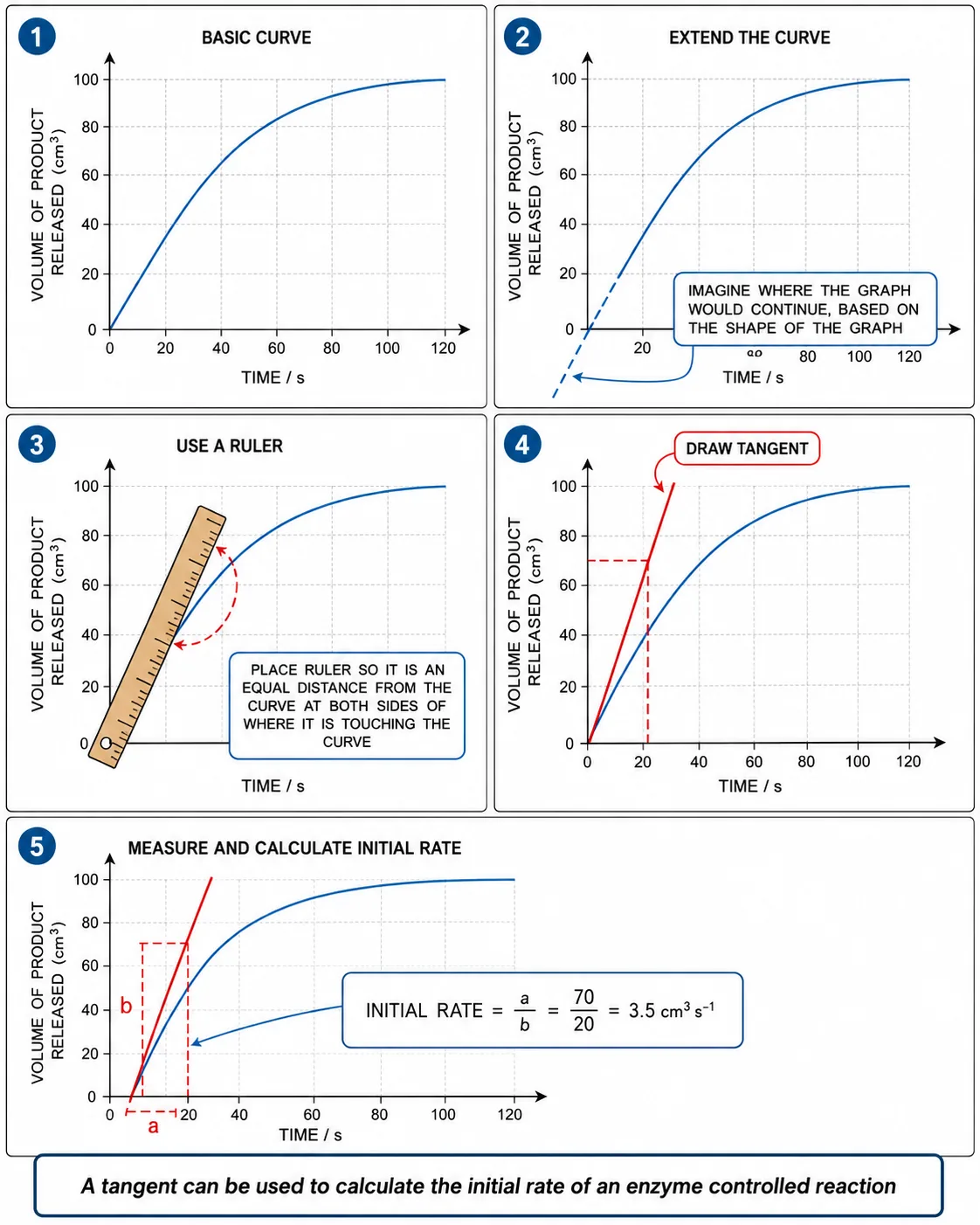
- Tangent A tangent is a straight line touching the curve at one point;
- its gradient equals the rate at that point.
Initial rate
- Initial rate A tangent at t = 0 gives the initial rate, the fastest rate of the reaction.
Section 2 of 7Drawing a good tangent (HT only)
1
Use a sharp pencil and a clear ruler.
2
Place the ruler on the chosen point so it just touches the curve there.
3
Rotate the ruler until the gap between ruler and curve is equal on both sides of the point.
4
Draw a straight line, extending it well beyond the point, across as much of the graph as possible.
5
Make sure the curve is still visible and not hidden under the ruler.
Section 3 of 7Calculating the gradient (HT only)
1Choose two points
- Choose two points Pick two points on the tangent line, far apart, where it crosses grid lines.
2Rise
- Rise Find the change in the quantity on the y-axis.
3Run
- Run Find the change in time on the x-axis.
4Divide
- Divide Gradient = change in product ÷ change in time, with units such as cm3/s.
Section 4 of 7Worked example (HT only)
| Stage | Working |
|---|---|
| Graph | Volume of gas against time, curve levelling off |
| Tangent | Drawn at t = 0 touching the curve at the origin |
| Two points | (0 s, 0 cm3) and (20 s, 60 cm3) on the tangent |
| Gradient | 60 ÷ 20 = 3.0 |
| Answer | Initial rate = 3.0 cm3/s |
Section 5 of 7Using tangents to compare
Rate at different times
Early on
- Early on Steep tangent, high rate.
Mid-reaction
- Mid-reaction Gentler tangent, lower rate as reactants are used.
Near the end
- Near the end Almost horizontal tangent, rate close to zero.
Different conditions
- Different conditions Compare tangents at the same time for two curves to find which run is faster.
Section 6 of 7Key terms
| Term | Meaning |
|---|---|
| Tangent | A straight line that touches a curve at one point without crossing it. |
| Gradient | The steepness of a line, equal to change in y divided by change in x. |
| Initial rate | The rate of reaction at time zero. |
| Rise over run | A memory aid for gradient: vertical change divided by horizontal change. |
| Extrapolate | To extend a line beyond the plotted data to read values. |
Section 7 of 7Exam technique
1
Using two points on the curve rather than on the tangent to calculate the gradient.
2
Drawing the tangent so it cuts through the curve instead of just touching it.
3
Choosing two points too close together, which increases uncertainty.
4
Leaving the unit off the answer or giving the rate as a volume rather than volume per second.