Section 1 of 12Principle of paper chromatography
Use
- Use separates substances with different solubilities in a solvent, such as the dyes in black ink.
Spots
- Spots a pencil line is drawn and spots of sample placed on it.
- Pencil
- used because ink would run with the samples.
- Solvent
- the paper is lowered into solvent with the pencil line above the surface.
- Movement
- the solvent rises by capillary action, carrying substances with it.
- Separation
- more soluble substances travel further.
Section 2 of 12Method
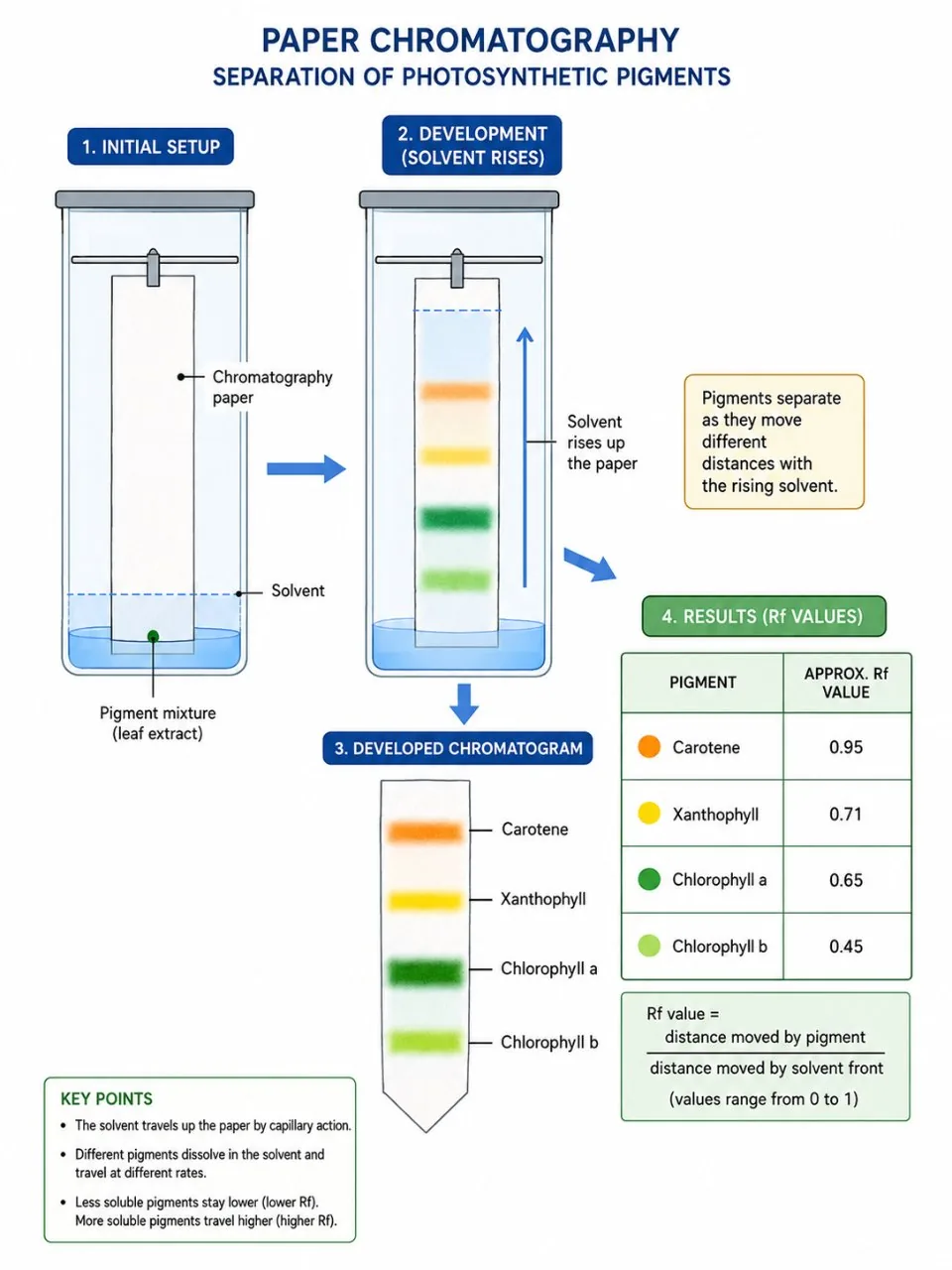
1
Draw a pencil line near the bottom of the chromatography paper.
2
Place small spots of each sample on the line, with a known reference alongside.
3
Lower the paper into a container with solvent below the line.
4
Let the solvent rise through the paper.
5
Remove the paper before the solvent reaches the top and mark the solvent front.
6
Dry the paper and examine the chromatogram.
Section 3 of 12Interpreting a chromatogram
Terms
- Terms paper chromatography is the technique and a chromatogram is the paper showing the result.
Same substance
- Same substance gives the same pattern and identical spots.
- Reference spot
- a known compound used for comparison with unknown spots.
- Mixture
- separates into several spots, one for each component.
- Pure substance
- gives one spot.
- Impure sample
- shows more than one spot.
Section 4 of 12Locating agents
Problem
- Problem colourless substances such as amino acids and sugars cannot be seen on the paper.
Locating agent
- Locating agent a chemical that reacts with the sample to give a coloured product.
- Use
- apply after the run so the spots become visible to the naked eye.
Section 5 of 12Retention factor (Rf)
Definition
- Definition the distance moved by a substance divided by the distance moved by the solvent.
Equation
- Rf = distance travelled by substance ÷ distance travelled by solvent.What the symbols mean: Rf has no unit and is always between 0 and 1 · both distances are measured from the baseline
- Units
- none, as it is a ratio.
- Always between 0 and 1
- a substance cannot move further than the solvent.
- Constant
- the Rf of a compound is the same under the same conditions.
- Identification
- compare the Rf of an unknown with known values.
Section 6 of 12Worked example of Rf
1
Measure the distance from the baseline to the centre of the spot, e.g. 3.6 cm.
2
Measure the distance from the baseline to the solvent front, e.g. 9.0 cm.
3
Divide: 3.6 ÷ 9.0 = 0.40.
4
Compare 0.40 with the table of known Rf values.
- Measurement tip
- always measure from the pencil line, not from the bottom of the paper.
Section 7 of 12Reasons for a good chromatogram
Small spots
- Small spots large spots overlap and separate poorly.
Solvent level
- Solvent level keep it below the baseline.
- Lid
- cover the container so solvent does not evaporate from the paper.
- Stop
- remove the paper before the solvent front reaches the top so the distance can be measured.
- Drying
- dry in air before using a locating agent.
Section 8 of 12Identifying components from a chromatogram
| Observation | Conclusion |
|---|---|
| Spot level with a reference spot | Sample contains the reference substance |
| One spot only | Sample is probably pure |
| Several spots | Sample is a mixture |
| Spot not matching any reference | Unknown substance present |
- Rf use
- compare calculated Rf values with a data table for the same solvent.
Section 9 of 12Uses of chromatography
Food
- Food testing whether a colouring is permitted by comparing with known dyes.
Forensics
- Forensics matching an ink or dye from a sample to a suspect source.
- Medicine
- detecting drugs and checking that a product is pure.
- Colourless samples
- amino acids from a protein can be separated and sprayed with a locating agent.
Section 10 of 12Worked examples
Explain why the starting line is drawn in pencil. [2]2 marks
Worked examplesPencil does not dissolve in the solvent.Ink would run up the paper with the samples.A spot travels 4.2 cm while the solvent travels 6.0 cm. Calculate the Rf. [2]2 marks
- Rf = 4.2 ÷ 6.0.
- = 0.70.
A chromatogram of a food dye shows two spots. What does this show? [1]1 mark
- The dye is a mixture of at least two substances.
Why must a locating agent be used for amino acids? [2]2 marks
Worked examplesAmino acids are colourless.The agent reacts to give a coloured product that can be seen.
Section 11 of 12Key terms
| Term | Meaning |
|---|---|
| Chromatography | A method to separate substances based on their different solubilities. |
| Chromatogram | The paper showing the separated spots. |
| Solvent front | The furthest point reached by the solvent. |
| Locating agent | A reagent that makes colourless spots visible. |
| Rf value | Distance moved by a substance divided by distance moved by solvent. |
Section 12 of 12Exam technique
1
Having the baseline below the solvent level — samples would wash away.
2
Calculating Rf with the wrong distances.
3
Giving Rf units — it has none.
4
Saying more soluble substances move less far.