6.1.5Plant Nutrition
Investigating the Need for Chlorophyll, Light and Carbon Dioxide
5 min read 6 parts Lesson 6 of 11 1 quiz
Section 1 of 6Principle: testing a leaf for starch


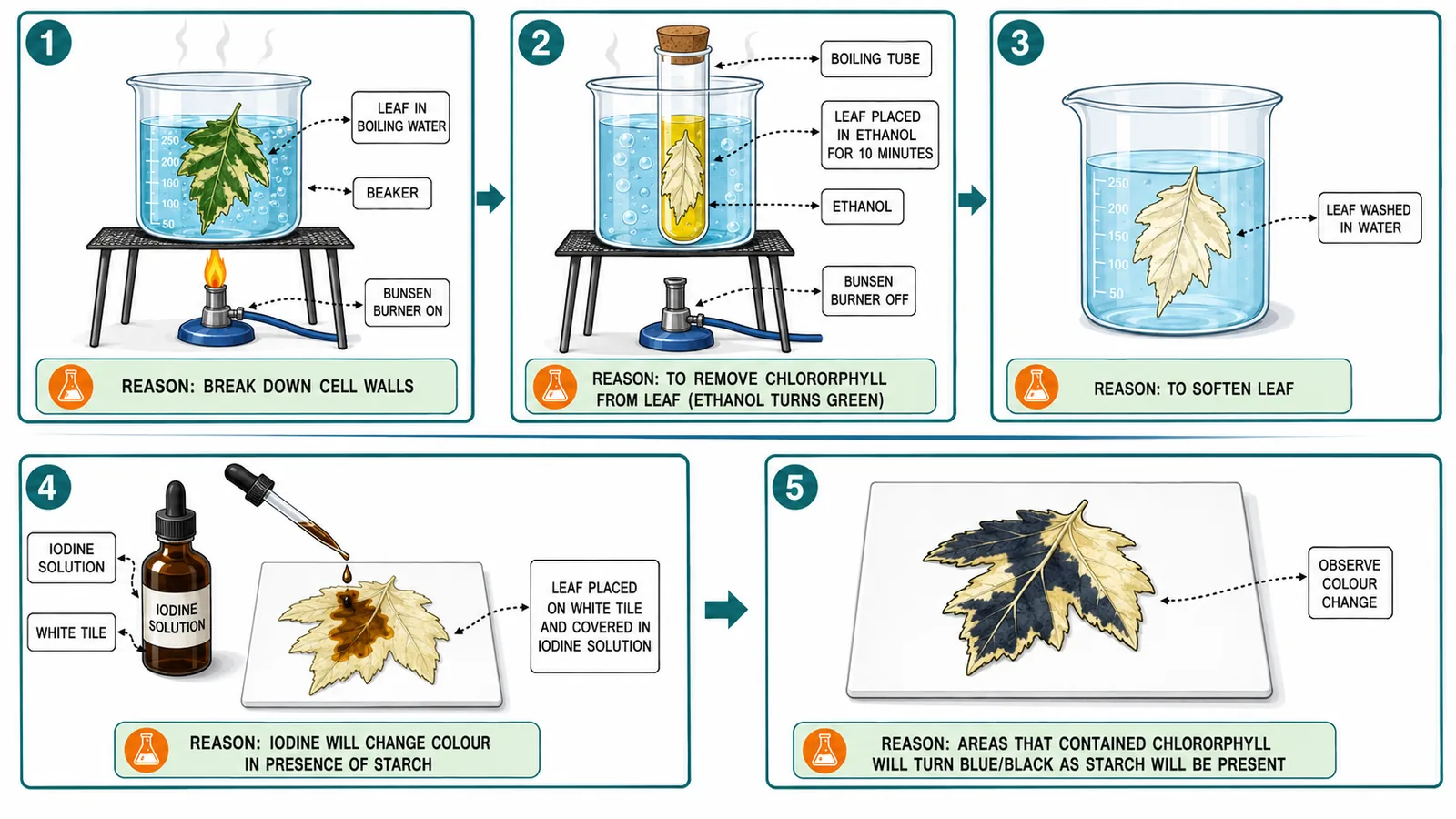
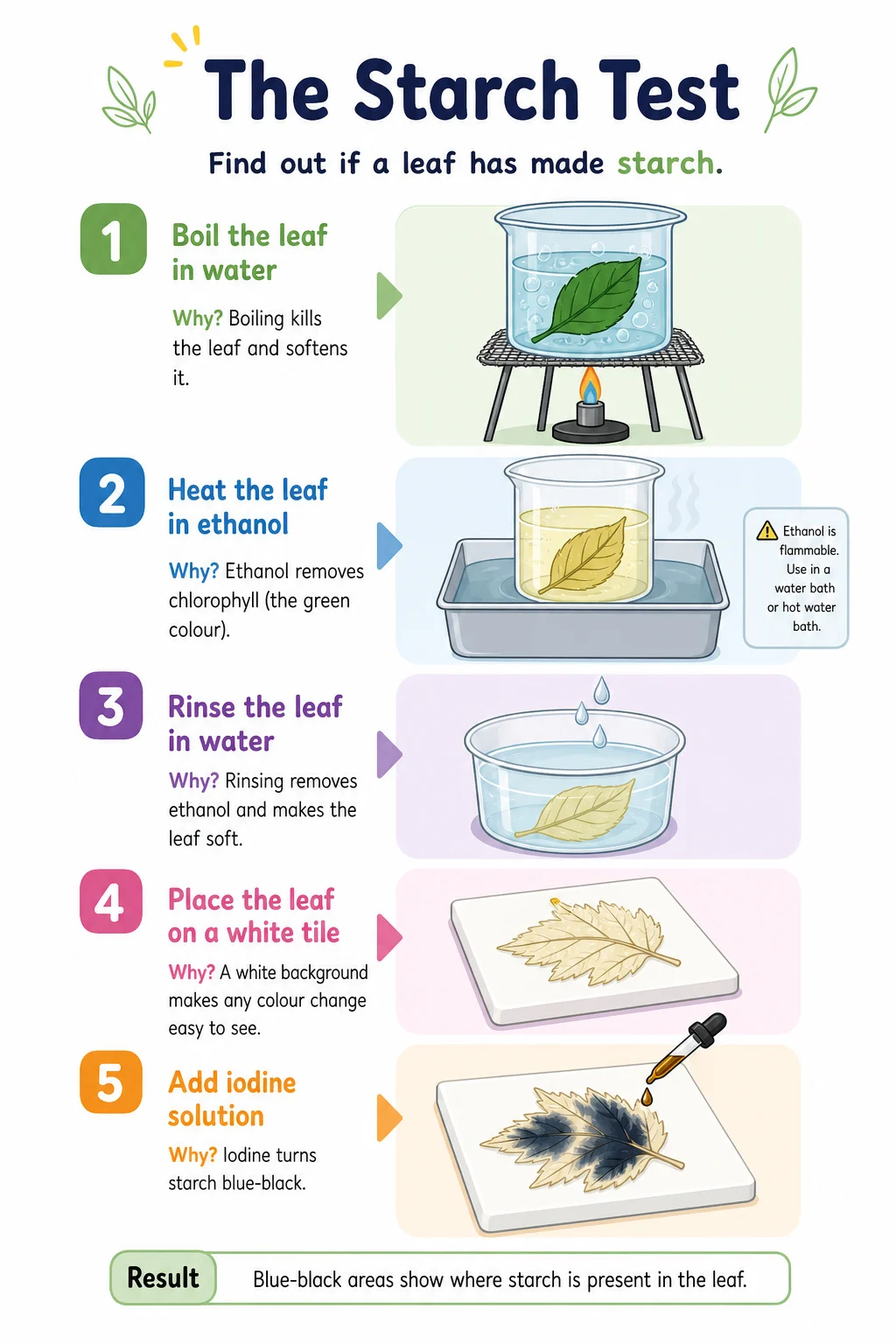
1
Place the leaf in boiling water for about 30 seconds. This kills the cells and softens the waxy layer.
2
Turn off the Bunsen burner, then place the leaf in a boiling tube of ethanol standing in the hot water, to remove the chlorophyll. Ethanol is flammable, so keep naked flames away.
3
After a few minutes the leaf is pale and brittle. Rinse it in cold water to soften it.
4
Spread the leaf on a white tile and add drops of iodine solution.
5
A blue-black colour shows starch is present. Orange-brown shows starch is absent. Starch is evidence that photosynthesis has happened, because the glucose made is stored as starch.
Section 2 of 6Three investigations
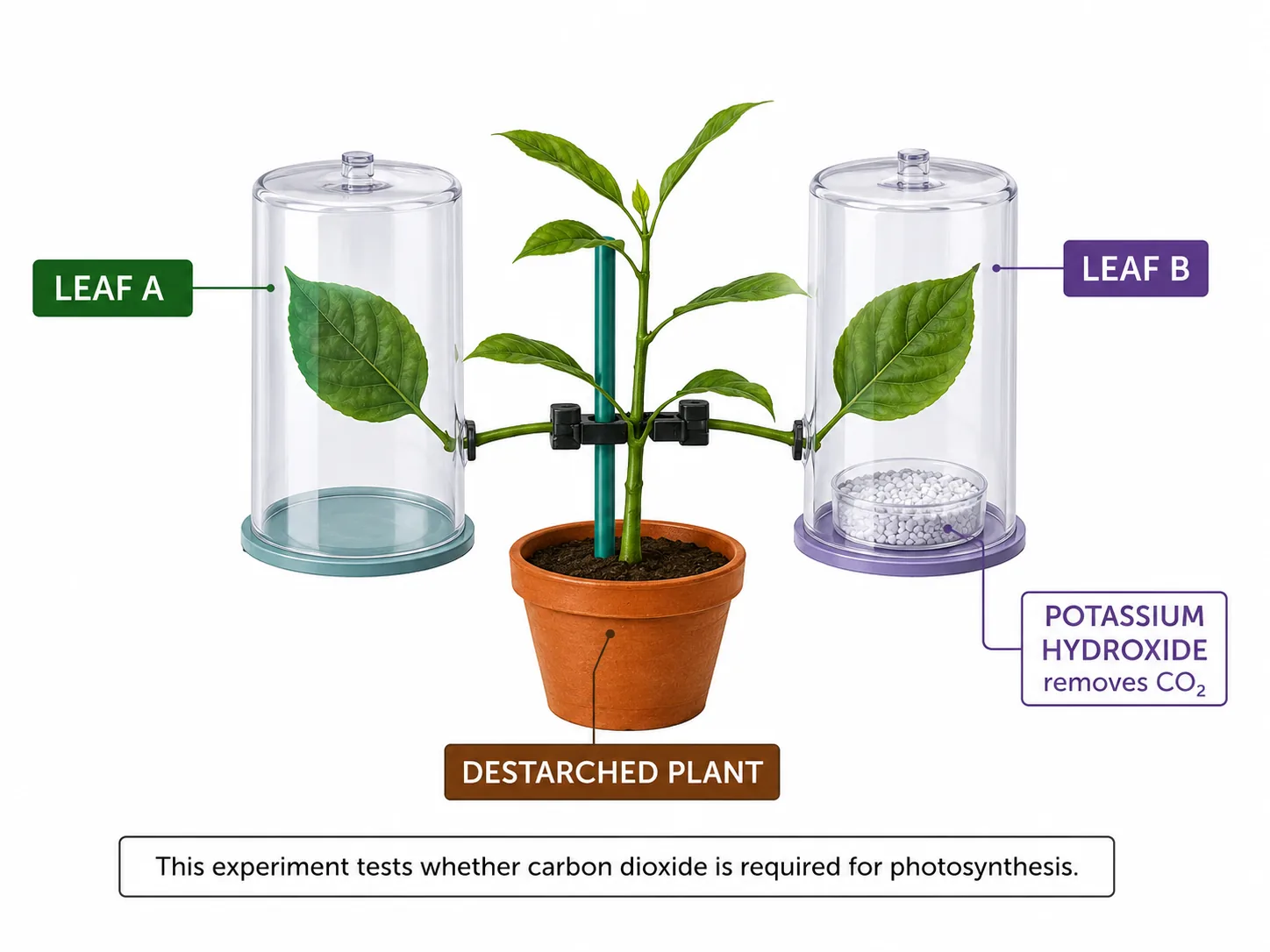


| Factor tested | Set-up | Expected result | Conclusion |
|---|---|---|---|
| Chlorophyll | Variegated leaf with green and white areas, destarched and left in light | Only the green areas turn blue-black | Chlorophyll is needed for photosynthesis |
| Light | Destarched plant with part of a leaf covered in black paper or foil, left in bright light | Covered area stays orange-brown; uncovered area turns blue-black | Light is needed for photosynthesis |
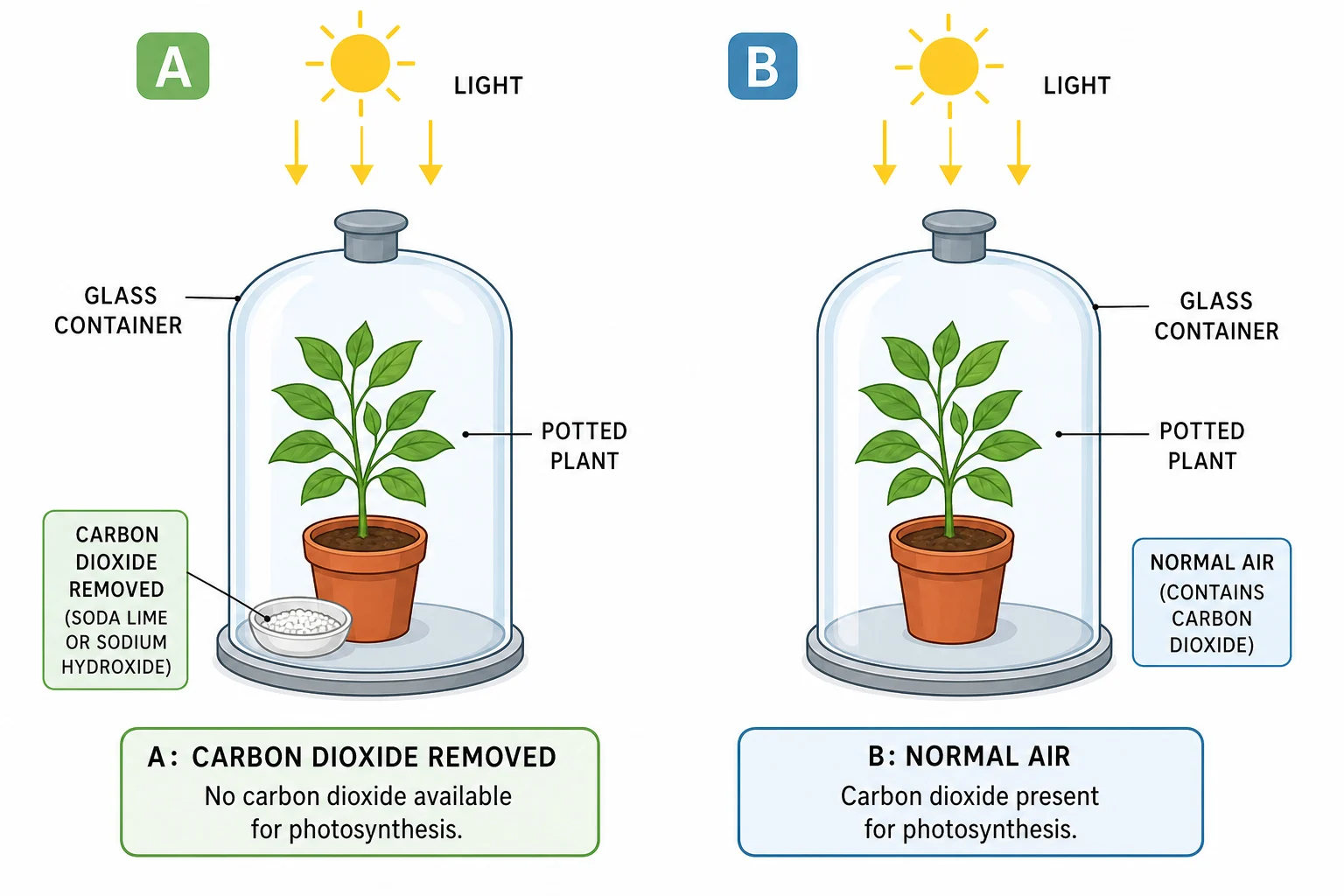
| Carbon dioxide | Destarched plant with one leaf in a sealed bag or flask with soda lime or potassium hydroxide, which absorbs CO2; a control leaf is in a bag without it | Leaf without CO2 stays orange-brown; control leaf turns blue-black | Carbon dioxide is needed for photosynthesis |
Section 3 of 6Why we destarch first

1Plant may already hold starch
- Plant may already hold starch Starch from earlier photosynthesis could give a false positive result.
2Keep it in darkness
- Keep it in darkness Leave the plant in a dark cupboard for 24 to 48 hours.
3Starch is used up
- Starch is used up With no light the plant cannot photosynthesise, so it respires its starch store.
4Test a destarched leaf
- Test a destarched leaf Check with iodine that a leaf is starch-free, then begin the experiment.
Section 4 of 6Controls and reliability
Control experiments
- Control experiments Each experiment needs a control,
- such as an uncovered leaf or a bag containing no soda lime,
- so you can be sure that only one factor changed.
Fair test
- Fair test Keep temperature, plant type, leaf age and time in the light the same, and repeat where possible to check reliability.
Safety
- Safety Wear eye protection.
- Hot water and flammable ethanol must be handled with care, and soda lime is corrosive.
Section 5 of 6Key terms
| Term | Meaning |
|---|---|
| Starch test | A test using iodine solution; a blue-black colour shows that starch is present. |
| Variegated leaf | A leaf with both green areas that contain chlorophyll and white areas that do not. |
| Destarching | Keeping a plant in darkness so that it uses up its stored starch. |
| Soda lime | A chemical that absorbs carbon dioxide from the air. |
| Control | A set-up in which the factor being tested is left unchanged so results can be compared. |
Section 6 of 6Exam technique
1
Heating ethanol directly with a flame — always warm it in a beaker of hot water that is off the heat.
2
Forgetting to destarch the plant, which makes the results unreliable.
3
Saying the iodine turns 'black' with no mention of the blue; and iodine stays orange-brown when starch is absent.
4
Not including a control, so it is not clear whether the missing factor caused the result.
5
Concluding that starch is the product of photosynthesis; glucose is the product and starch is the store made from it.
Marked practiceQuizzes for this lesson
Biology 0610 & 9700 Exam Model
Limiting Factors Master
Photosynthesis: Limiting Factors & Graph Plateau
6CO2 + 6H2O → C6H12O6 + 6O2 (Light & Chlorophyll required)
- Limiting Factor Definition: Something present in the environment in such short supply that it restricts life processes.
- Graph Plateau: When rate levels off as light intensity increases, light is no longer the limiting factor; CO2 concentration or temperature has become limiting.
- High Temperature Drop: Beyond optimum temp (~40°C), enzymes (e.g. RuBisCO) denature, permanently decreasing rate.