Section 1 of 6The three neurones


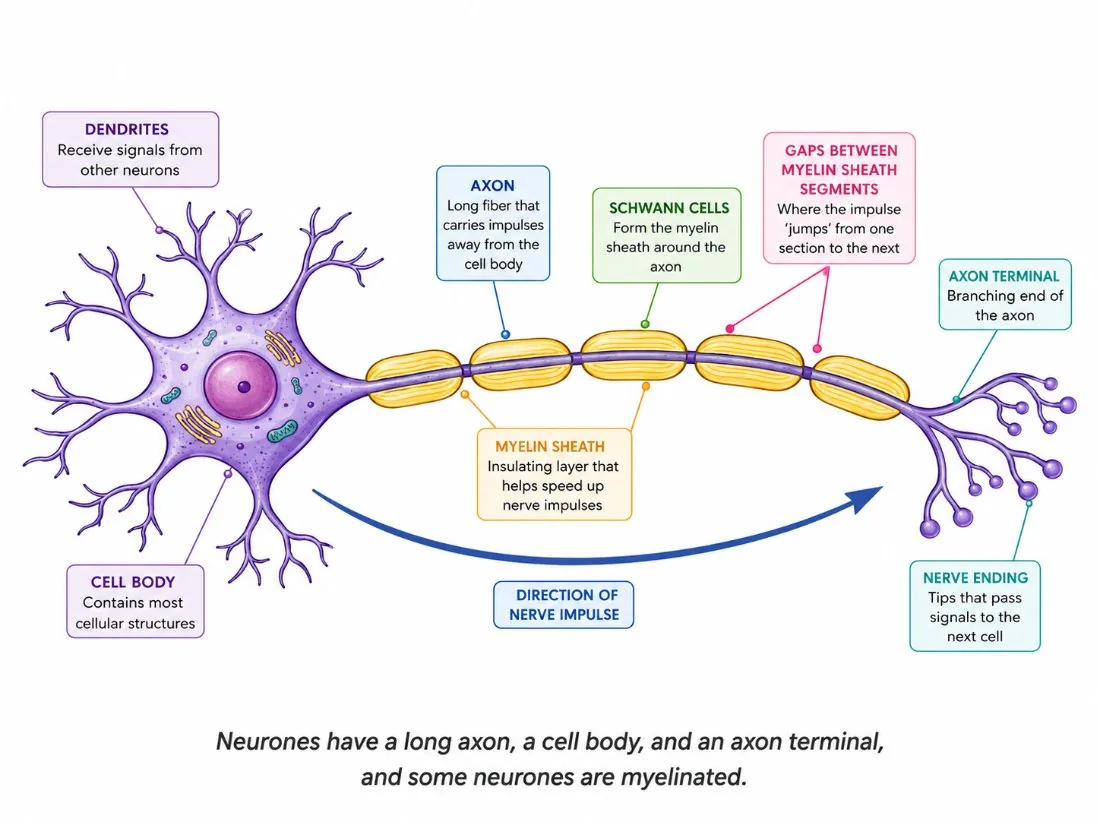

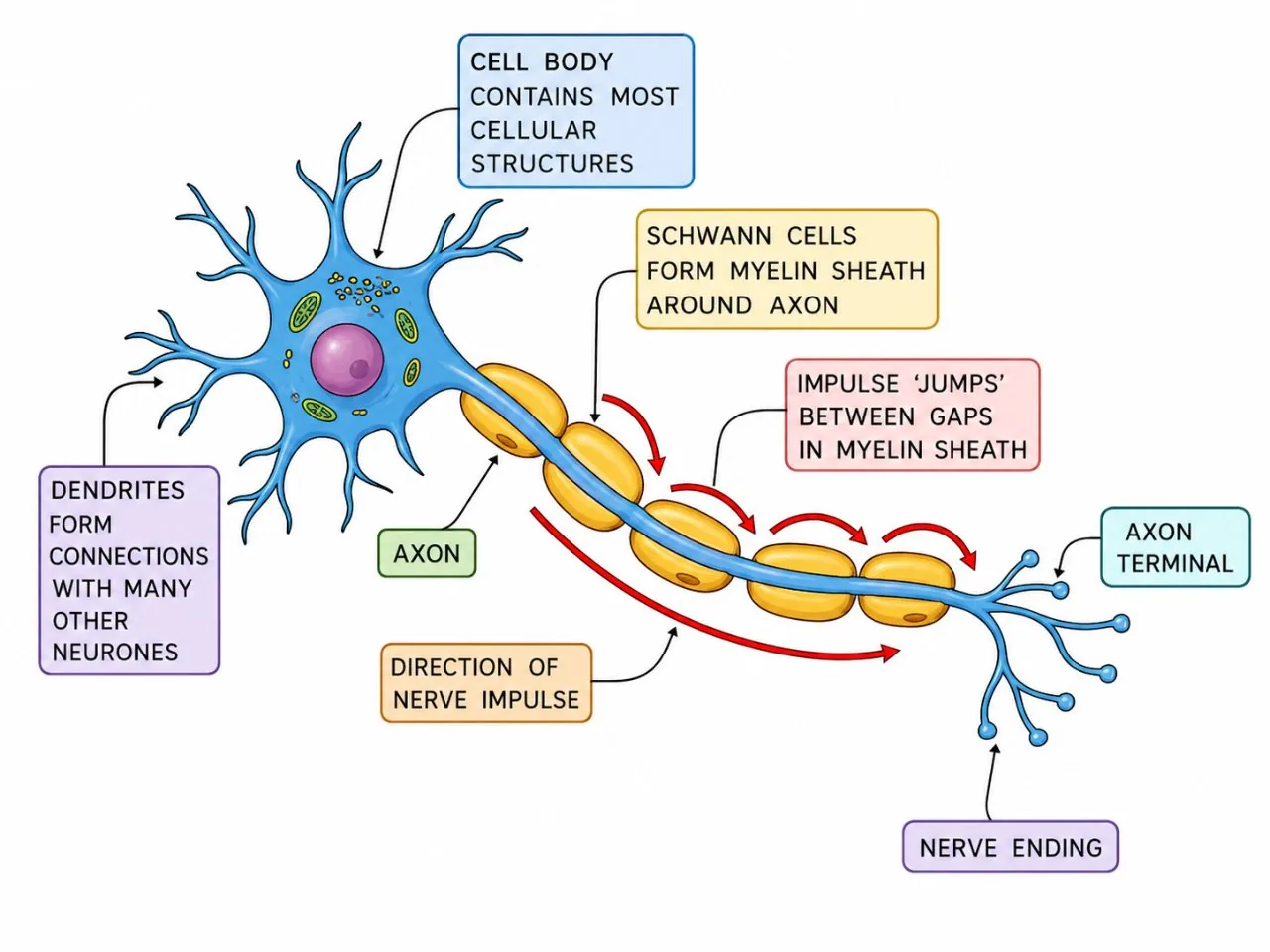

| Neurone | Where it is found | Carries impulses | Appearance |
|---|---|---|---|
| Sensory | From sense organs to the CNS | From receptors to the brain or spinal cord | Long, with the cell body branching off the middle of the fibre |
| Relay | Inside the CNS | Between sensory and motor neurones | Short, small cell body at one end with many dendrites |
| Motor | From the CNS to muscles or glands | From the CNS to effectors | Long, large cell body at one end with long dendrites |
Section 2 of 6Adaptations of neurones
Neurone adaptations
Long axon
- Long axon A long fibre carries the impulse over a great distance in a single cell, so less time is lost passing it from cell to cell.
Insulating fatty sheath
- Insulating fatty sheath The axon is wrapped in a fatty insulating layer with small uninsulated gaps called nodes.
Jumping impulses
- Jumping impulses Because of the sheath, the impulse jumps from one node to the next instead of travelling the whole length,
- which speeds up transmission.
Dendrites
- Dendrites The cell body has many extensions called dendrites,
- so the neurone can connect to many others and receive impulses from them,
- forming a network.
Section 3 of 6Pathway through the three neurones


1
A receptor in a sense organ detects a stimulus and starts an impulse in a sensory neurone.
2
The sensory neurone carries the impulse to the brain or spinal cord.
3
In the CNS the impulse is passed to a relay neurone, which connects to a motor neurone.
4
The motor neurone carries the impulse to an effector, which makes the response.
Section 4 of 6Remembering which is which

Sensory
- Sensory Connects a sense organ, such as the eye, nose or tongue, to the CNS.
Motor
- Motor Leads to a response, often movement, so think of the word motor in a moving vehicle.
Relay
- Relay Relays the message between the other two inside the CNS.
Section 5 of 6Key terms
| Term | Meaning |
|---|---|
| Sensory neurone | A neurone that carries impulses from receptors to the CNS. |
| Relay neurone | A neurone inside the CNS that links sensory and motor neurones. |
| Motor neurone | A neurone that carries impulses from the CNS to an effector. |
| Axon | The long fibre of a neurone along which impulses travel. |
| Dendrite | A short branched extension of the cell body that receives impulses. |
| Node | An uninsulated gap in the fatty sheath of an axon. |
Section 6 of 6Exam technique
1
Mixing up sensory and motor neurones — sensory goes towards the CNS and motor goes away from it.
2
Saying the impulse travels slowly because of the fatty sheath — the sheath makes transmission faster.
3
Describing relay neurones as long cells that reach the muscles; they are short and lie within the CNS.
4
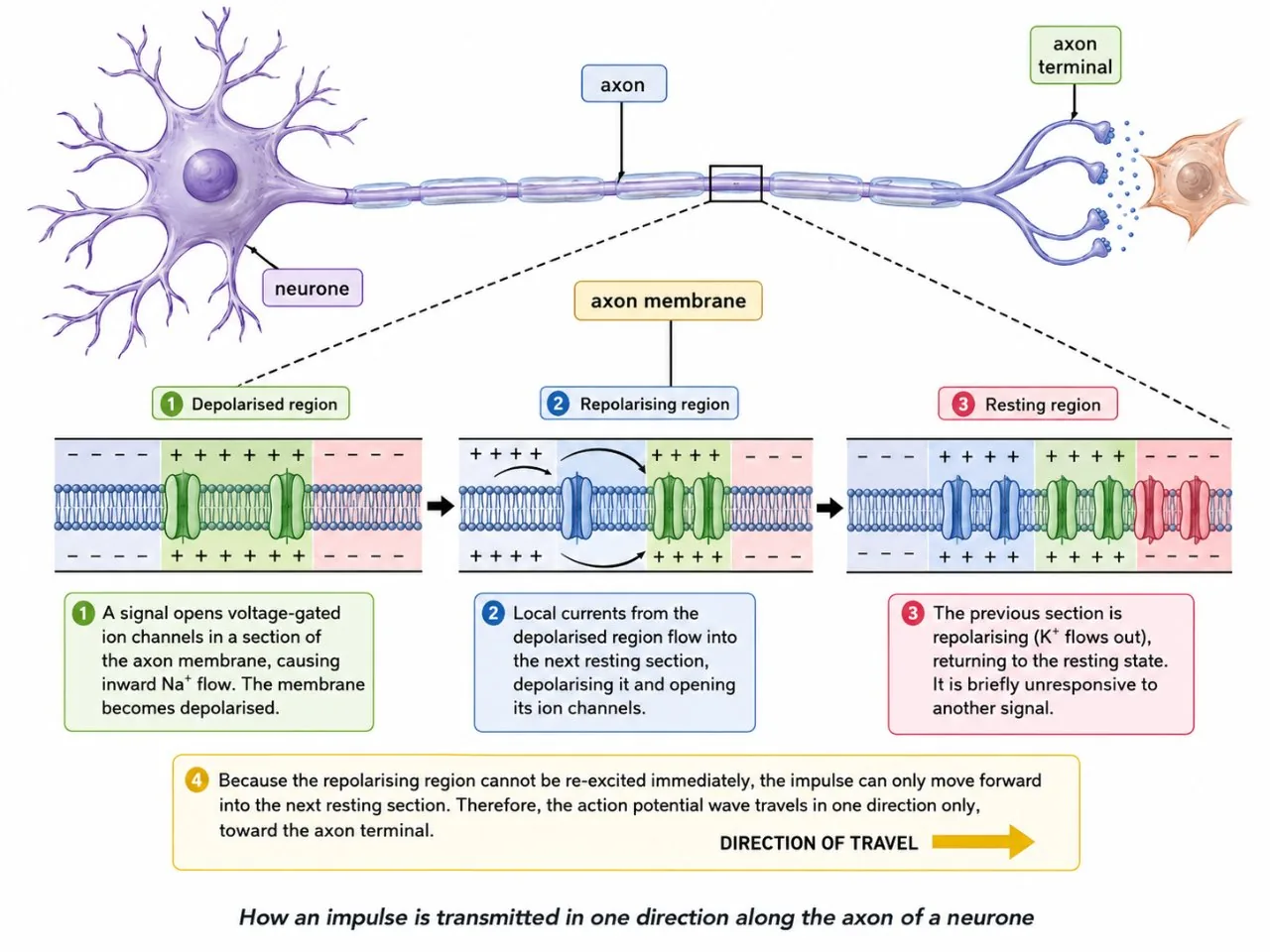
Drawing impulses as travelling in both directions along a neurone — they travel one way.