Skip to content
Dabour HubLEARN · PRACTICE · EXPLORESign inStudent

18.1.1Organisms and Their Environment

Transfer of Energy

5 min read 9 parts Lesson 2 of 6 1 quiz

0%read

Section 1 of 9Energy enters through producers
waterfall energy landscape

The Sun is the source of energy for almost all ecosystems.

Energy enters through producers
Only a small fraction of the light that falls on a plant is absorbed by chlorophyll and used in photosynthesis.
Much is reflected, transmitted through the leaf, or is of a wavelength that chlorophyll does not absorb.
The energy that is captured is stored in the chemical bonds of glucose and other organic compounds, and is the energy available to the rest of the food chain.

Section 2 of 9Energy losses at each level
pasted 1782446296896 0

When a herbivore eats a plant, only part of the energy in the plant is stored in the herbivore's body as new biomass. The rest is lost in several ways:

Respiration
Respiration organisms release energy from glucose to power movement, to maintain a constant body temperature (in birds and mammals), active transport, and growth. Much of this ends up as heat lost to the surroundings.
Egestion
Egestion parts of the food cannot be digested, such as cellulose in some animals, bone, fur or cell walls, and pass out in faeces. This energy is still in the faeces and becomes available to decomposers.
Excretion
Excretion energy is lost in urine, which contains urea.
Parts not eaten
Parts not eaten roots, bones, antlers, or shells which the consumer does not eat.
Not all the organisms are eaten
Not all the organisms are eaten some die and are decomposed.

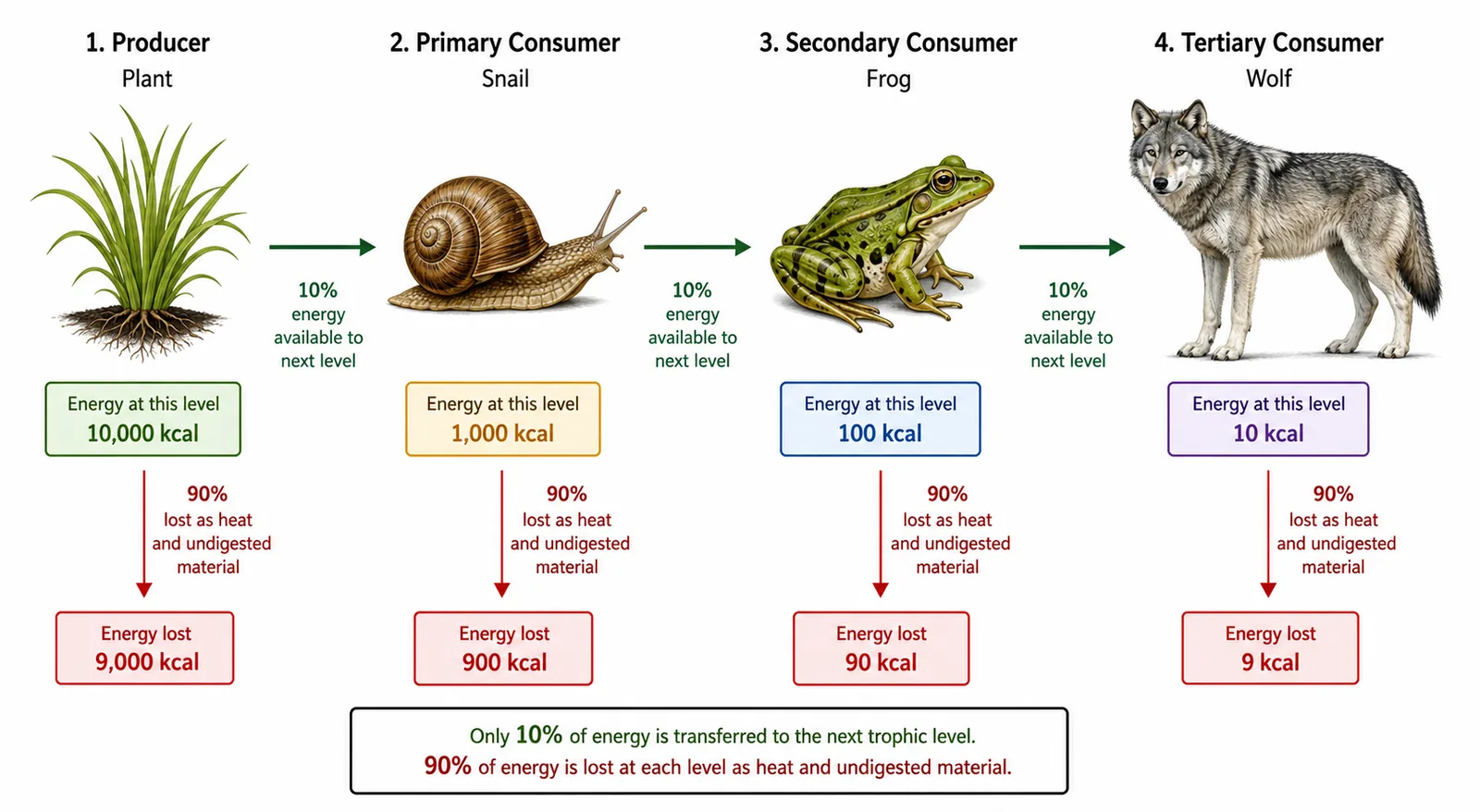
Only the energy used to make new body tissue is available to the next trophic level, and typically that is about 10 per cent.

Section 3 of 9Calculating efficiency

Calculating efficiency
The efficiency of energy transfer between two trophic levels is calculated as:
Efficiency (%) = (energy transferred to the next level / energy available at the previous level) × 100
Typical values are 5 to 20 per cent.
Calculating efficiency
Efficiency is also given for the whole food chain as the energy in the top consumer compared to that in the producers.
For example, if grass provides 20 000 kJ per m2 per year, rabbits receive 2000 kJ and foxes 180 kJ, the efficiency from grass to rabbit is 2000 / 20 000 × 100 = 10 per cent, and from rabbit to fox it is 180 / 2000 × 100 = 9 per cent.

Section 4 of 9Why food chains are short and what this means for food production

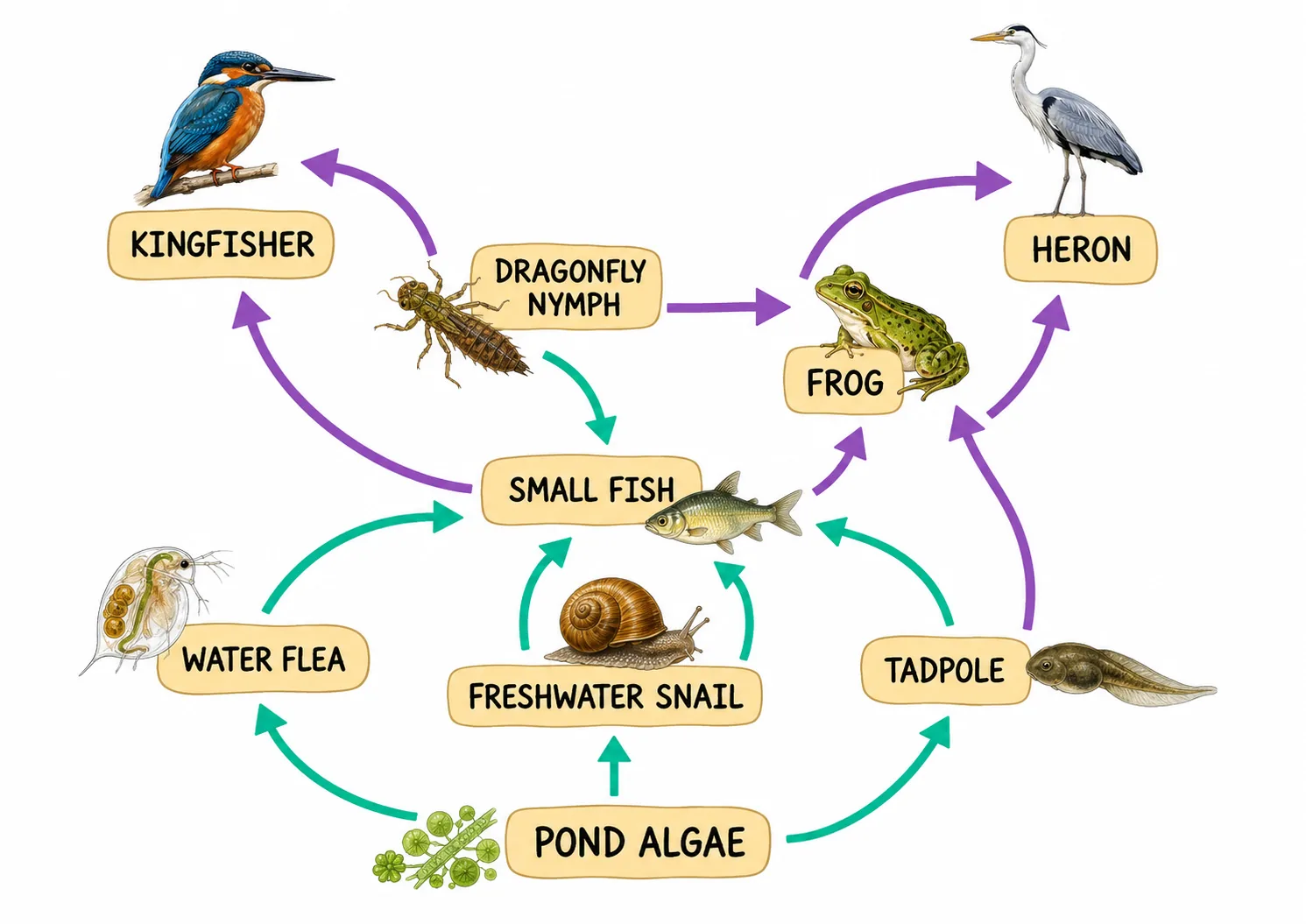
food chains landscape
Food Chain and Energy Transfer — Teaching Console
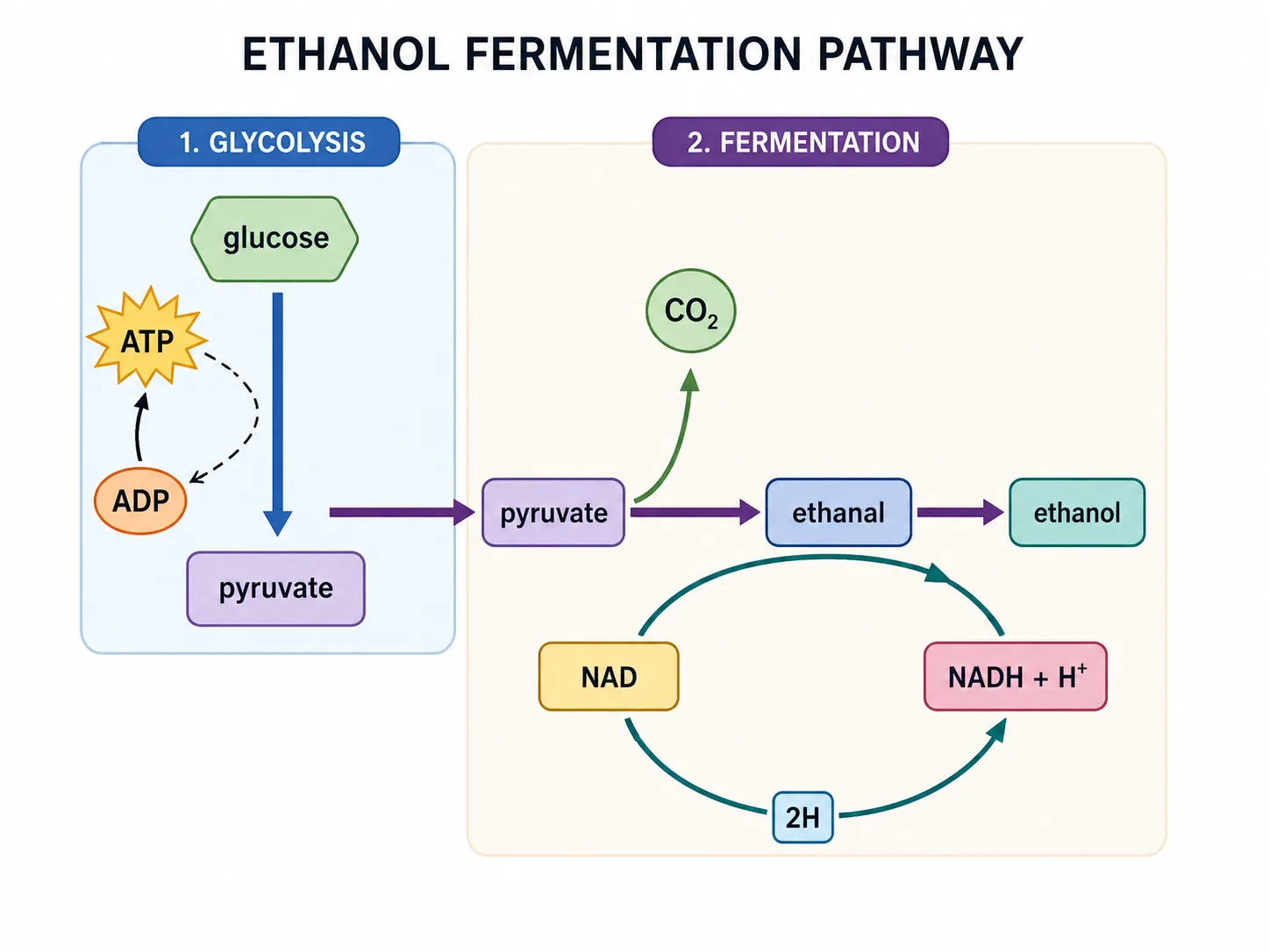
Alcoholic Fermentation
Food Chain — Step-by-Step Mechanism Simulation
Food Chain & Energy Flow — Interactive Teaching Console
Food chains — interactive teaching console
Food Chain Energy Flow — Step-by-Step Mechanism Simulation (10% Rule)
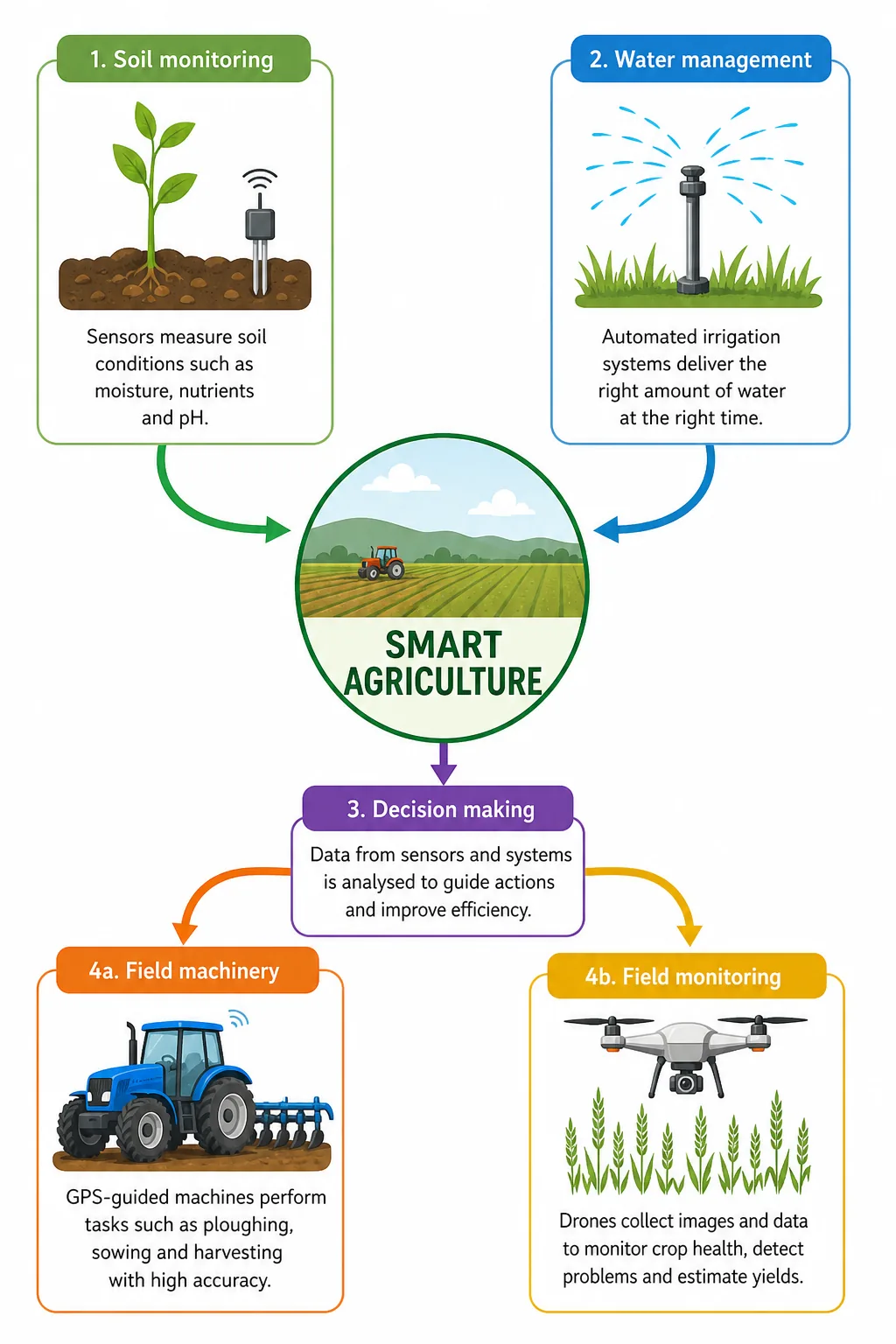
Smart agriculture: sensors and automated farming

Because roughly 90 per cent of the energy is lost at each stage, the energy remaining after four or five trophic levels is too small to support another. This also explains why top predators are rare and have large territories.

Farmers can increase the efficiency of energy transfer to humans by reducing the loss of energy.

Why food chains are short and what this means for food production
In intensive animal farming, animals are kept in warm indoor conditions and movement is restricted, so less energy is lost as heat and in movement, and more can go into growth.
However, there are ethical objections to such treatment of the animals.
Another approach is eating at a lower trophic level, which uses less land: a field of wheat feeds more people than if it were used to grow feed for cattle.

Section 5 of 9Reasoning with data

In data questions, show the formula, the substitution and the answer with units.

Reasoning with data
Give percentages to two or three significant figures unless told otherwise.
When explaining a low efficiency, always name specific losses such as heat from respiration, undigested material in faeces and parts of the organism that are not eaten, rather than saying energy is 'used up'.
Energy is never destroyed: it is transferred to the surroundings, mostly as heat, and so cannot be recycled, which is why ecosystems need a constant energy input from the Sun, whereas matter such as carbon and nitrogen is recycled.

Section 6 of 9Worked example: energy in a woodland

A woodland receives a great deal of sunlight, but the trees convert only about 1 to 2 per cent of the incident energy into chemical energy.

1
Suppose the trees store 40 000 kJ per m2 per year, the leaf-eating caterpillars gain 3200 kJ, and the birds that eat them gain 320 kJ.
2
The efficiency at the first transfer is 3200 / 40 000 × 100 = 8 per cent; at the second it is 320 / 3200 × 100 = 10 per cent.
3
Overall only 0.8 per cent of the energy stored by the trees reaches the birds.
4
The loss from the trees to the caterpillars is high because much plant material, such as wood, roots and bark, is not eaten and because cellulose is hard to digest.

Warm-blooded animals such as birds lose more energy as heat than cold-blooded animals such as insects, because they respire to keep their body temperature constant, so transfers to and from them are usually less efficient.

Section 7 of 9Exam-style questions

  1. A field of grass receives energy and the grass stores 25 000 kJ per m2 per year. Cows eating the grass gain 2 250 kJ. Calculate the efficiency of transfer from grass to cows. [2]2 marks

  2. Explain why only about 10 per cent of the energy in a herbivore is passed to the carnivore that eats it. [4]4 marks

Section 8 of 9Key terms

TermMeaning
EfficiencyThe percentage of energy that is transferred from one trophic level to the next.
RespirationThe release of energy from glucose in cells.
EgestionRemoval of undigested material from the gut as faeces.
ExcretionRemoval of metabolic waste such as urea from the body.
BiomassThe mass of living material.
Energy transferThe movement of energy between trophic levels through feeding.
Intensive farmingFarming that aims to produce as much food as possible from a small area.

Section 9 of 9Exam technique

1
Saying energy is 'used up' or destroyed. It is transferred, mostly as heat, to the surroundings.
2
Forgetting that egested material still contains energy, which passes to decomposers.
3
Dividing the wrong way round in efficiency calculations. The energy in the higher level goes on top.
4
Stating that energy is recycled in the ecosystem. Matter is recycled; energy flows through and is lost.
\n