2.3.2Atoms, Elements and Compounds
Molecules and Compounds
5 min read 6 parts Lesson 10 of 13 Unit quiz
Section 1 of 6More than one shared pair
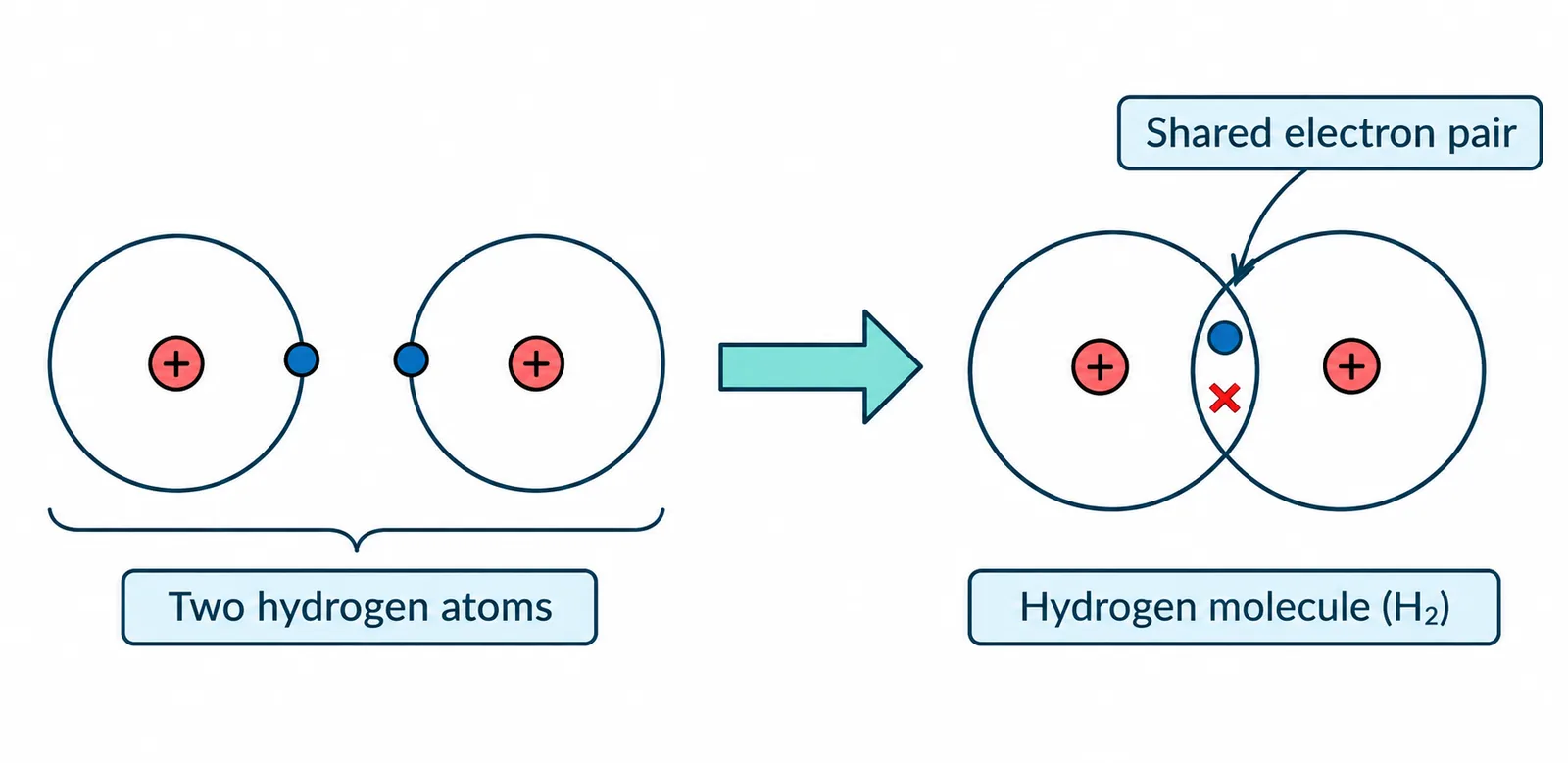

Why more pairs?
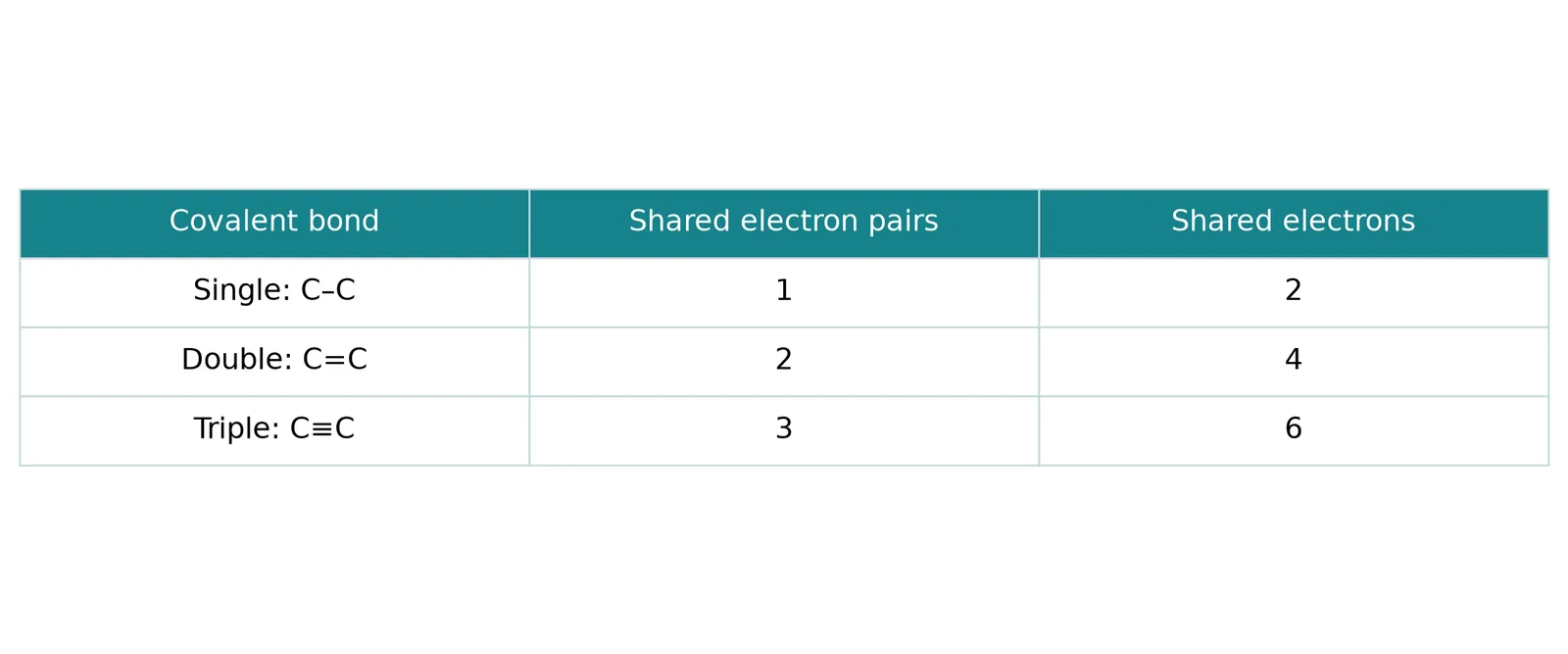
- Why more pairs? Some atoms must share more than one pair of electrons to reach a full outer shell.
Double bond
- Double bond Two adjacent atoms share two pairs of electrons, forming a double covalent bond.
Triple bond
- Triple bond Two adjacent atoms share three pairs of electrons, forming a triple covalent bond.
Section 2 of 6Examples of multiple bonds


| Molecule | Formula | Bonding |
|---|---|---|
| Oxygen | O2 | Each atom has six outer electrons and shares two pairs, giving a double bond |
| Nitrogen | N2 | Each atom has five outer electrons and shares three pairs, giving a triple bond |
| Ethene | C2H4 | The two carbon atoms share two pairs, a double bond, and each also bonds to two hydrogens |
| Carbon dioxide | CO2 | Carbon forms a double bond with each oxygen atom |
| Methanol | CH3OH | All bonds are single: carbon to three hydrogens and to oxygen, then oxygen to hydrogen |
Section 3 of 6Worked example: carbon dioxide
1
Carbon is in Group IV with four outer electrons, and each oxygen is in Group VI with six.
2
Carbon needs to share four electrons and each oxygen needs to share two.
3
Each oxygen shares two pairs with the carbon, forming two double bonds in total, O=C=O.
4
Count the electrons: carbon has eight outer electrons and each oxygen has eight, including its two non-bonded pairs.
5
The molecule is neutral and has no brackets or charges.
Section 4 of 6Choosing the correct type of diagram
Ionic or covalent?
Metal and non-metal
- Metal and non-metal The compound is ionic. Draw separate ions, each in square brackets with its charge.
Non-metals only
- Non-metals only The compound is covalent. Draw overlapping shells containing one or more shared pairs.
Check the shells
- Check the shells In both cases make sure each atom or ion ends with a full outer shell.
Section 5 of 6Key terms
| Term | Meaning |
|---|---|
| Double bond | A covalent bond made of two shared pairs of electrons. |
| Triple bond | A covalent bond made of three shared pairs of electrons. |
| Compound | A substance made of two or more different elements chemically joined together. |
| Ethene | A hydrocarbon with formula C2H4 that has a carbon-carbon double bond. |
| Shared pair | Two electrons, one from each atom, that sit between two nuclei and form a bond. |
Section 6 of 6Exam technique
1
Drawing a double bond with only one pair of electrons. A double bond has two shared pairs, so four electrons.
2
Using the wrong type of diagram, such as ions with brackets for a molecule of non-metals.
3
Forgetting that nitrogen has non-bonded pairs as well as its triple bond.
4
Showing carbon dioxide with single bonds, which leaves carbon and oxygen with incomplete outer shells.