Section 1 of 10Chemical symbols and molecular formulae

Chemical symbol
- Chemical symbol an element is represented by the symbol from the Periodic Table, such as Li, Cr, Al, Ca, Au and S
Diatomic elements
- Diatomic elements seven elements exist as molecules of two atoms: H2, N2, O2, F2, Cl2, Br2 and I2
Molecular formula
- Molecular formula shows the type of atoms by their symbols and the number of atoms by the subscript after each symbol
- No subscript means one atom.
- A subscript after a bracket multiplies every atom inside the bracket.
Deducing a formula
- Deducing a formula count the atoms of each element in a model or diagram of the molecule
- In the diagram of water the two hydrogen atoms are each bonded to the oxygen atom, not joined in a row.
| Substance | Molecular formula | Atoms present |
|---|---|---|
| Hydrogen | H2 | 2 H |
| Chlorine | Cl2 | 2 Cl |
| Water | H2O | 2 H, 1 O |
| Methane | CH4 | 1 C, 4 H |
| Ammonia | NH3 | 1 N, 3 H |
| Sulfuric acid | H2SO4 | 2 H, 1 S, 4 O |
Section 2 of 10Empirical formulae (Extended)


Empirical formula
Empirical formula the simplest whole-number ratio of the atoms of each element in one molecule or formula unit
Organic compounds
- Organic compounds the empirical formula is often different from the molecular formula
- Ethanoic acid is C2H4O2 but its empirical formula is CH2O.
- C2H4 has the empirical formula CH2.
Ionic compounds
- Ionic compounds the chemical formula is always the empirical formula, such as NaCl
Section 3 of 10Formulae of ionic compounds (Extended)
Ionic compounds
- Ionic compounds form when metals and non-metals react, so they are not simple molecules
No overall charge
- No overall charge the positive charge of the ions cancels the negative charge
Ions to know
- H+; Group 1 ions such as Li+, Na+, K+; Group 7 ions F−, Cl−, Br−; Cu2+, Fe2+, Fe3+
Polyatomic ions
- Polyatomic ions carbonate CO32−, sulfate SO42−, hydroxide OH−, nitrate NO3−, ammonium NH4+
1
Write the ions with their charges.
2
Compare the charges and add ions until the total positive charge equals the total negative charge.
3
Or use swap-and-drop: swap the charge numbers between the ions and drop them as subscripts, ignoring the signs and the number 1.
4
If both ions have the same size of charge, give the simplest whole-number ratio.
5
Put brackets around a polyatomic ion when more than one is needed.
Section 4 of 10Word equations
Reactants
- Reactants the substances on the left of the arrow, like the chemical ingredients
Products
- Products the new substances formed, on the right of the arrow
Arrow
- Arrow means ‘to form’ or ‘produces’
- Conditions or the name of a catalyst can be written above the arrow.
Burning in air
- Burning in air means reacting with oxygen, for example carbon + oxygen → carbon dioxide
Example
- Example sodium hydroxide + hydrochloric acid → sodium chloride + water
Order in a sentence
- Order in a sentence the products may be given before the reactants, so check which are formed
Section 5 of 10Symbol equations and state symbols

Symbol equation
- Symbol equation uses the formulae of the reactants and products, with reactants on the left and products on the right
Diatomic non-metals
- Diatomic non-metals write H2, N2, O2, F2, Cl2, Br2 and I2 as molecules
State symbols
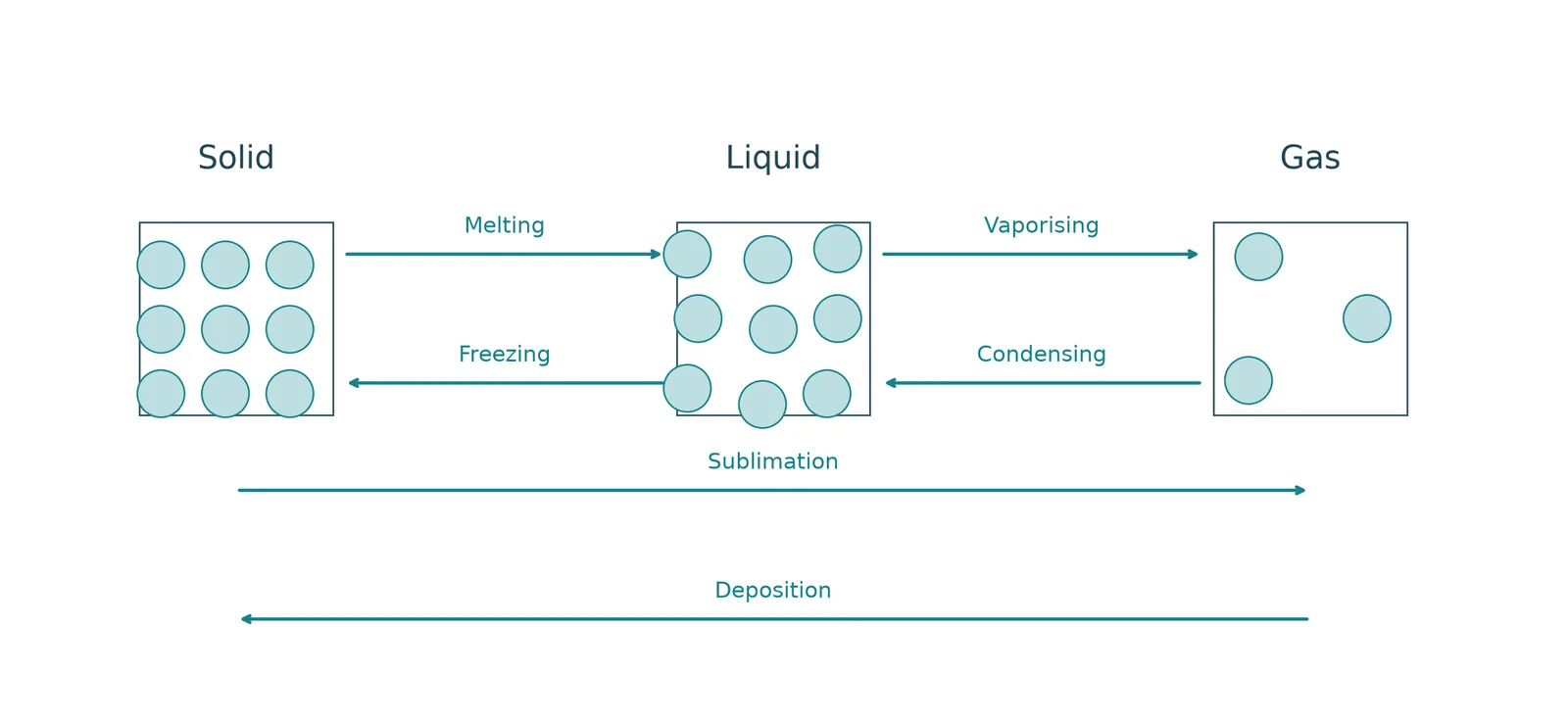
- (s) solid, (l) liquid, (g) gas, (aq) aqueous
- (dissolved in water)
Clues for state
- Clues for state metal compounds and ionic compounds are usually solid unless in solution, non-metal compounds can be solids, liquids or gases,
- and precipitates count as solids
Ethanol
- Ethanol pure ethanol is (l) but ethanol in water is (aq)
Combustion of sulfur
- S(s) + O2(g) → SO2(g)
Section 6 of 10Balancing equations

1Law of conservation of mass
- Law of conservation of mass there must be the same number of atoms of each element on both sides
2Change only coefficients
- Change only coefficients the numbers in front of formulae are changed, never the formulae themselves
1
Write the correct formulae for all reactants and products.
2
Work across from left to right, checking one element after another.
3
Count an unchanged group such as NO3 as one unit.
4
Balance elements that appear on their own last.
5
Check the number of atoms of each element on both sides.
- Deducing equations (Extended)
- work out the formulae from the element, the ion charges and the given states before balancing
- Aluminium burning in chlorine gives 2Al(s) + 3Cl2(g) → 2AlCl3(s).
Section 7 of 10Ionic equations (Extended)
1Dissociation
- Dissociation in aqueous solution ionic compounds separate into ions, such as HCl(aq) → H+(aq) + Cl−(aq)
2Compounds that dissociate
- Compounds that dissociate acids such as HCl and H2SO4, Group 1 and 2 hydroxides and soluble salts
1
Write the full balanced symbol equation.
2
Replace the aqueous ionic compounds with their component ions.
3
Remove the ions that appear on both sides (spectator ions).
4
Include state symbols in the ionic equation.
Section 8 of 10More from the specification
More from the specification
Deducing Formulae from Ionic Charges
- Ionic compounds must be electrically neutral;
- combining magnesium ions (Mg2+) with nitrate ions (NO3−) requires two nitrate ions per magnesium ion,
- giving magnesium nitrate the formula Mg(NO3)2.
Transition Metal Valency and Roman Numerals
- Roman numerals in chemical names denote oxidation states of transition metals,
- such as copper(II) indicating Cu2+ in copper(II) chloride (CuCl2) and iron(III) indicating Fe3+ in iron(III) chloride (FeCl3).
Relative Atomic Mass and Molecular Formulae
- The relative formula mass (Mr) of a compound is calculated by summing the relative atomic masses (Ar) of all constituent atoms shown in its chemical formula.
Section 9 of 10Key terms
| Term | Meaning |
|---|---|
| Compound | Two or more elements chemically joined. |
| Molecular formula | The number and type of atoms in one molecule. |
| Empirical formula | The simplest whole-number ratio of atoms or ions. |
| Subscript | The small number after a symbol that gives how many atoms. |
| Reactant | A substance on the left of the arrow. |
| Product | A substance formed in a reaction. |
Section 10 of 10Exam technique
1
Changing a subscript to balance an equation — change only the coefficients
2
Writing CaOH₂ — use bracketsCa(OH)₂
3
Writing the products before the reactants — reactants go on the left
4
Leaving out state symbols — include (s), (l), (g) or (aq)