Section 1 of 7Oxidation and reduction in terms of electrons (HT only)

Definitions
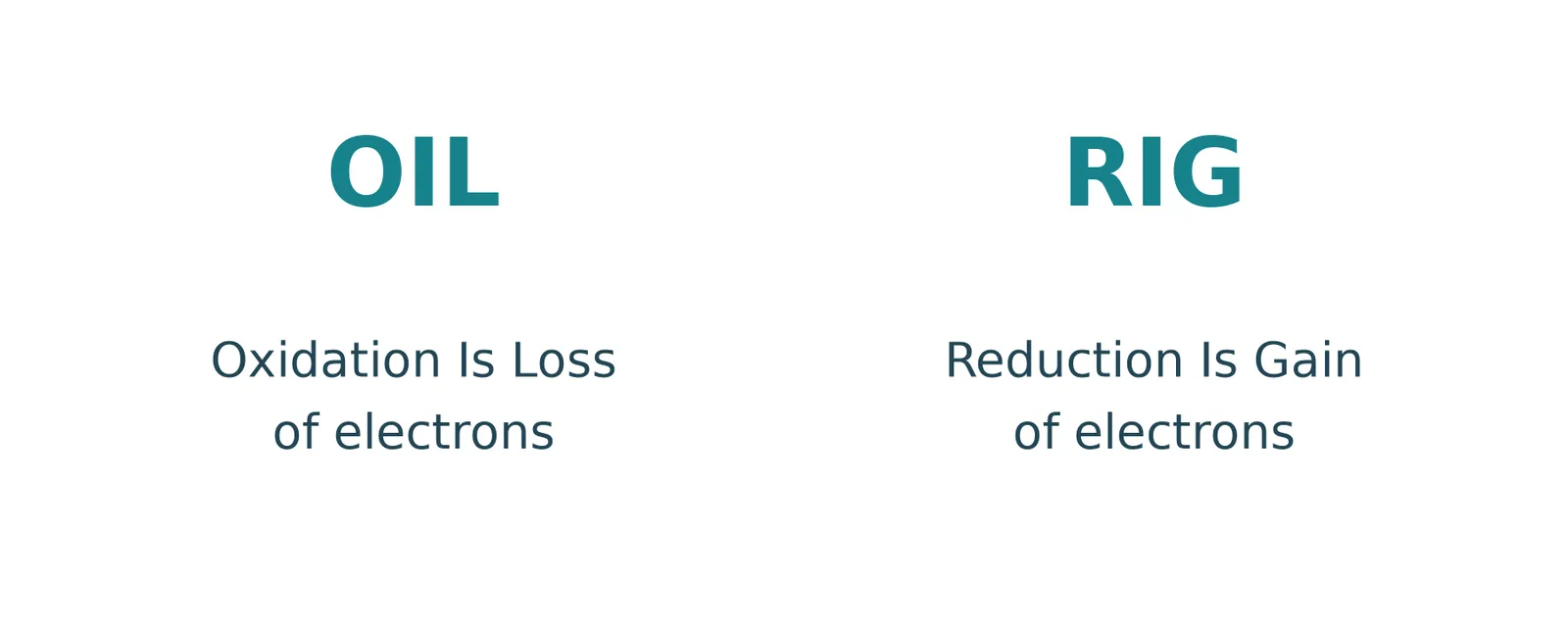
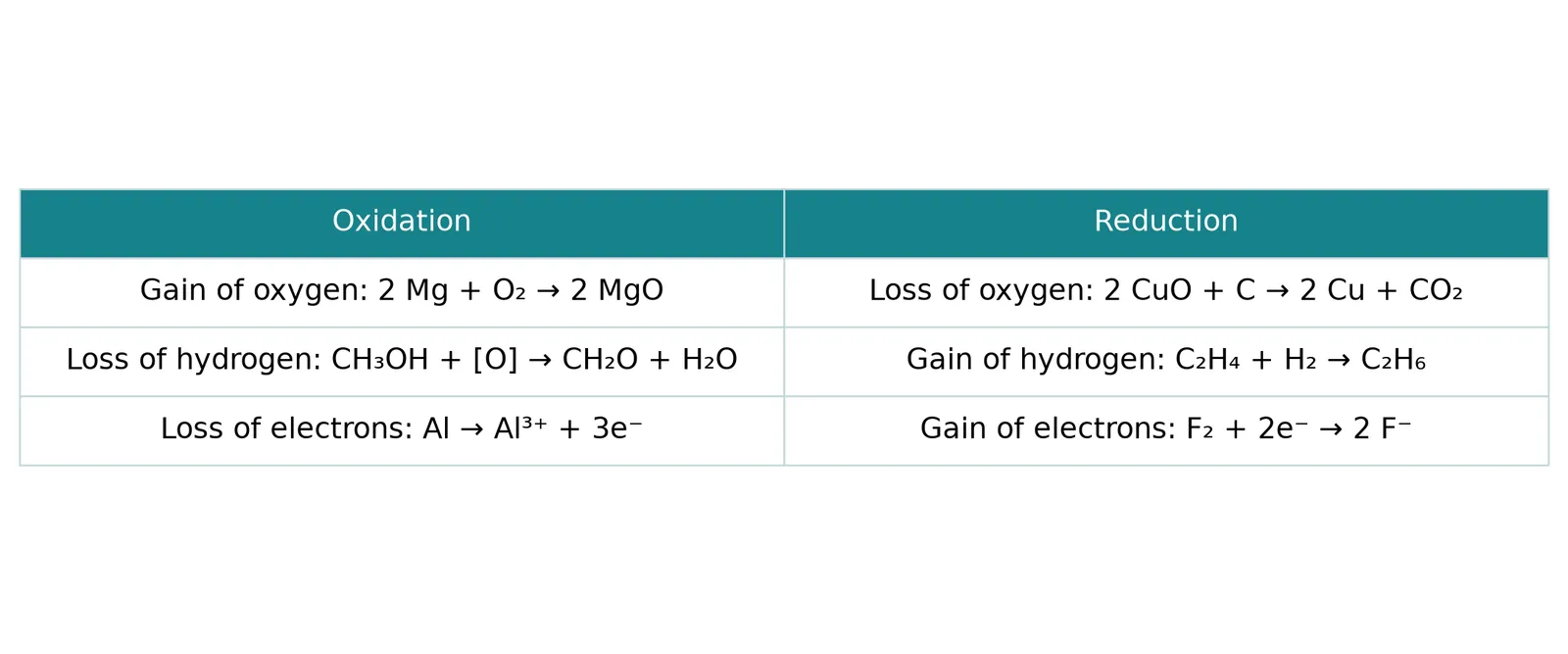
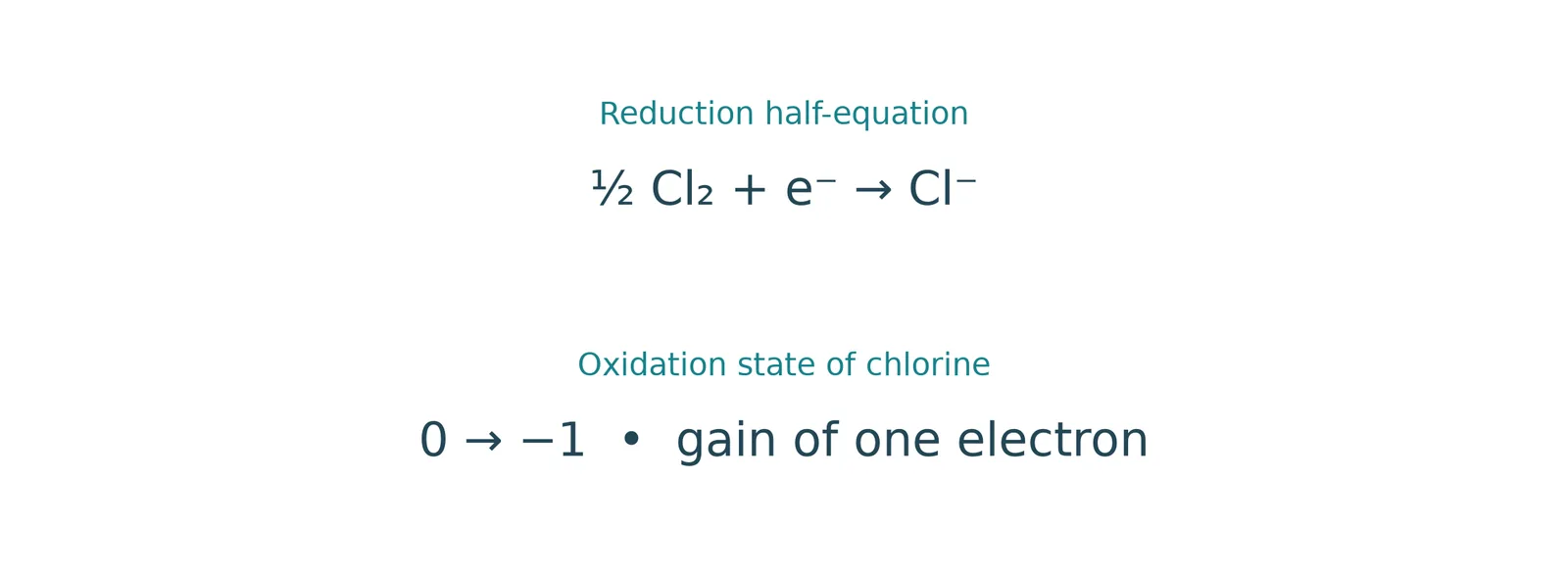
- Definitions Oxidation is the loss of electrons and reduction is the gain of electrons.
- Remember OIL RIG: Oxidation Is Loss, Reduction Is Gain.
- Electrochemistry is about moving electrons, which is why these definitions are used instead of 'gain of oxygen'.
Where each happens
- Where each happens Reduction takes place at the cathode (RED CAT) because positive ions arrive there and gain electrons.
- Oxidation takes place at the anode (AN OX) because negative ions arrive there and lose electrons.
Half equations
- Half equations A half equation shows only one of these changes.
- Both the atoms and the charges must balance, with electrons written as e-.
Section 2 of 7Writing a half equation
1
Decide which electrode you are at and what ion arrives there.
2
Write the ion on the left and the product atom or molecule on the right.
3
Balance the atoms, remembering that H, O, Cl, Br and I leave as diatomic molecules.
4
Add electrons to the correct side so that the total charge is the same on both sides: electrons on the left at the cathode, on the right at the anode.
5
Check both atoms and charges once more.
Section 3 of 7Reactions at the cathode (HT only)
| Ion | Half equation | Type |
|---|---|---|
| Lithium ion | Li+ + e- → Li | Reduction |
| Copper(II) ion | Cu2+ + 2e- → Cu | Reduction |
| Aluminium ion | Al3+ + 3e- → Al | Reduction |
| Hydrogen ion | 2H+ + 2e- → H2 | Reduction |
Section 4 of 7Reactions at the anode (HT only)
| Ion | Half equation | Type |
|---|---|---|
| Chloride ion | 2Cl- → Cl2 + 2e- | Oxidation |
| Bromide ion | 2Br- → Br2 + 2e- | Oxidation |
| Hydroxide ion | 4OH- → O2 + 2H2O + 4e- | Oxidation |
Section 5 of 7Whole-electrolysis examples (HT only)
Link the electrolyte to its half equations
Molten lead(II) bromide
- Molten lead(II) bromide Cathode: Pb2+ + 2e- → Pb. Anode: 2Br- → Br2 + 2e-.
Concentrated aqueous sodium chloride
- Concentrated aqueous sodium chloride Cathode: 2H+ + 2e- → H2. Anode: 2Cl- → Cl2 + 2e-.
Dilute sulfuric acid
- Dilute sulfuric acid Cathode: 2H+ + 2e- → H2. Anode: 4OH- → O2 + 2H2O + 4e-.
Balancing electrons
- Balancing electrons The number of electrons gained at the cathode equals the number lost at the anode,
- so for the same current twice as much hydrogen forms as oxygen.
Section 6 of 7Key terms
| Term | Meaning |
|---|---|
| Oxidation | A reaction in which a species loses electrons. |
| Reduction | A reaction in which a species gains electrons. |
| Half equation | An equation showing the loss or gain of electrons by one species at one electrode. |
| Electron (e-) | A negatively charged particle transferred in oxidation and reduction. |
| Diatomic | Made of two atoms joined together, for example Cl2. |
Section 7 of 7Exam technique
1
Putting electrons on the wrong sideelectrons are gained (left side) at the cathode and lost (right side) at the anode.
2
Writing chlorine as Cl instead of Cl2, which leaves atoms unbalanced.
3
Balancing the atoms but not the charge; the total charge on each side of a half equation must be equal.
4
Mixing up oxidation and reduction; use OIL RIG and RED CAT to check the electrode.