Section 1 of 7Which ions make a solution acidic or alkaline

Acids and H+
- Acids and H+ An acid is a substance that releases hydrogen ions, H+, when it dissolves in water.
- Hydrochloric acid, HCl, is a typical example: in water it separates into H+(aq) and Cl-(aq).
Alkalis and OH-
- Alkalis and OH- An alkali is a soluble base. It releases hydroxide ions, OH-, in water.
- Sodium hydroxide, NaOH, gives Na+(aq) and OH-(aq).
Why this matters
- Why this matters The ions, not the whole compounds, are what give a solution its acidic or alkaline properties and decide how it behaves with an indicator.
Section 2 of 7Neutralisation at the ion level
1
An acid and an alkali are mixed. The acid supplies H+(aq) ions and the alkali supplies OH-(aq) ions.
2
The H+ ions and OH- ions join together in a one-to-one ratio to make water molecules.
3
The ionic equation is the same for every acid-alkali neutralisation: H+(aq) + OH-(aq) → H2O(l).
4
The other ions (for example Na+ and Cl-) stay in solution as spectator ions and form the salt when the water is removed.
5
When exactly enough alkali has been added to use up all the H+, the solution is neutral with a pH of 7.
Section 3 of 7Reading the pH scale
| pH range | Description | Examples |
|---|---|---|
| 0 to 2 | Strong acid | Hydrochloric acid, sulfuric acid |
| 3 to 6 | Weak acid | Ethanoic acid, citric acid |
| 7 | Neutral | Pure water |
| 8 to 11 | Weak alkali | Ammonia solution, sodium hydrogencarbonate |
| 12 to 14 | Strong alkali | Sodium hydroxide, potassium hydroxide |
Section 4 of 7pH and hydrogen ion concentration

pH and H+ concentration
Inverse link
- Inverse link The more hydrogen ions per unit volume, the lower the pH.
- A solution with a high H+ concentration is strongly acidic.
Alkalis
- Alkalis As the concentration of OH- ions rises, the pH rises above 7.
Tenfold steps
- Tenfold steps The scale is logarithmic: each drop of 1 pH unit means the H+ concentration is ten times greater.
- A solution of pH 2 therefore has ten times more H+ than one of pH 3 and a hundred times more than one of pH 4.
Measuring pH
- Measuring pH Universal indicator gives an approximate pH by its colour;
- a pH meter gives a more precise digital reading.
Section 5 of 7Not every acid reaction is neutralisation




Metal plus acid
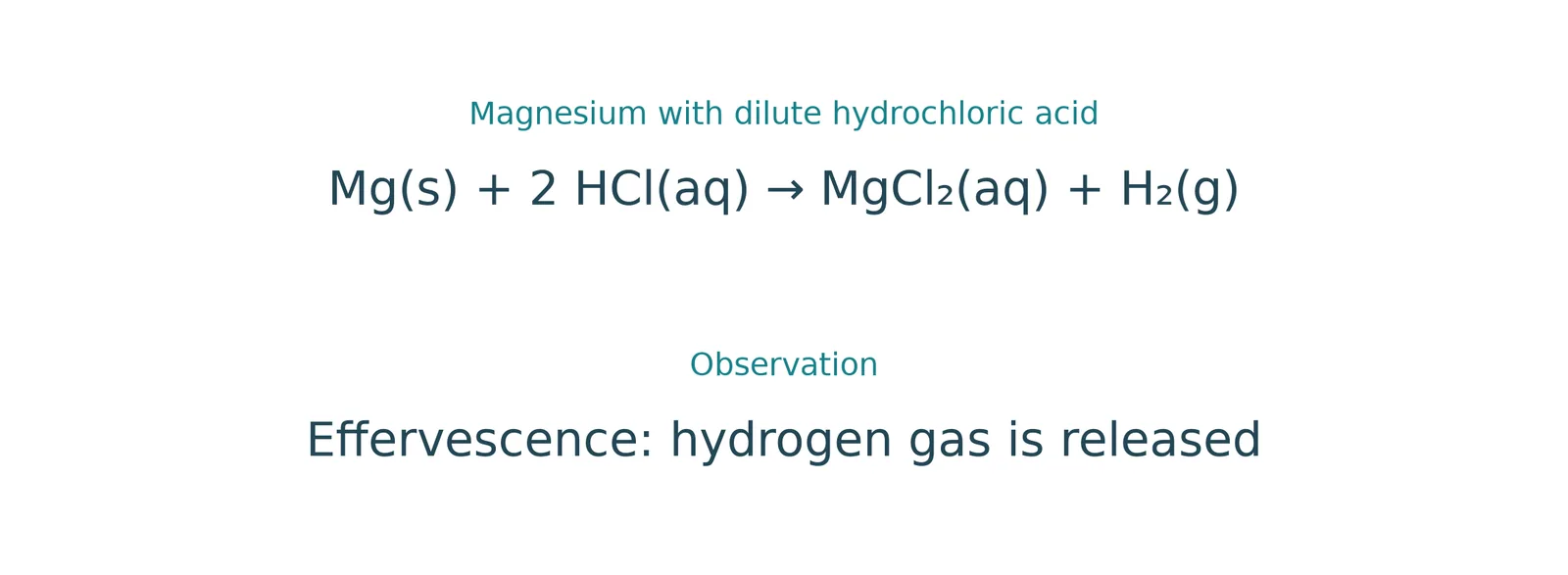
- Metal plus acid Magnesium reacts with hydrochloric acid to form a salt and hydrogen gas, but no water is made.
- Because water is not a product, this is not classed as a neutralisation.
Test for neutralisation
- Test for neutralisation A true neutralisation always involves H+ and OH- (or O2- or CO32- in bases) forming water, and the pH moves towards 7.
Section 6 of 7Key terms
| Term | Meaning |
|---|---|
| Acid | A substance that releases hydrogen ions, H+, in aqueous solution. |
| Alkali | A soluble base that releases hydroxide ions, OH-, in aqueous solution. |
| Neutralisation | The reaction of H+ ions with OH- ions to form water. |
| pH | A number that shows how acidic or alkaline a solution is; it depends inversely on the H+ concentration. |
| Spectator ion | An ion present in the mixture that does not take part in the reaction. |
| Strong acid | An acid with a very low pH (about 0 to 2) because it has a high concentration of H+ ions. |
Section 7 of 7Exam technique
1
Saying that alkalis contain H+ ions. Alkalis are defined by OH- ions; the H+ concentration is simply very low.
2
Thinking pH 3 is only slightly more acidic than pH 4. It has ten times the H+ concentration because the scale is logarithmic.
3
Calling every acid reaction a neutralisation. Metal plus acid makes a salt and hydrogen, not water.
4
Writing the ionic equation without state symbols or with unbalanced charges, such as H + OH → H2O.