Section 1 of 7What a salt is and how to name it
Definition
- Definition A salt is formed when the hydrogen of an acid is replaced by a metal ion or by the ammonium ion.
- Replacing the H in HCl with potassium gives potassium chloride, KCl.
Two-part name
- Two-part name The first part comes from the metal, metal oxide, hydroxide or carbonate used.
- The second part comes from the acid: hydrochloric gives chlorides, sulfuric gives sulfates, nitric gives nitrates.
Uses
- Uses Salts are used in fertilisers, batteries, cleaning products, healthcare products and fungicides.
Section 2 of 7Choosing the method
Preparing a soluble salt
Excess metal
- Excess metal Used for metals that react steadily with dilute acid, such as magnesium and zinc.
Excess insoluble base
- Excess insoluble base Used for oxides and hydroxides that do not dissolve, such as copper(II) oxide.
Excess insoluble carbonate
- Excess insoluble carbonate Used for carbonates such as calcium carbonate or copper(II) carbonate;
- carbon dioxide is given off.
Titration with an alkali
- Titration with an alkali Used when the base is soluble, such as sodium hydroxide, because the excess cannot be filtered off.
Section 3 of 7Method A: using an excess of a solid
1
Warm a measured volume of dilute acid in a beaker.
2
Add the metal, insoluble base or carbonate a little at a time, stirring, until some solid no longer reacts and stays at the bottom. This shows the solid is in excess and all the acid has been used.
3
Filter the mixture to remove the excess solid. The filtrate is the salt solution.
4
Pour the filtrate into an evaporating basin and heat gently to evaporate some of the water.
5
Test for saturation by dipping a cold glass rod in; crystals forming on it show the solution is ready.
6
Leave the solution to cool and crystallise slowly in a warm place, then pour off the leftover liquid.
7
Dry the crystals between sheets of filter paper.
Section 4 of 7Method B: titration with a soluble alkali
1
Use a pipette to place an exact volume of alkali into a conical flask and add a few drops of indicator.
2
Add acid from a burette until the indicator just changes colour. Record the volume needed.
3
Repeat the experiment with the same volumes of acid and alkali but without the indicator, because the indicator would contaminate the salt.
4
Evaporate part of the water, leave to crystallise, then filter and dry the crystals as in Method A.
Section 5 of 7Example reactions


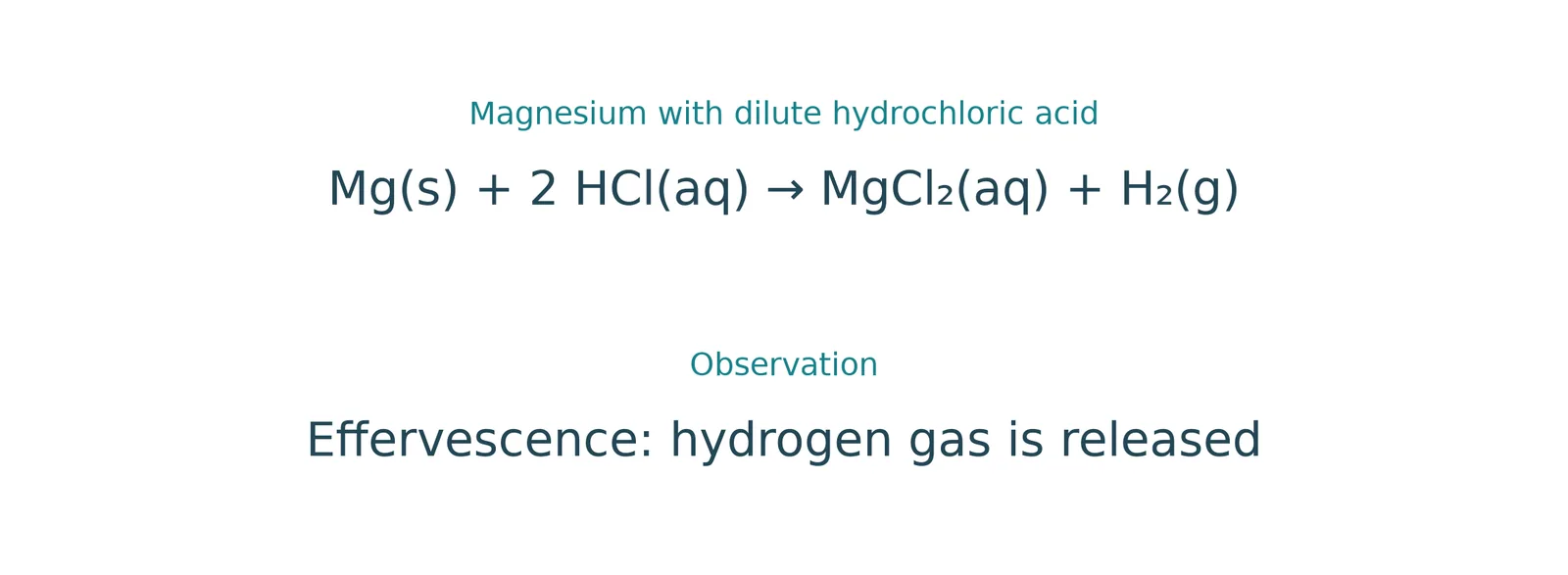

| Reactants | Salt formed | Word or symbol equation |
|---|---|---|
| Magnesium + sulfuric acid | Magnesium sulfate | Mg + H2SO4 → MgSO4 + H2 |
| Copper(II) oxide + sulfuric acid | Copper(II) sulfate | CuO + H2SO4 → CuSO4 + H2O |
| Zinc carbonate + hydrochloric acid | Zinc chloride | ZnCO3 + 2HCl → ZnCl2 + H2O + CO2 |
| Sodium hydroxide + hydrochloric acid | Sodium chloride | NaOH + HCl → NaCl + H2O |
Section 6 of 7Key terms
| Term | Meaning |
|---|---|
| Salt | A compound formed when the hydrogen of an acid is replaced by a metal or ammonium ion. |
| Excess | More of a reactant than is needed, so some is left over when the reaction finishes. |
| Filtrate | The liquid that passes through the filter paper. |
| Saturated solution | A solution that cannot dissolve any more solute at that temperature. |
| Crystallisation | The formation of solid crystals as a hot, concentrated solution cools. |
Section 7 of 7Exam technique
1
Adding an excess of the acid instead of the solid. The excess solid can be filtered off, but excess acid would contaminate the salt.
2
Evaporating the solution to dryness, which can decompose the salt and gives poor crystals. Stop when the solution is saturated and let it crystallise.
3
Using the filtration method for sodium or potassium hydroxide. These are soluble, so titration is needed.
4
Keeping the indicator in the final mixture used to make crystals. The titration must be repeated without it.