Unit 8 · Lesson 8.2.3
Group VII Displacement Reactions
Predict and explain displacement reactions between halogens and halide solutions, using colour changes, reactivity trends and ionic equations.
Reactivity of the halogens
Trend in reactivity
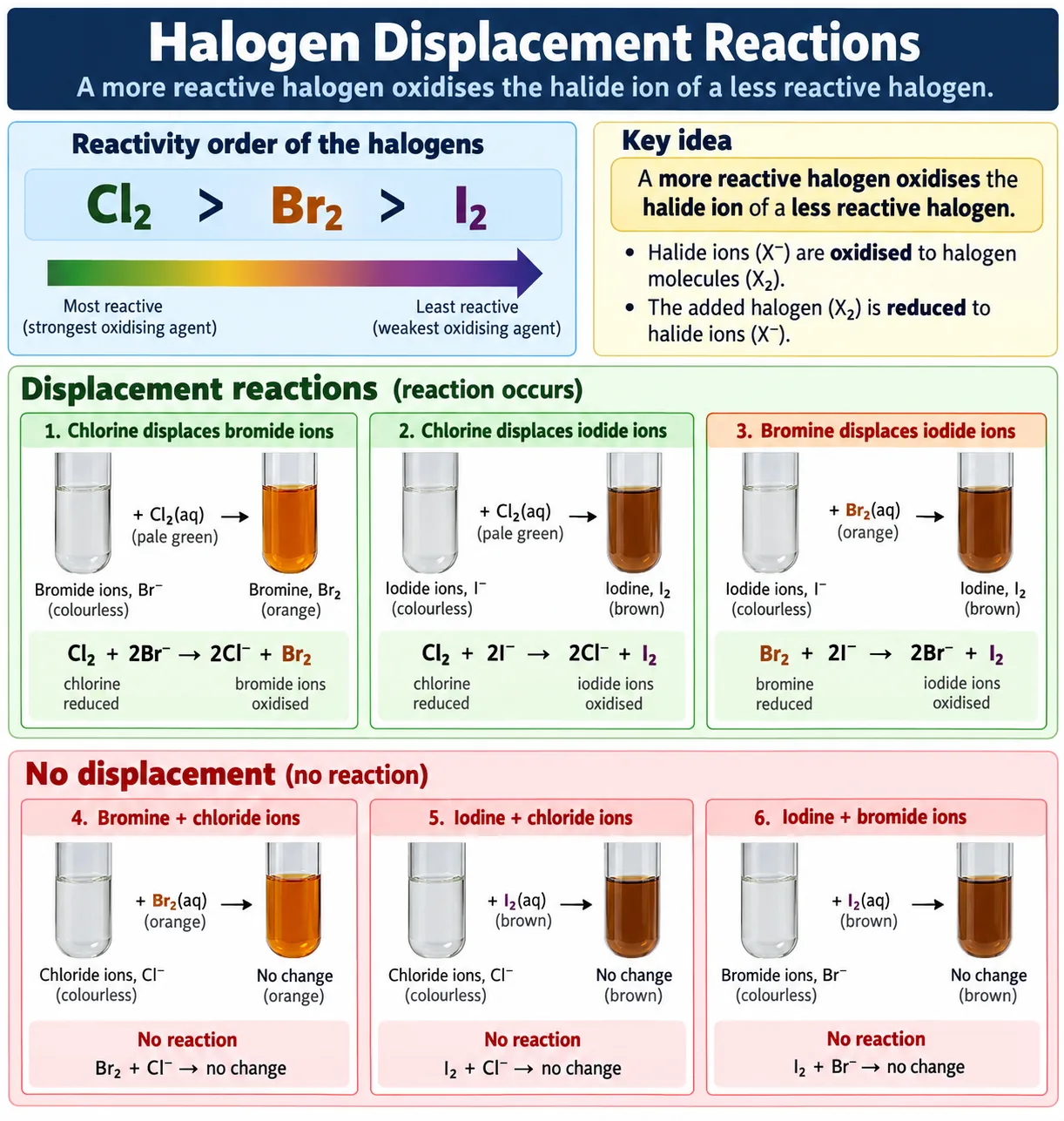
- Trend in reactivity Reactivity of the Group VII elements decreases down the group: chlorine is more reactive than bromine,
- which is more reactive than iodine.
- Smaller atoms attract an extra electron more strongly because the outer shell is closer to the nucleus.
What displacement means
- What displacement means A more reactive halogen takes the place of a less reactive halogen in a solution of its halide salt.
- The less reactive halogen is released as the free element.
Colours in water
- Colours in water Chlorine solution is colourless or very pale green, bromine solution is orange (yellow when dilute) and iodine solution is brown.
Carrying out the test
1
Pour about 2 cm3 of a halide solution (KCl, KBr or KI) into each of three test tubes.
2
Add a few drops of one halogen solution to each tube and shake gently.
3
Look for a colour change and record it. A change shows that displacement occurred; no change means no reaction.
4
Repeat with the other halogen solutions, wearing eye protection and working in a ventilated area because chlorine and bromine are toxic.
Results grid
| Chlorine | Bromine | Iodine | |
|---|---|---|---|
| Potassium chloride | No reaction | No reaction | No reaction |
| Potassium bromide | Orange: bromine made | No reaction | No reaction |
| Potassium iodide | Brown: iodine made | Brown: iodine made | No reaction |
Equations
Chlorine and potassium bromide
- Chlorine and potassium bromide 2KBr(aq) + Cl2(aq) → 2KCl(aq) + Br2(aq)
- The solution changes from colourless to orange.
Bromine and magnesium iodide
- Bromine and magnesium iodide MgI2(aq) + Br2(aq) → MgBr2(aq) + I2(aq)
- The solution becomes brown.
Ionic form (HT only)
- Ionic form (HT only) 2Br-(aq) + Cl2(aq) → 2Cl-(aq) + Br2(aq).
- The potassium ions are spectators and do not appear.
Why displacement happens (HT only)
1Stronger electron attraction
- Stronger electron attraction The more reactive halogen has a greater tendency to gain electrons.
2Electrons transferred
- Electrons transferred Halide ions of the less reactive halogen lose electrons to it.
3Oxidation and reduction
- Oxidation and reduction The halide ion is oxidised to the element; the reacting halogen is reduced to its halide ion.
4New halogen appears
- New halogen appears The element formed is seen by its colour, confirming the order of reactivity.
Key terms
| Term | Meaning |
|---|---|
| Displacement reaction | A reaction in which a more reactive element replaces a less reactive one from a compound. |
| Halide | A compound or ion containing a halogen, such as bromide Br-. |
| Oxidation | Loss of electrons. |
| Reduction | Gain of electrons. |
| Aqueous | Dissolved in water. |
Avoid these mistakes
1
Saying a halogen displaces a more reactive halide. A halogen only displaces halides of halogens below it in the group.
2
Writing that chlorine displaces chloride. There is no reaction because it is the same halogen.
3
Mixing up the colours: bromine is orange or yellow, iodine is brown.
4
Forgetting to balance the equation, such as writing KBr + Cl2 → KCl + Br2 without the 2s.