Section 1 of 6What is an addition reaction?

The idea
- The idea Alkenes are reactive because of the C=C double bond.
- In an addition reaction, atoms from a small molecule add across this bond.
What changes
- What changes One of the two bonds in C=C breaks, the carbons become joined by a single bond, and new single bonds form to the added atoms.
- Only one product is made, which is why addition reactions make no waste by-product.
Section 2 of 6Three addition reactions of ethene


| Reactant | Conditions | Product | Equation |
|---|---|---|---|
| Bromine | Room temperature | 1,2-dibromoethane (saturated) | C2H4 + Br2 → C2H4Br2 |
| Hydrogen | Nickel catalyst, heated | Ethane (an alkane) | C2H4 + H2 → C2H6 |
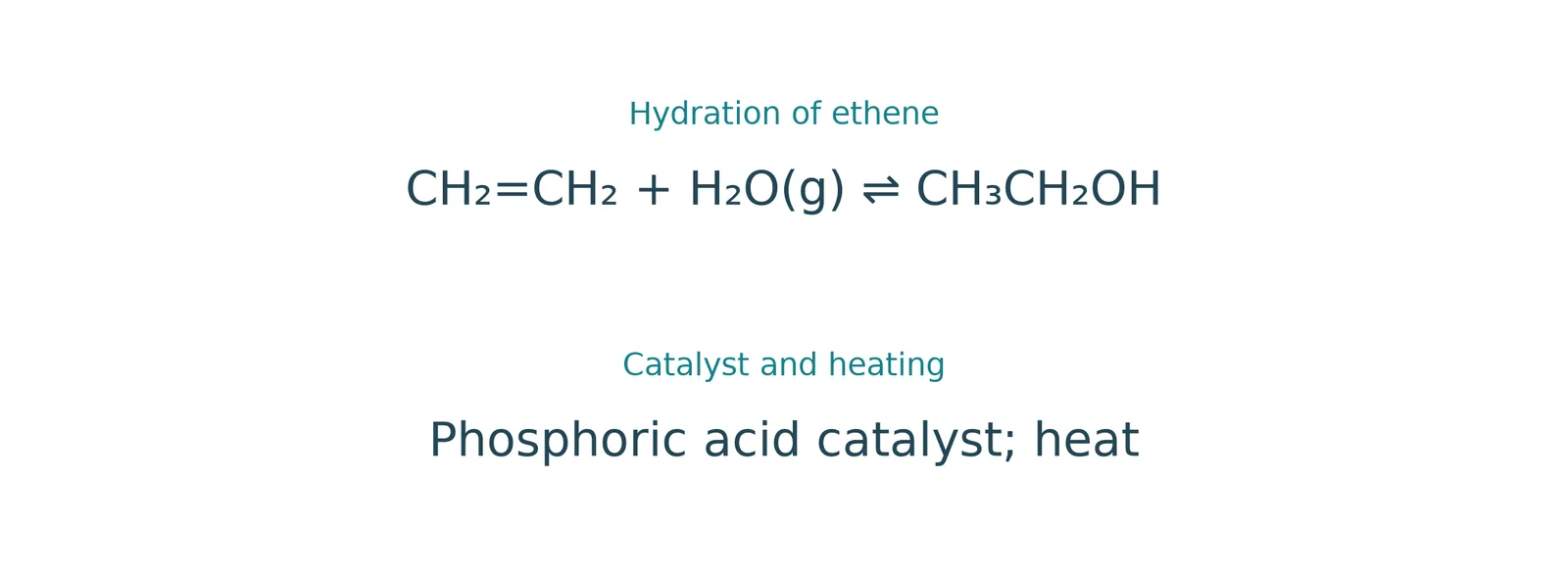
| Steam (hydration) | Acid catalyst, high temperature and pressure | Ethanol (an alcohol) | C2H4 + H2O → C2H5OH |
Section 3 of 6Testing for an alkene with bromine water
1
Add a few drops of orange aqueous bromine to a sample of the unknown compound and shake.
2
If the compound is an alkene, the bromine adds across the C=C bond and is used up.
3
The mixture changes from orange to colourless, which shows the compound is unsaturated.
4
A saturated alkane has no double bond, so the bromine water stays orange.
Section 4 of 6Other alkenes behave in the same way
Propene, C3H6
With hydrogen
- With hydrogen Propene + hydrogen → propane, using a nickel catalyst.
With steam
- With steam Propene + steam → propanol, using an acid catalyst.
With bromine
- With bromine Propene decolourises bromine water and gives a saturated dibromo compound.
Section 5 of 6Key terms
| Term | Meaning |
|---|---|
| Addition reaction | A reaction in which atoms add across a C=C double bond to give a single product. |
| Hydrogenation | The addition of hydrogen to an alkene to form an alkane. |
| Hydration | The addition of water (steam) to an alkene to form an alcohol. |
| Bromine water | An orange solution used to test for C=C double bonds. |
| Catalyst | A substance that speeds up a reaction without being used up. |
Section 6 of 6Exam technique
1
Saying bromine water turns 'clear'. The correct description is that it goes from orange to colourless.
2
Writing that the bromine water is 'bleached'. Bleaching is a different process, so use the word decolourised.
3
Forgetting the catalystsnickel for hydrogenation and an acid catalyst for hydration.
4
Believing the double bond is removed entirely. One bond of the pair breaks and a single bond remains.
5
Giving two products for an addition reaction. There is only one.