11.3.2Organic Chemistry
Addition and Condensation Polymers
5 min read 5 parts Lesson 12 of 12 2 quizzes
Section 1 of 5Addition polymerisation

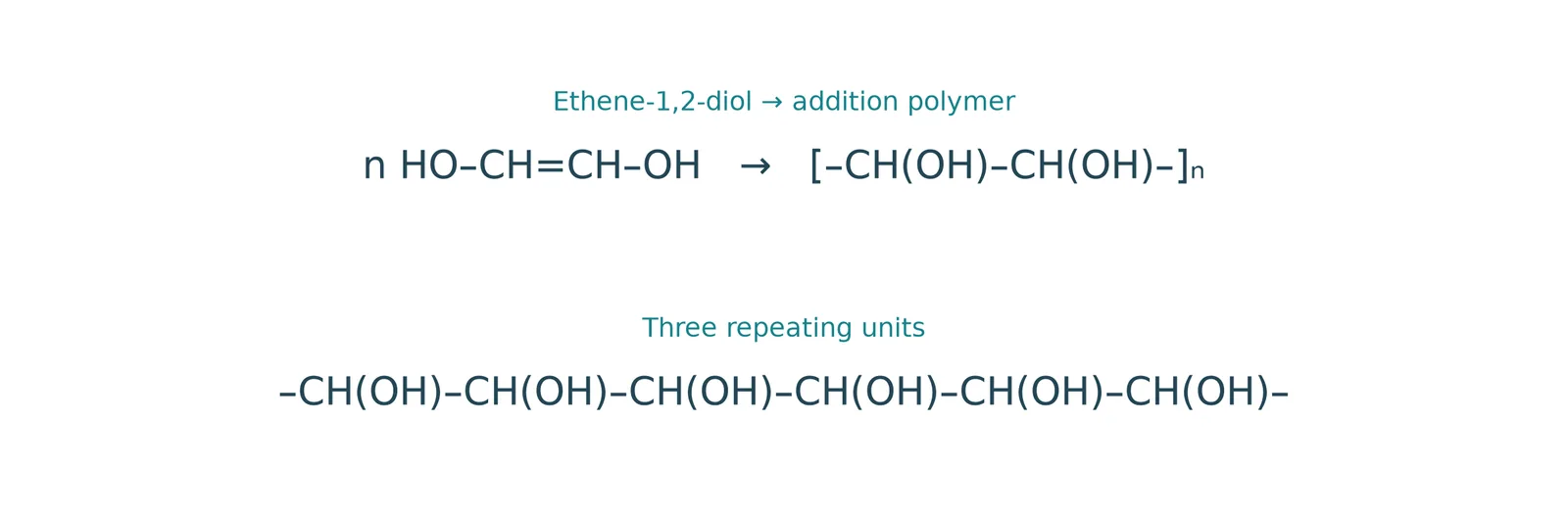

- Addition polymersformed when many identical alkene monomer molecules join together by opening their carbon-carbon double bonds.
- Only one product (the polymer) is formed; 100% atom economy.
- Poly(ethene)
- made from ethene monomers (n C2H4 → -[CH2-CH2]n-).
- Used in plastic bags, bottles, and packaging films.
- Poly(propene)
- made from propene monomers.
- Hard, flexible, used in ropes, carpets, and crate packaging.
- Poly(chloroethene) (PVC)tough, electrical insulator, used in water pipes and electrical wire coating.
- Poly(tetrafluoroethene) (PTFE / Teflon)slippery, non-stick, chemically inert, used in non-stick frying pans and chemical seals.
Section 2 of 5Condensation polymerisation
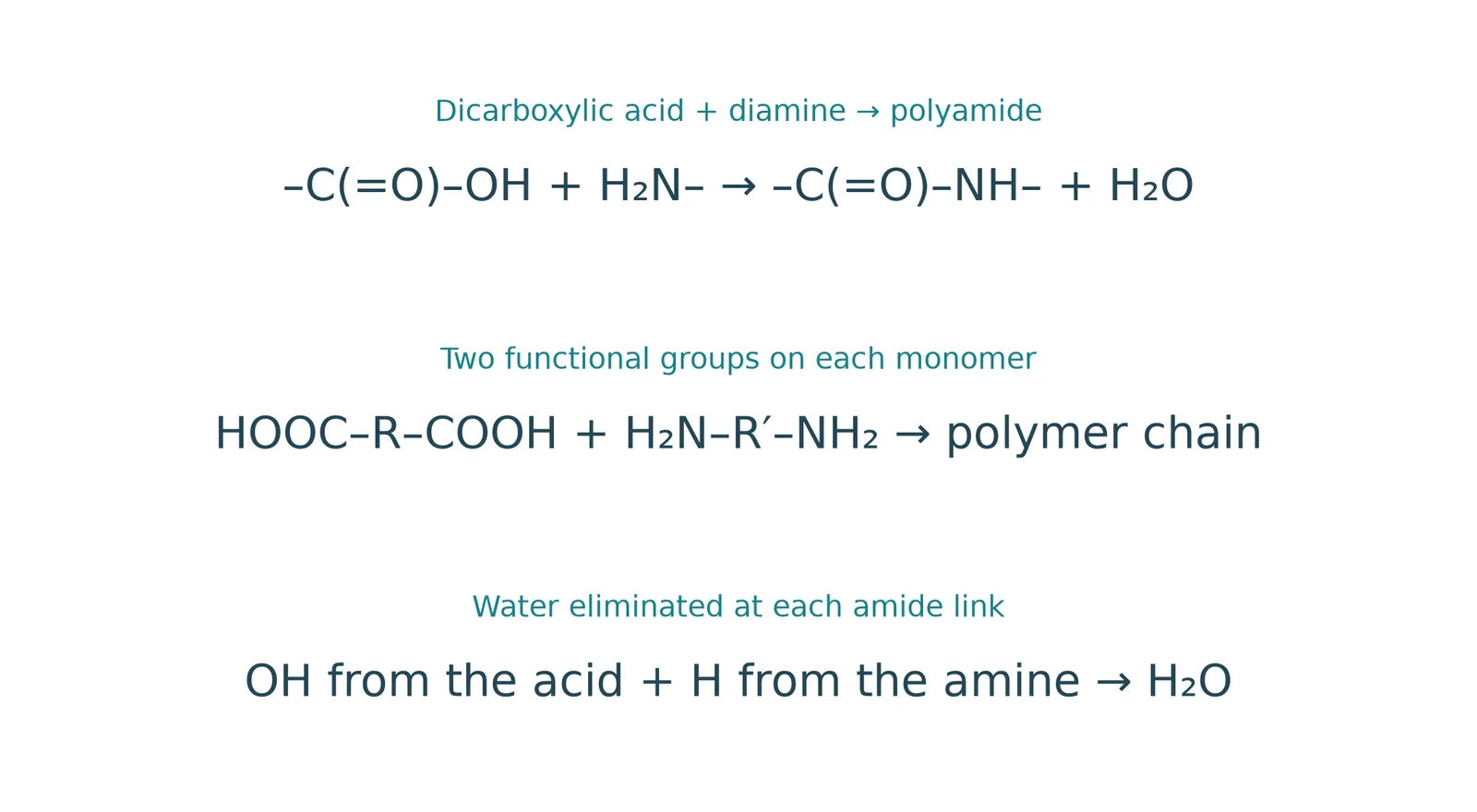

- Condensation polymersformed when monomer molecules with two functional groups react together, eliminating a small molecule (usually water, H2O) at each bond formation.
Type Description Polyesters formed by reacting a dicarboxylic acid (two -COOH groups) with a diol (two -OH groups) forming ester linkages (-COO-). Polyamides formed by reacting a dicarboxylic acid with a diamine (two -NH2 groups), eliminating water to form amide linkages (e.g. nylon).
Section 3 of 5Naturally occurring polymers
| Natural Polymer | Monomer Subunit | Biological Function and Structure |
|---|---|---|
| DNA (Deoxyribonucleic acid) | Nucleotides (phosphate, deoxyribose sugar, base: A, T, C, G) | Encodes genetic instructions; forms a double helix of two polymer strands |
| Proteins | Amino acids (containing -NH2 and -COOH) | Catalysis (enzymes), muscle structural tissue, antibodies, transport |
| Starch & Cellulose | Glucose (C6H12O6) | Energy storage in plants (starch); structural cell walls (cellulose) |
Section 4 of 5Key terms
| Term | Meaning |
|---|---|
| Monomer | A small reactive molecule that can join with other monomers to form a repeating polymer chain. |
| Polymer | A very large macromolecule composed of many repeating small structural units bonded together. |
| Condensation polymerisation | A reaction linking bifunctional monomers while eliminating small molecules such as water. |
| Nucleotide | The repeating monomer unit of nucleic acids consisting of a sugar, phosphate, and nitrogenous base. |
Section 5 of 5Exam technique
Avoid these mistakes
Drawing double bonds in the repeating unit of an addition polymer — the double bond breaks during polymerisation to form single bonds extending out through the brackets.
Forgetting that condensation polymerisation produces a small by-product (water) alongside the polymer chain.