Section 1 of 9Why a nervous system?


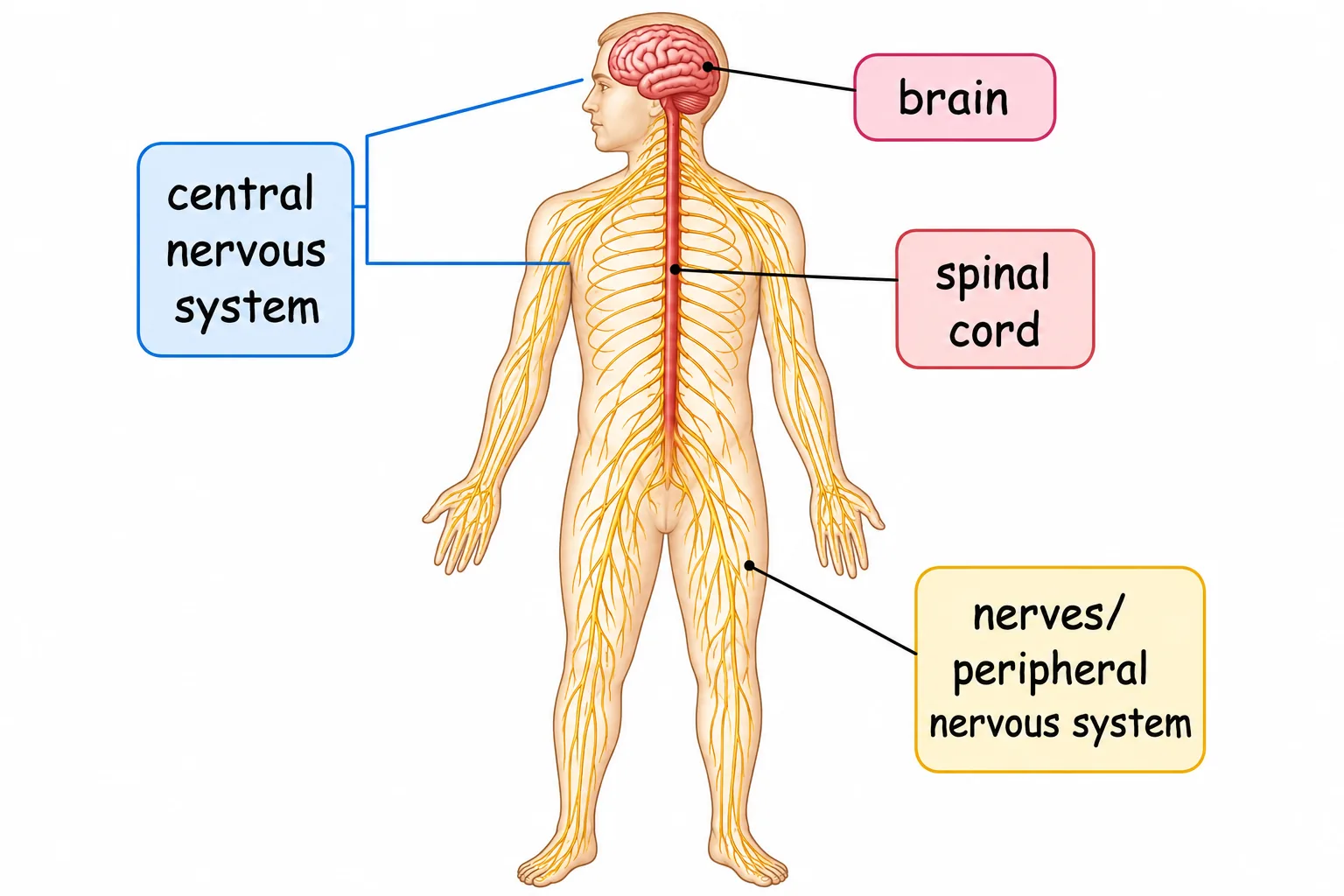
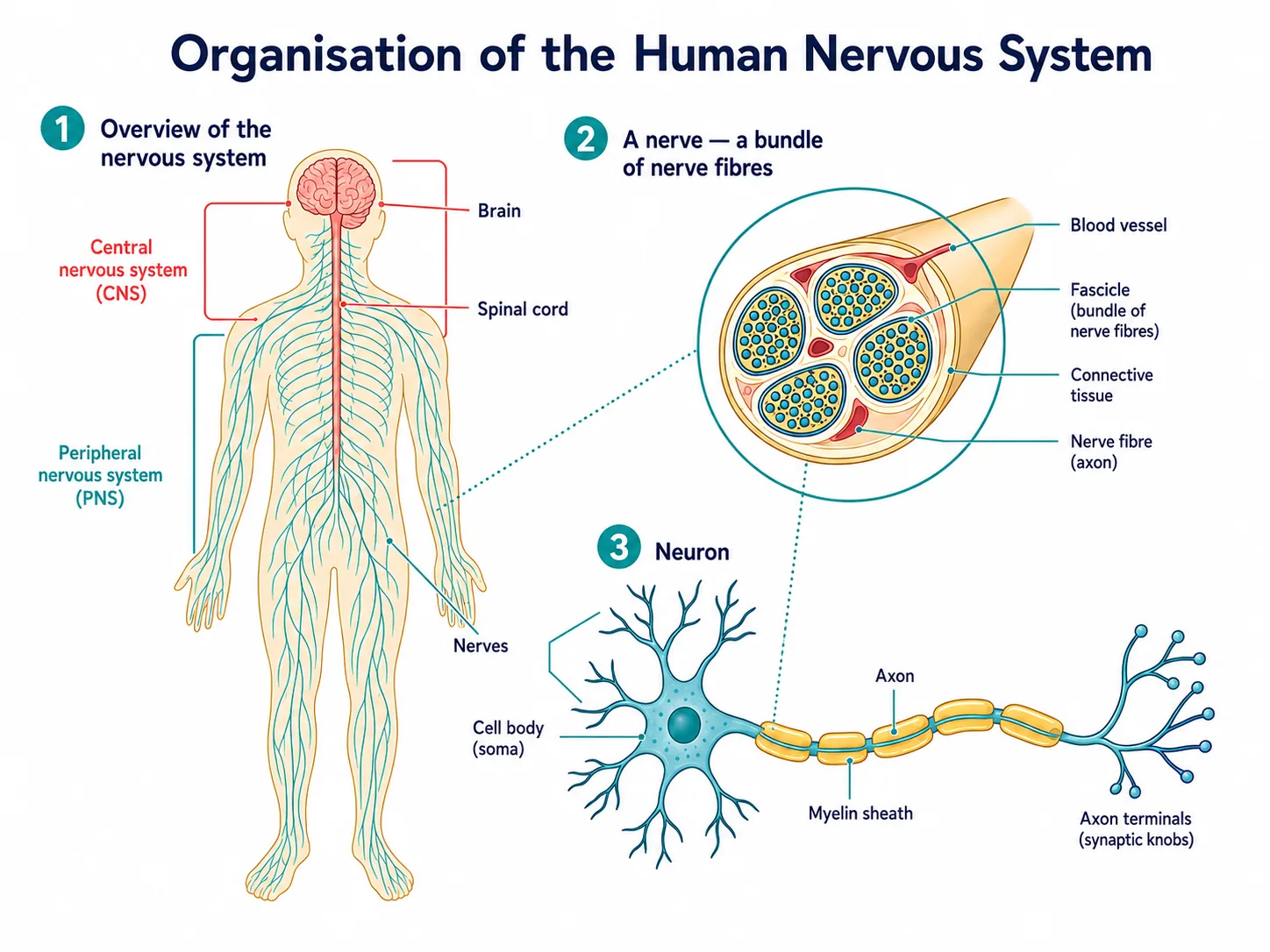
Organisms need to detect changes in their surroundings and respond to them so they can find food, avoid danger and keep conditions inside the body stable.
- which is the brain and spinal cord, and the peripheral nervous system,
- which is the nerves that run between the CNS and the rest of the body.
A change in the environment is a stimulus. Examples include light, sound, touch, temperature, chemicals and pressure.
Section 2 of 9Receptors and effectors

Receptors are cells or organs that detect stimuli and convert them into electrical impulses. Different receptors respond to different stimuli, as in the table.
| Receptor | Stimulus detected |
|---|---|
| Light receptors in the retina | Light |
| Sound receptors in the cochlea | Sound vibrations |
| Touch, pressure and pain receptors in the skin | Contact, pressure, damage |
| Temperature receptors in the skin | Heat and cold |
| Taste buds and smell receptors | Chemicals |
Effectors are the parts of the body that respond to the stimulus. Muscles contract and glands secrete hormones or other substances, such as sweat or saliva. A response can therefore be a movement or a secretion.
Section 3 of 9The three types of neurone
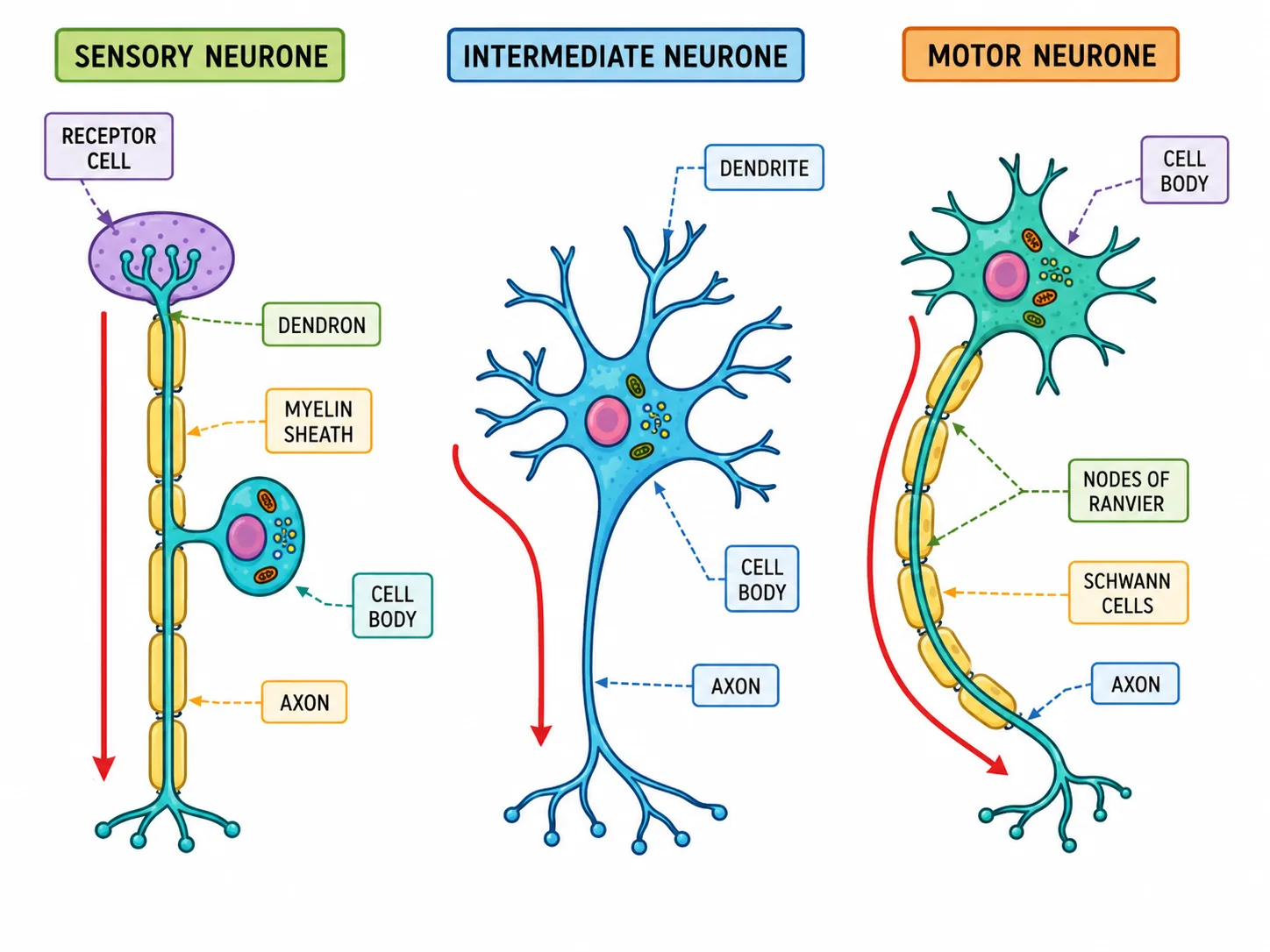
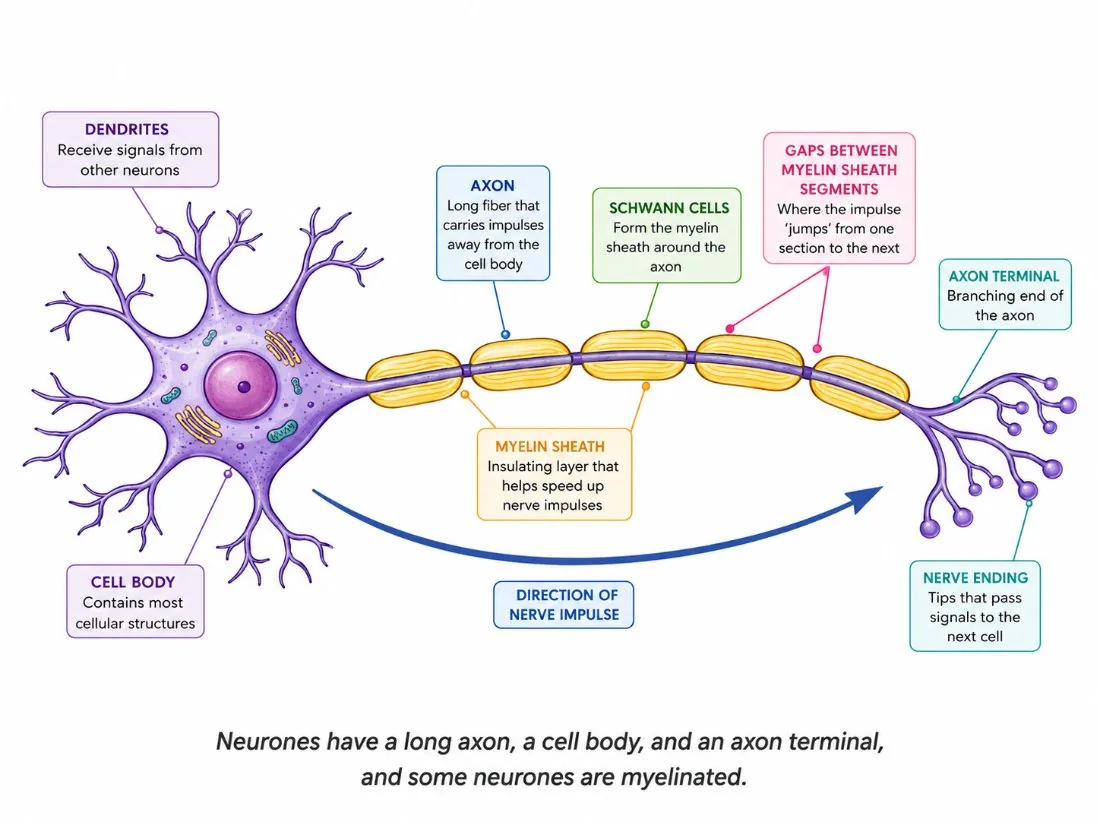
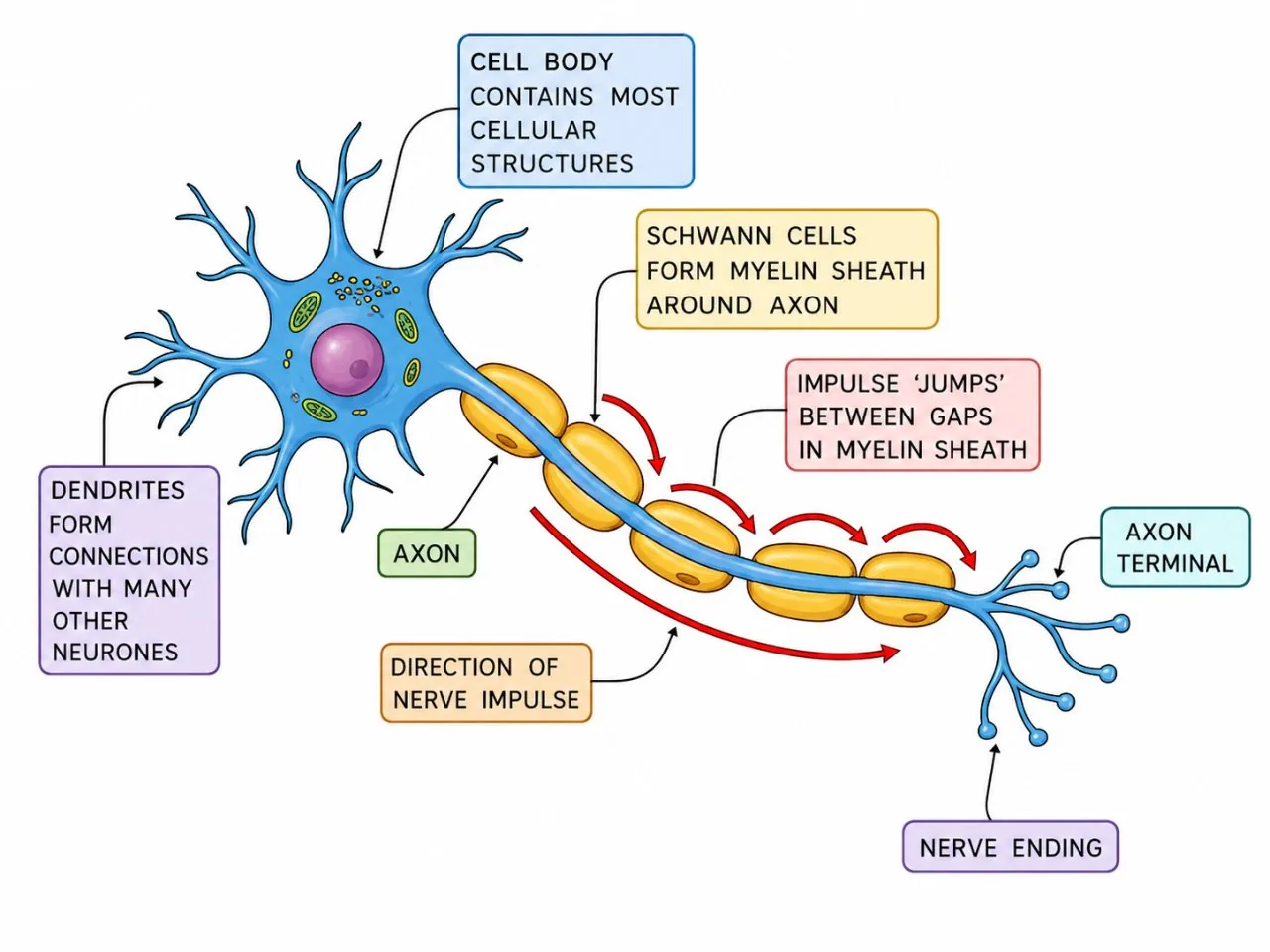
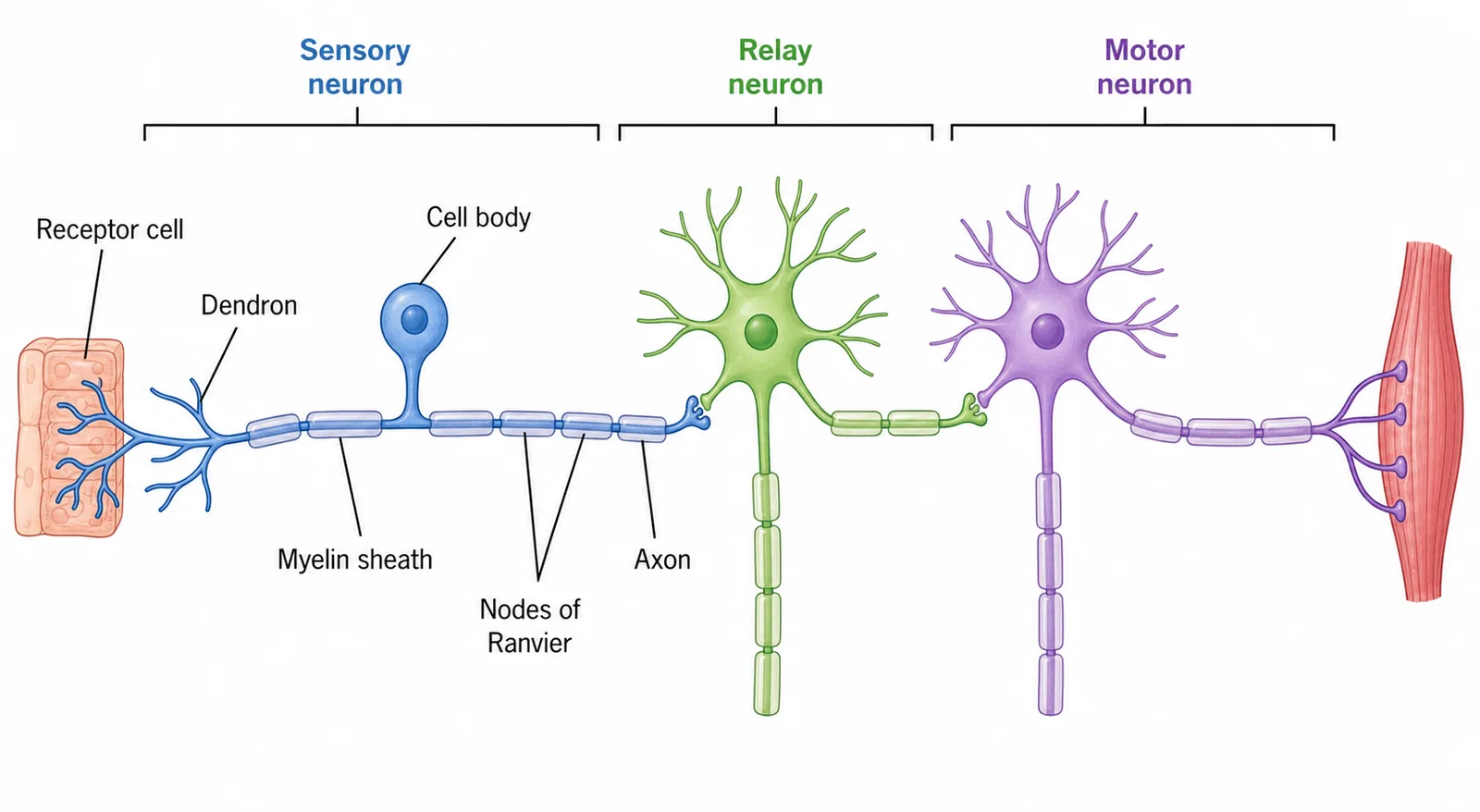

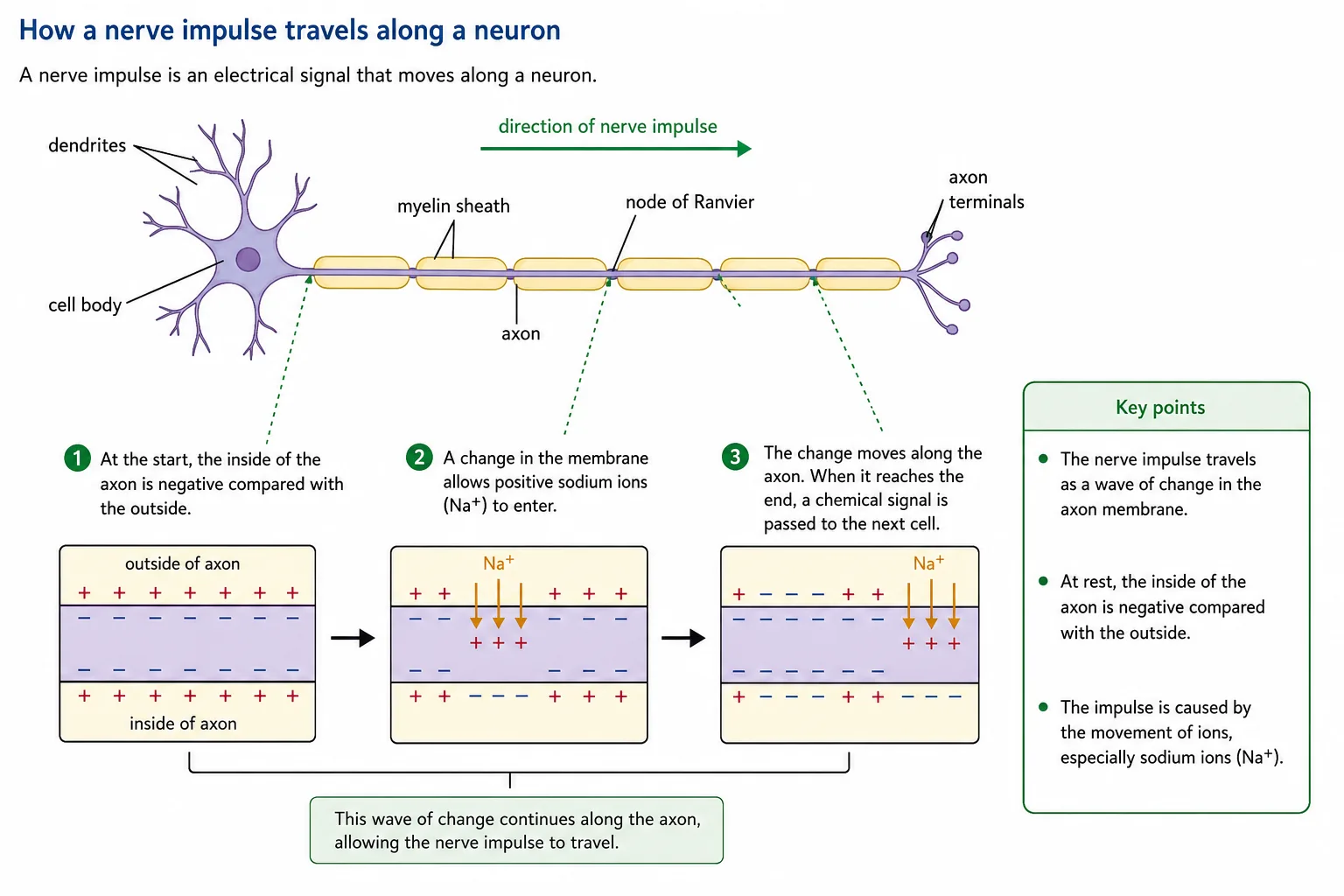
A neurone has a cell body with a nucleus, branching dendrites that receive signals, and a long fibre called an axon that carries impulses.
Section 4 of 9The pathway of a response
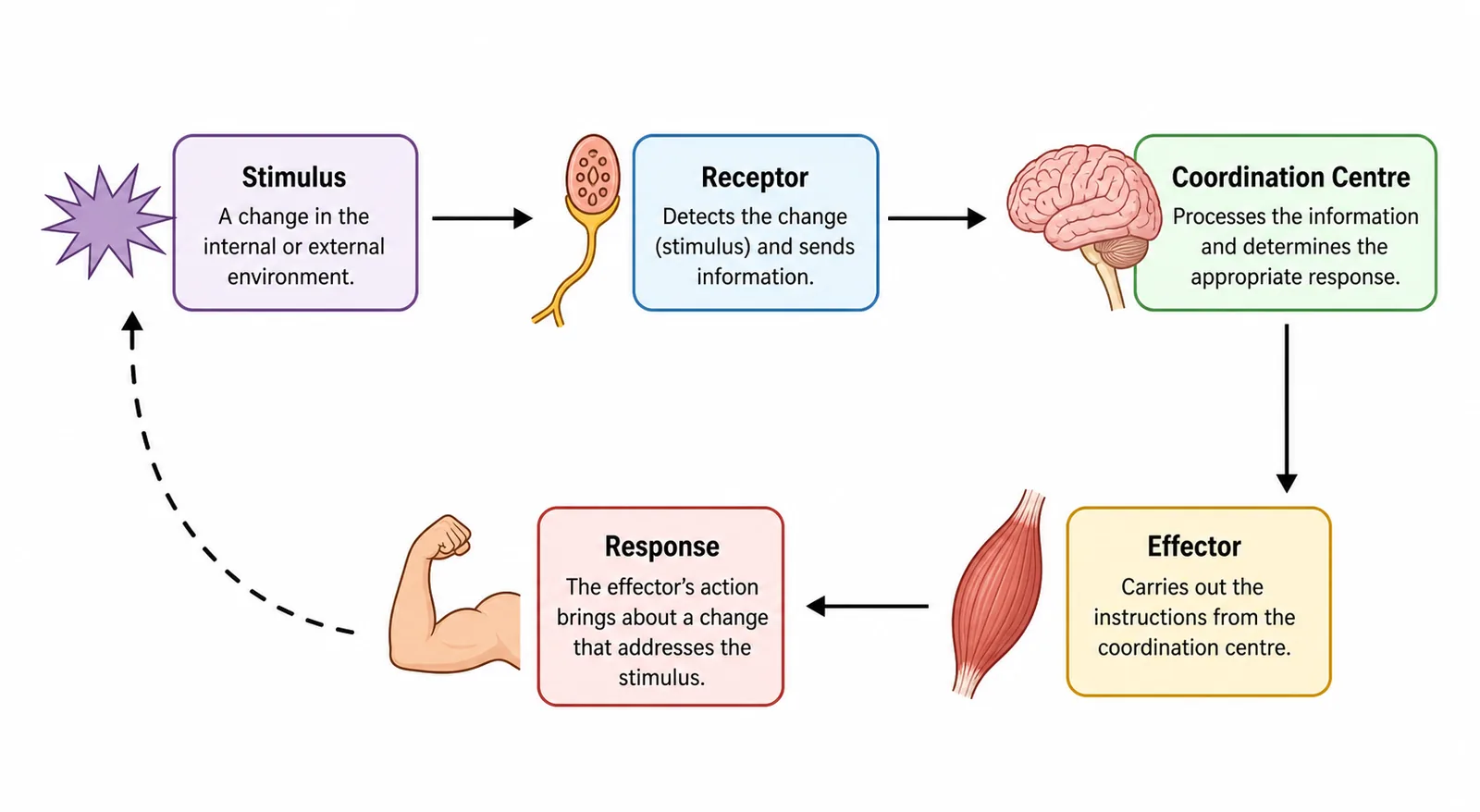


The sequence for a voluntary response is: stimulus, receptor, sensory neurone, CNS (brain and spinal cord), motor neurone, effector, response. For example, if a person hears a shout, sound receptors in the ear detect the vibrations, sensory neurones carry impulses to the brain, the brain processes the information and decides what to do, and motor neurones carry impulses to muscles in the neck so the head turns.
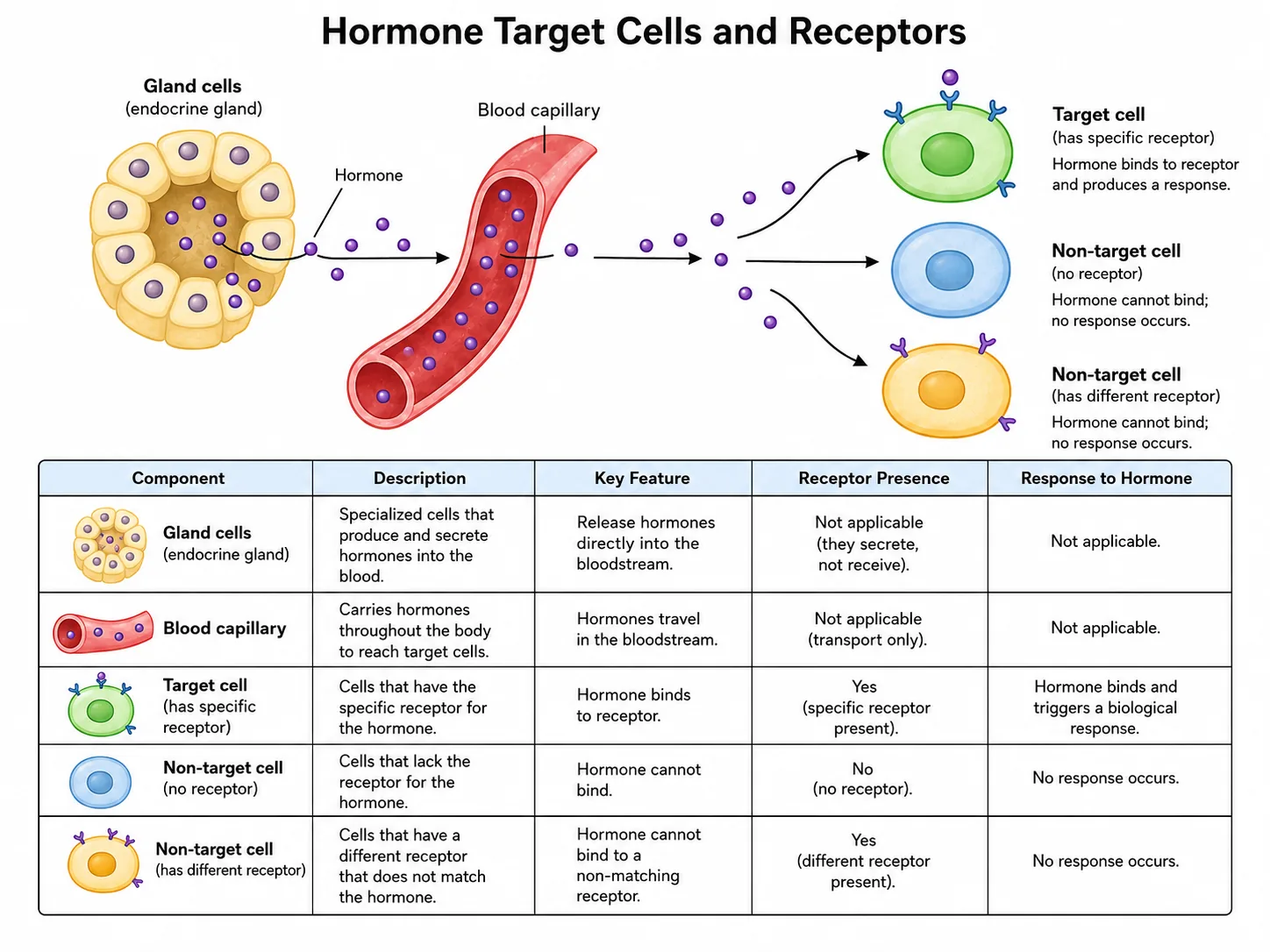
Nervous responses are fast because impulses travel in milliseconds, and they are usually short-lived and precise, acting on a very specific effector. This contrasts with hormonal responses, which are slower, longer-lasting and often widespread, carried in the blood. You should compare these two systems in an examination.
Section 5 of 9Voluntary and involuntary responses
Voluntary responses are under conscious control and involve the cerebral cortex, for example deciding to pick up a pen. Involuntary (automatic) responses happen without conscious thought, such as the control of heart rate by the medulla, or reflex actions. Reflexes are especially fast because the impulse passes through the spinal cord or lower brain without waiting for a decision from the higher brain, as the topic on the reflex arc explains.
Damage to nerves or to the spinal cord can cut off the pathway between the brain and body, which is why spinal injuries may cause paralysis or loss of sensation below the injury.
Section 6 of 9Nerves, neurones and the spinal cord

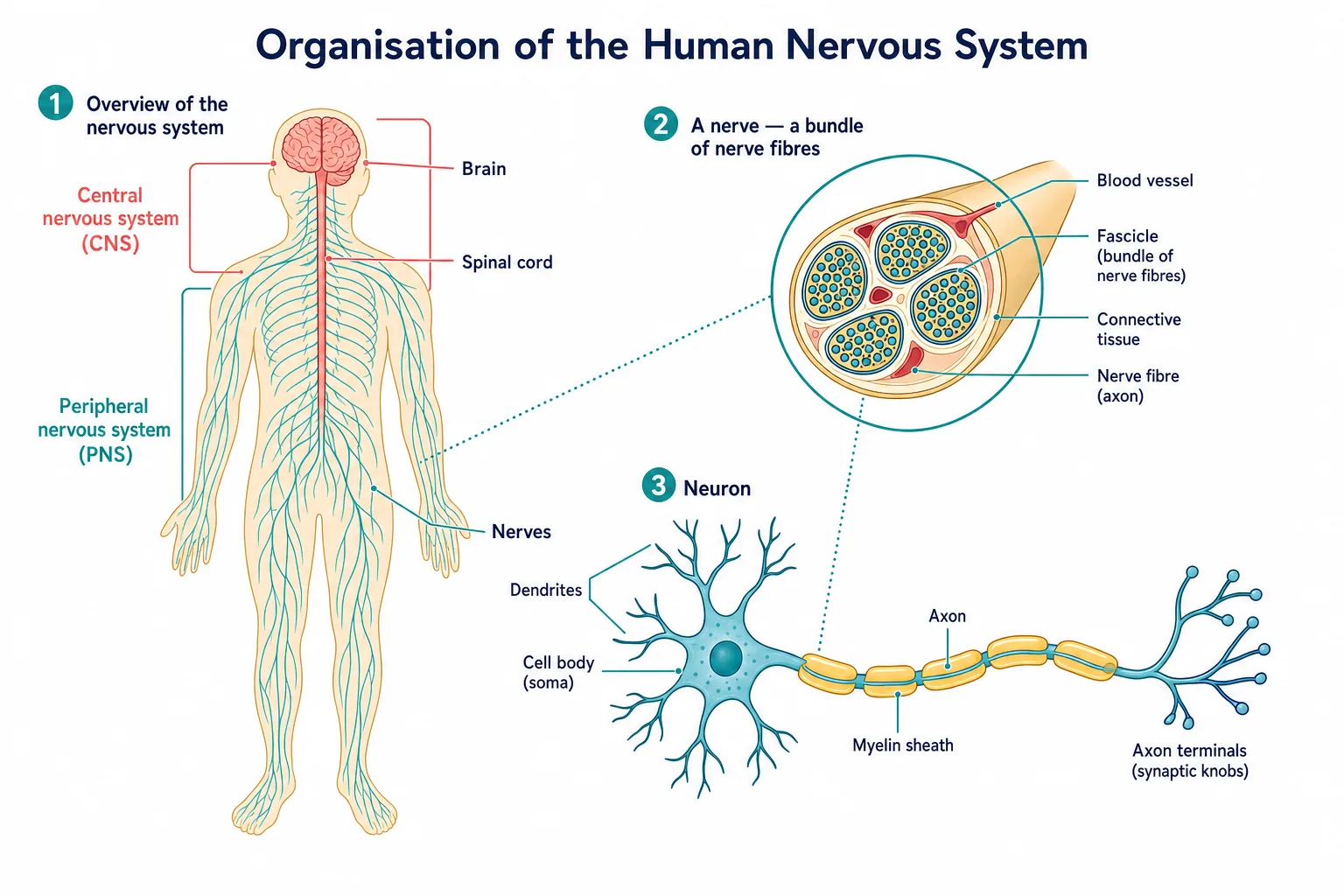
A nerve is a bundle of many axons, from sensory and motor neurones, wrapped together in a protective sheath.
The brain and spinal cord are also protected by the meninges and cerebrospinal fluid, which acts as a shock absorber and carries nutrients. This matters because neurones that die are generally not replaced, so protecting the CNS is more important than for tissues that can regrow.
Section 7 of 9Exam-style questions
Describe the pathway of a nervous response, starting from a stimulus, using the terms receptor, effector and CNS. [4]4 marks
Receptor detects the stimulus [1]; impulse travels along a sensory neurone to the CNS [1]; the CNS coordinates / sends impulses along a motor neurone [1]; the effector (muscle or gland) carries out the response [1].
Explain how the structure of a motor neurone makes it suited to its function. [3]3 marks
It has a long axon to carry impulses over long distances, for example to a distant muscle [1]; myelin sheath insulates and speeds up the impulse [1]; branched endings let it connect to the muscle fibres or other neurones [1].
Give two differences between nervous and hormonal communication. [2]2 marks
Nervous responses are fast, hormonal are slower [1]; nervous effects are short-lived, hormonal effects last longer [1]. (Also: nerves act on a precise target, hormones may act widely.)
Section 8 of 9Key terms
| Term | Meaning |
|---|---|
| Stimulus | A change in the environment that is detected by a receptor. |
| Receptor | A cell or organ that detects a stimulus. |
| Effector | A muscle or gland that carries out a response. |
| Sensory neurone | A neurone that carries impulses from a receptor to the CNS. |
| Motor neurone | A neurone that carries impulses from the CNS to an effector. |
| Relay neurone | A neurone in the CNS that links sensory and motor neurones. |
| Myelin sheath | A fatty layer that insulates an axon and speeds up impulses. |
| Central nervous system | The brain and spinal cord. |