Section 1 of 9Genes, alleles and chromosomes


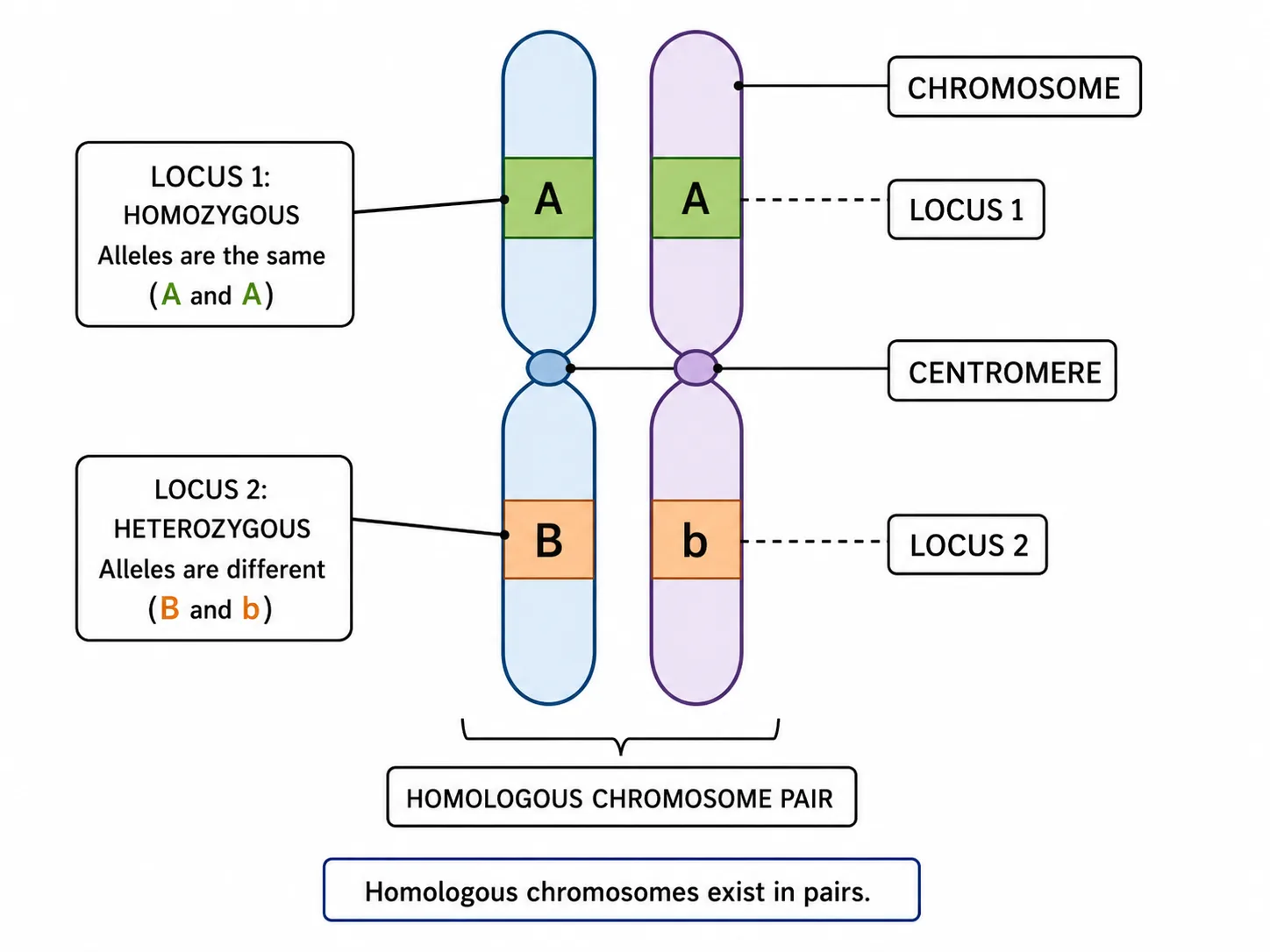


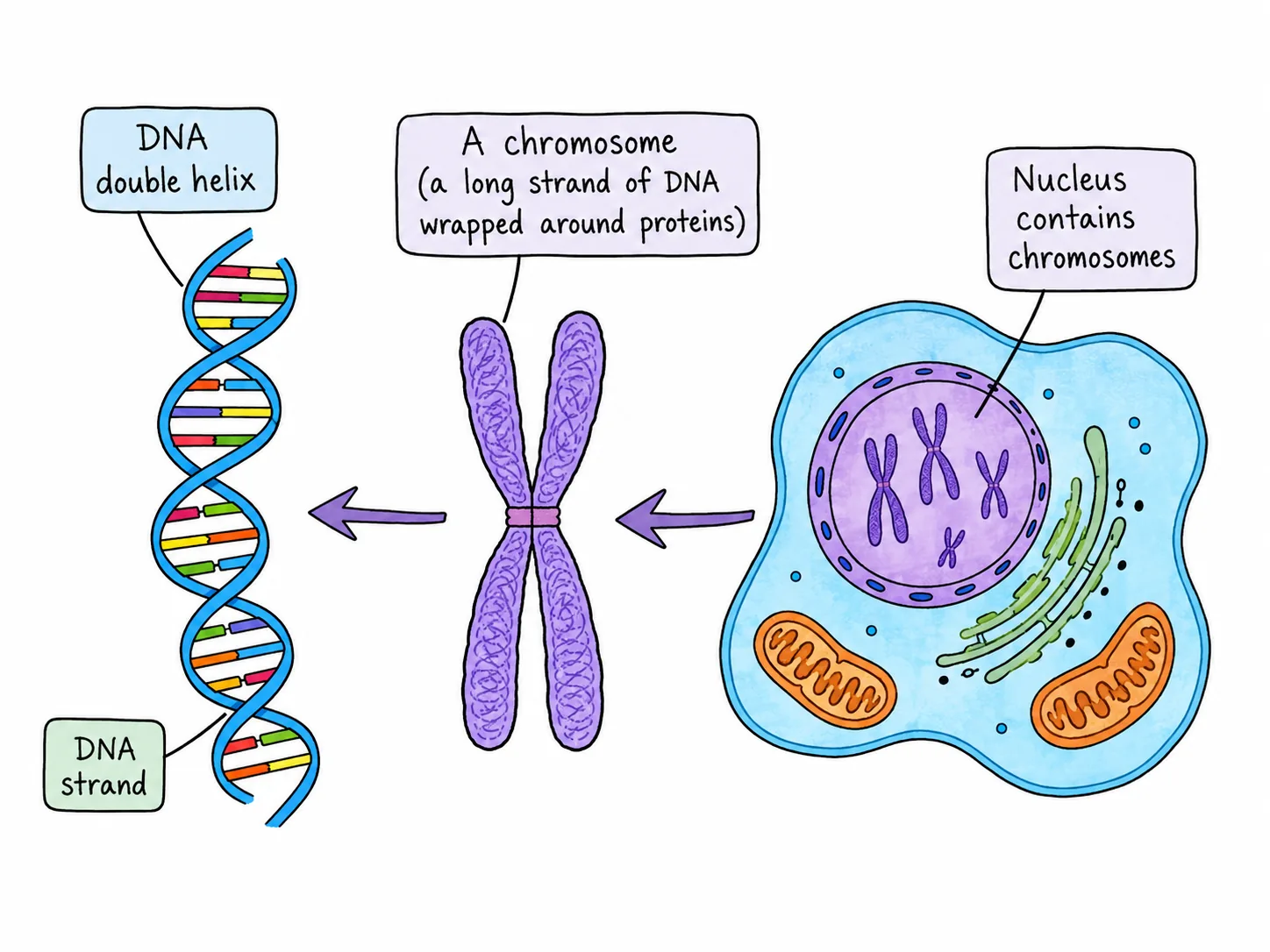
A chromosome is a long molecule of DNA, packaged with proteins, found in the nucleus.
The set of all the genetic material is the genome, and many genes interact with the environment to produce the final features of the organism.
Section 2 of 9Genotype and phenotype

The genotype is the combination of alleles an individual has for a gene, written as letters.
Section 3 of 9Dominant and recessive

A dominant allele produces its feature whether there are one or two copies, and is written as a capital letter (T).
- and is written as a lower-case version of the same letter (t).
Section 4 of 9Homozygous and heterozygous
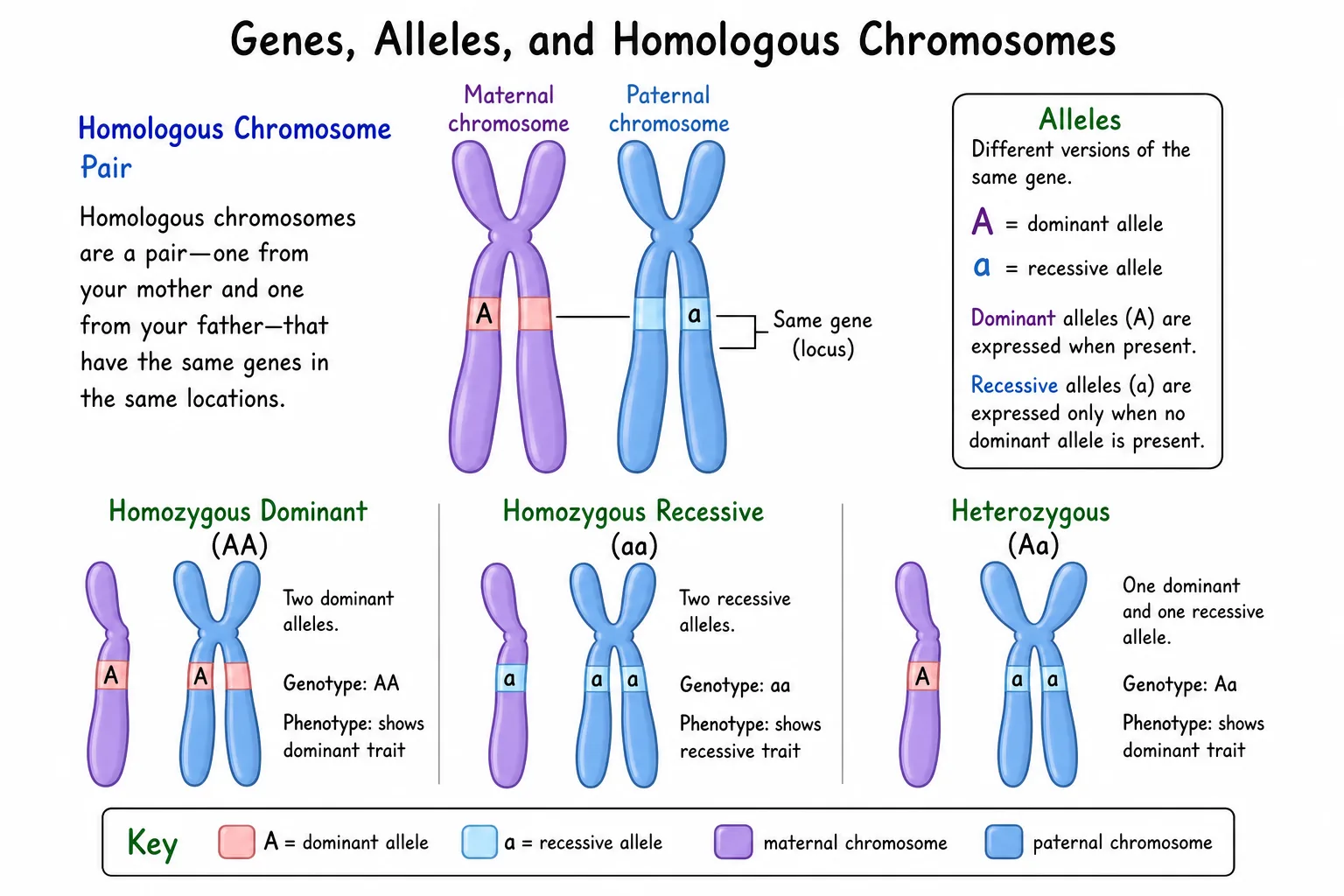


| Term | Meaning | Example | Phenotype (T = tall dominant) |
|---|---|---|---|
| Homozygous dominant | Two identical dominant alleles | TT | Tall |
| Homozygous recessive | Two identical recessive alleles | tt | Short |
| Heterozygous | Two different alleles | Tt | Tall (carries t) |
A heterozygous person who has a recessive allele for a disease but does not show it is called a carrier if the allele would cause the disease in homozygous form (cystic fibrosis, for example).
Section 5 of 9Using the terms accurately
Mistakes with these terms lose marks.
Gametes carry only one allele for each gene because the two chromosomes of a pair separate in meiosis. A Tt parent therefore produces two types of gamete, T and t, in equal numbers. These ideas are used in the next sub-topic to predict the results of crosses.
Section 6 of 9Worked ideas to practise the vocabulary
Take a gene for flower colour in which R is red and r is white, with R dominant.
If a question gives the phenotypes of parents and offspring, work backwards.
As a last check on vocabulary, note that a person with cystic fibrosis is homozygous recessive, a carrier is heterozygous, and a person without the allele is homozygous dominant. All three have different genotypes, but the carrier and the homozygous dominant person have the same phenotype.
Section 7 of 9Exam-style questions
Explain the difference between a gene and an allele. [2]2 marks
A gene is a section of DNA that codes for a protein / a characteristic [1]; alleles are the different versions of a particular gene [1].
A plant has the genotype Rr, where R (round) is dominant to r (wrinkled). State its phenotype and say whether it is homozygous or heterozygous. [2]2 marks
Phenotype round [1]; heterozygous because it has two different alleles [1].
A gardener has a tall plant of unknown genotype. Describe how a test cross could show whether it is TT or Tt. [3]3 marks
Cross it with a short (tt) plant [1]. If any offspring are short, the tall plant must be Tt [1]; if all offspring are tall, it is probably TT [1].
Section 8 of 9Key terms
| Term | Meaning |
|---|---|
| Gene | A section of DNA that codes for a protein. |
| Allele | A version of a gene. |
| Genotype | The combination of alleles an organism has. |
| Phenotype | The observable characteristics of an organism. |
| Dominant allele | An allele expressed when present in one or two copies. |
| Recessive allele | An allele expressed only when two copies are present. |
| Homozygous | Having two identical alleles of a gene. |
| Heterozygous | Having two different alleles of a gene. |
| Carrier | A heterozygous individual with a recessive allele that is not expressed. |