Section 1 of 8Respiration
1Core
Core respiration involves enzymes in cells; energy released is used for muscle contraction, protein synthesis, cell division, growth, active transport, passage of nerve impulses and maintenance of a constant body temperature.
2Core
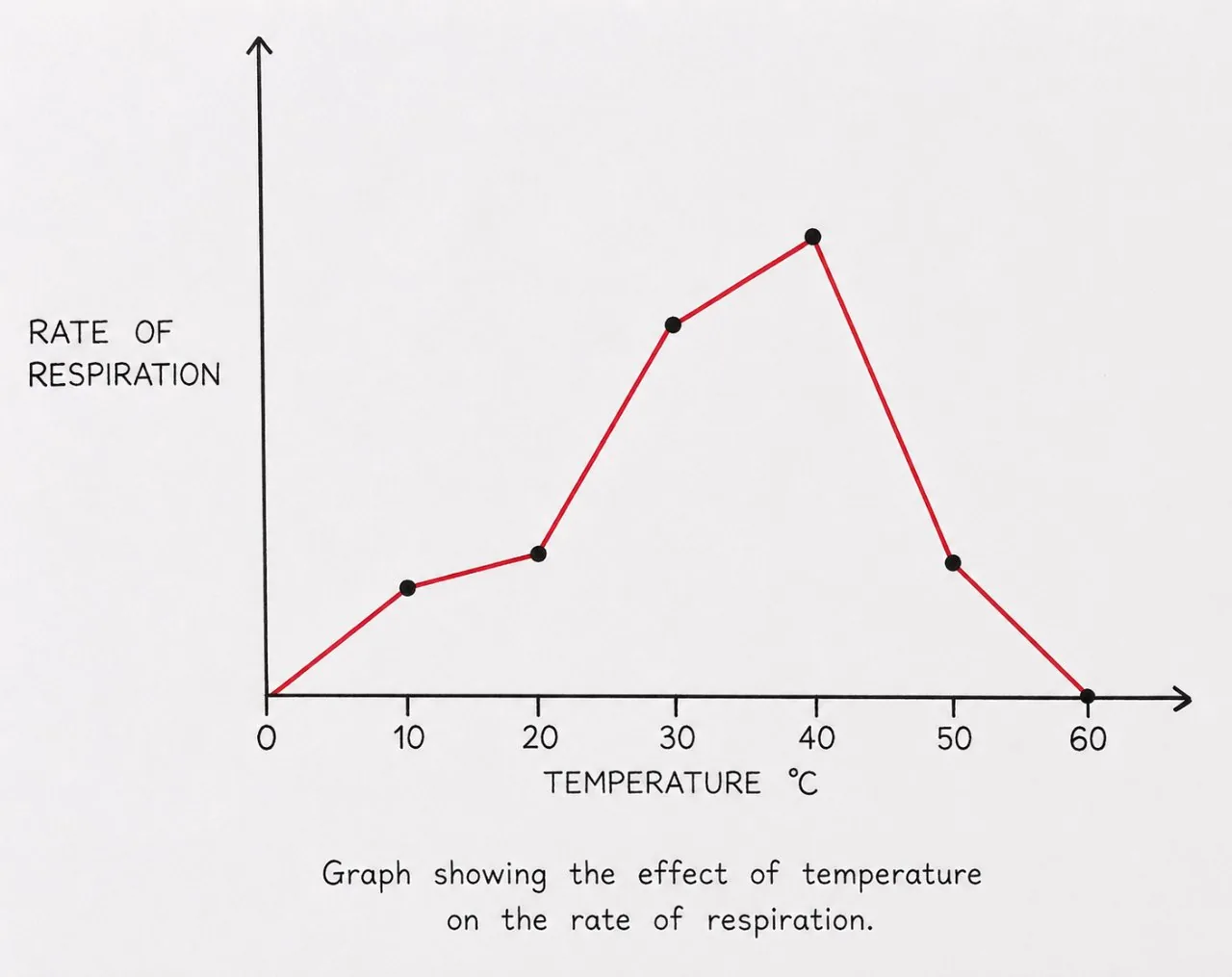
Core temperature affects respiration rate because the reactions are enzyme-controlled; this can be investigated with germinating seeds or yeast.
3Core
Core aerobic respiration uses oxygen and releases a relatively large amount of energy; products are carbon dioxide and water.
4Core
Core anaerobic respiration does not use oxygen and releases much less energy per glucose molecule.
5Core
Core in muscles, anaerobic respiration produces lactic acid; in yeast it produces alcohol and carbon dioxide.
6Supplement
Supplement balanced equations — aerobic C6H12O6 + 6O2 → 6CO2 + 6H2O; yeast C6H12O6 → 2C2H5OH + 2CO2.
7Supplement
Supplement during vigorous exercise, lactic acid builds up in muscles and blood, causing an oxygen debt.
8Supplement
Supplement the oxygen debt is removed after exercise by a continuing fast heart rate (transporting lactic acid in the blood from muscles to the liver) and continued fast and deep breathing (supplying oxygen for aerobic respiration of lactic acid in the liver).
9
Anaerobic respiration is less efficient because glucose is only partly broken down; energy remains in lactic acid or ethanol.
10
In a respirometer, soda lime (or potassium hydroxide) absorbs CO2, so movement of the drop shows oxygen uptake; boiled seeds act as a control.
11Core
Core investigating temperature and respiration (e.g. yeast in glucose solution, or germinating seeds): the independent variable is temperature; the dependent variable is the rate of respiration, measured as gas bubbles per minute, the volume of carbon dioxide released or the oxygen taken up.
12Core
Core keep these the same so the test is fair: mass of yeast or number of seeds, glucose concentration and volume, time allowed to acclimatise and length of each reading. Boiled (dead) yeast or seeds act as a control to show that living cells cause the change.
Section 2 of 8Process & sequence
- Set up two tubes with the same mass of germinating seeds (living) and boiled, cooled seeds (control) on gauze above soda lime.
- Connect each tube to a capillary tube containing a coloured liquid drop;
- allow to equilibrate in a water bath at a set temperature.
- Soda lime absorbs the carbon dioxide produced, so the volume of gas falls as oxygen is used.
- Record the distance the liquid drop moves in a fixed time (e.g. 10 minutes).
- Repeat at different water bath temperatures (e.g. 10, 20, 30, 40 °C), keeping mass of seeds and time the same.
- Calculate rate = distance moved ÷ time and plot against temperature.
Removal of oxygen debtwrite these steps in this order; each step is a marking point.
- Vigorous exerciseoxygen supply is too low, so muscles respire anaerobically.
- Lactic acid builds up in muscles and blood.
- After exercise, heart rate stays high, carrying lactic acid in the blood to the liver.
- Breathing stays fast and deep, supplying extra oxygen.
- In the liver, lactic acid is broken down by aerobic respiration, repaying the oxygen debt.
Section 3 of 8Compare
| Feature | Aerobic | Anaerobic (muscle) | Anaerobic (yeast) |
|---|---|---|---|
| Oxygen needed? | Yes | No | No |
| Products | Carbon dioxide + water | Lactic acid | Ethanol + carbon dioxide |
| Energy released per glucose | Large | Much smaller | Much smaller |
| Where in cell | Mainly mitochondria | Cytoplasm | Cytoplasm |
| Glucose fully broken down? | Yes | No | No |
Section 4 of 8Worked examples
In a respirometer, the drop moved 24 mm in 8 minutes. The capillary has a cross-sectional area of 0.50 mm2. Calculate the rate of oxygen uptake.
- Volume = 24 mm × 0.50 mm2 = 12 mm3. Rate = 12 ÷ 8 = 1.5 mm3/min.
18 molecules
How many molecules of oxygen are needed to respire 3 molecules of glucose aerobically?
- Ratio glucoseO2 = 1 : 6, so 3 × 6 = 18 molecules of oxygen (producing 18 CO2 and 18 H2O).
Section 5 of 8Keep going
Respiration IGCSE Biology topic: what to do next
These Respiration IGCSE Biology topic notes covered the key ideas, worked examples and exam technique for this topic. Check your Respiration IGCSE Biology topic understanding with the practice questions below, then reread any Respiration IGCSE Biology topic point you were unsure about before moving on.
Respiration IGCSE Biology topic: revision checklist
- Revise the main Respiration IGCSE Biology topic definitions until you can write them from memory.
- Practise Respiration IGCSE Biology topic exam questions under timed conditions.
- Link each Respiration IGCSE Biology topic idea to a diagram or a worked example.
- List the common Respiration IGCSE Biology topic mistakes and how to avoid them.
- Practice: Respiration IGCSE Biology topic practice questions
- Previous lesson: 10.2 Gas Exchange in Humans — 0610 Notes
- Next lesson: 10.4 Excretion in Humans — 0610 Notes
- Course: Cambridge IGCSE Biology 0610 — Topic Notes — all units
- Official syllabus: Cambridge IGCSE Biology 0610 syllabus
Section 6 of 8Key terms
Section 7 of 8Command terms
Command terms
State / Name
Give a short answer only; no explanation is needed (1 mark = 1 fact).
Define
Give the precise meaning. Learn the syllabus definitions word-for-word: every keyword in the definition is a marking point.
Describe
Say what happens / what the data show, with key features and figures. Do not give reasons.
Explain
Give reasonswhat happens AND why/how, linked with “because”, “so”, “therefore”.
Suggest
Apply knowledge to an unfamiliar situation; any sensible, scientifically-based answer can score.
Compare
Give similarities AND differences, each as a direct comparison (“X is … whereas Y is …”).
Outline
Set out the main points briefly.
Calculate
Work out from given facts; show working, give the unit and the requested significant figures.
Identify
Name/select from given information.
Predict
Give an expected result without a full justification.
Evaluate
Judge the importance or quality of the evidence/method, with reasons.
Section 8 of 8Exam technique
Keywords the mark scheme looks for in this lesson
Keywords the mark scheme looks for in this lesson
Respiration · Aerobic respiration · Anaerobic respiration · Glucose · Mitochondria · Lactic acid · Oxygen debt · Fermentation (yeast) · Ethanol · Respirometer · Energy uses in the body · Enzymes in respiration
Learn each definition in the Key words tab exactly; a missing keyword in a definition usually loses the mark.
How to get full marks (examiner guidance)
1
Use the exact scientific term and learn syllabus definitions word-for-word.
2
Write “rate of … increases”, not “… increases”.
3
Say “concentration gradient”, never just “gradient”; name particles precisely (atoms, molecules, ions) — never “it”.
4
Give units with every numerical answer and use the significant figures asked for; show all working.
5
Compare = a similarity AND a difference; describe = what happens; explain = why it happens.
6
Repeats let you identify anomalies and calculate a mean — they do not make an experiment “valid”.
Words to avoid
1
respiration produces energyrespiration releases energy.
2
respiration is breathingrespiration is a chemical reaction in all living cells.
3
anaerobic respiration releases no energyit releases much less energy per glucose molecule.
4
muscles make lactic acid and carbon dioxideanaerobic respiration in muscles produces only lactic acid.
5
the enzymes are killed at high temperaturethe enzymes are denatured (active site changes shape).
6
oxygen debt is paid by breathing out lactic acidlactic acid is carried to the liver and broken down by aerobic respiration.