Section 1 of 11Polymers and monomers
Polymer
- Polymer a large molecule built up from many smaller molecules called monomers.
Bonding
- Bonding each monomer is joined to the next by covalent bonds.
Examples — poly(ethene) and PVC are addition polymers, and nylon is a condensation polymer.
Section 2 of 11Addition polymerisation

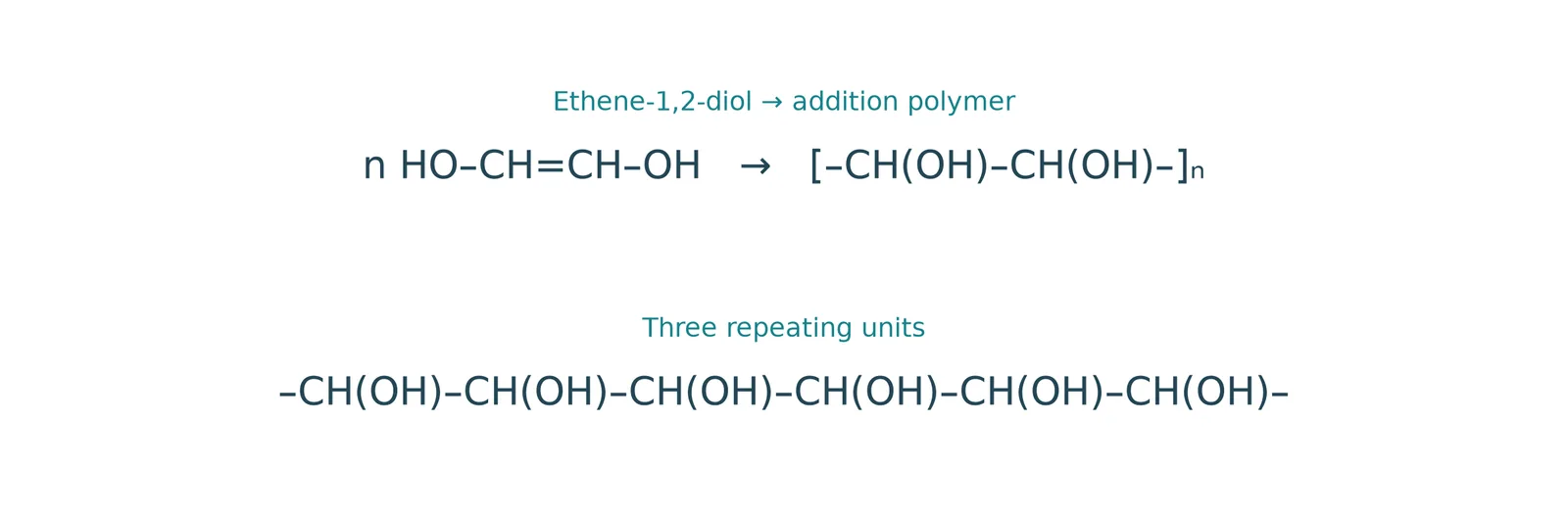

1Monomers
- Monomers alkenes, which contain a C=C double bond.
2Process
- Process one bond in each C=C breaks and forms a bond with the adjacent monomer, giving a polymer that contains only single bonds and only one product.
3Poly(ethene)
- Poly(ethene) formed from many ethene monomers.
4Naming
- Naming put the monomer name in brackets with poly- before it, such as poly(propene).
Section 3 of 11Examples of addition polymers
| Monomer | Polymer | Use |
|---|---|---|
| Ethene | Poly(ethene) | Plastic bags, bottles |
| Propene | Poly(propene) | Ropes, crates |
| Chloroethene | Poly(chloroethene), PVC | Pipes, window frames, cable insulation |
| Tetrafluoroethene | PTFE | Non-stick pans |
- Equation
- n CH2=CH2 → –[CH2–CH2]n–.
Section 4 of 11Repeat units (Extended)


To draw a repeat unit, change the double bond in the monomer to a single bond.
Add a continuation bond at each end, extending outside the brackets.
Write a small n at the bottom right of the brackets.
Keep the other groups in the same order as around the double bond.
Monomer from polymer
- Monomer from polymer identify the repeat unit, change the single bond to a double bond and remove the continuation bonds.
The repeat unit of CH2=CH2 is –CH2–CH2–, of CH2=CHCH3 is –CH2–CH(CH3)– and of CH2=CHCl is –CH2–CHCl–.
Section 5 of 11Condensation polymers (Extended)



1Condensation polymerisation
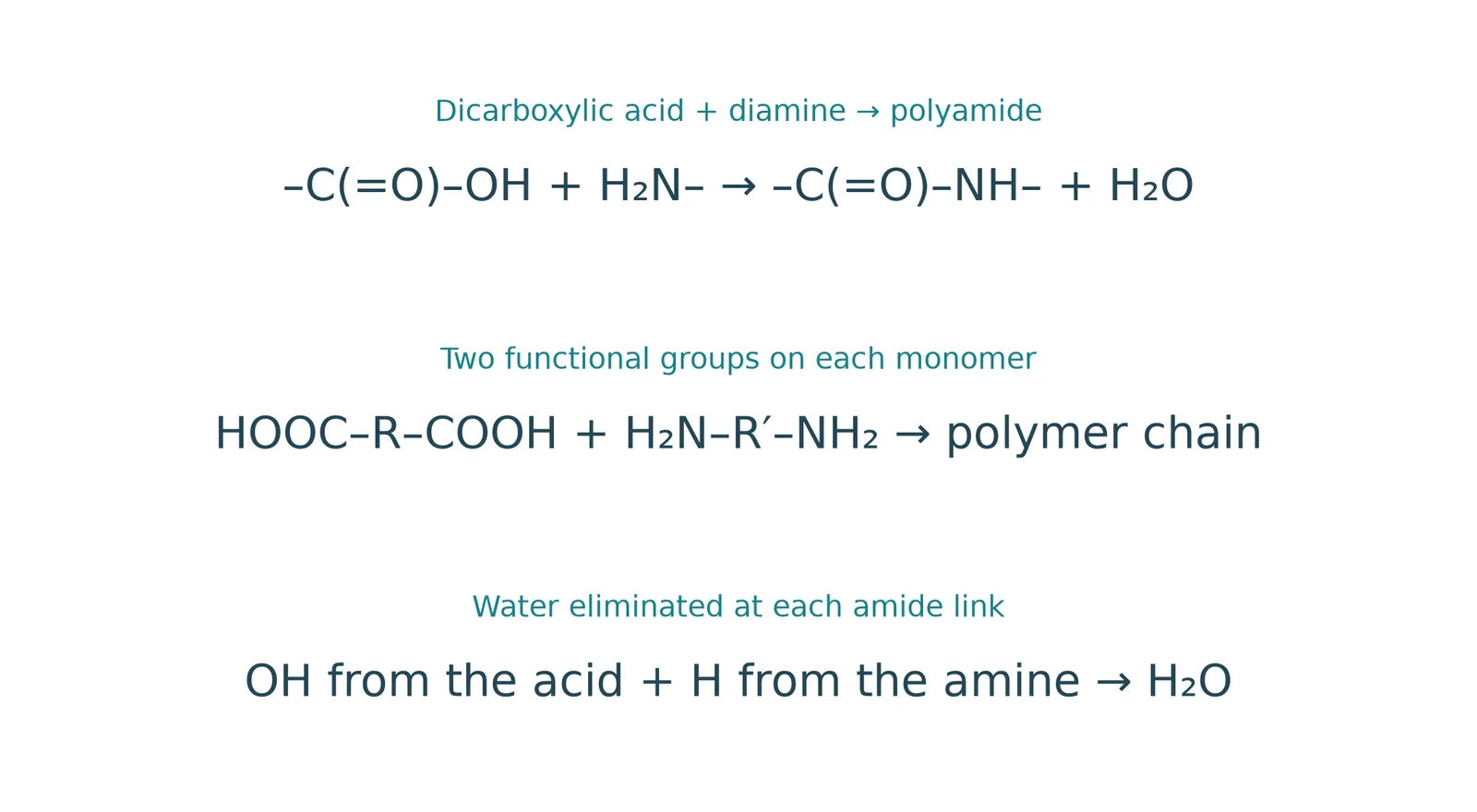
- Condensation polymerisation two different monomers join with the loss of a small molecule, usually water.
2Difference from addition
- Difference from addition addition forms only the polymer, while condensation forms the polymer and one water molecule per link.
3Monomers
- Monomers each has a functional group at both ends.
4Nylon
- Nylon a polyamide made from a dicarboxylic acid and a diamine, with an amide linkage formed with loss of water.
5PET
- PET a polyester made from a dicarboxylic acid and a diol, with an ester linkage formed with loss of water.
6
PET is used in plastic bottles and in synthetic fibres sold as terylene.
Section 6 of 11Proteins (Extended)


Proteins
- Proteins condensation polymers made from amino acid monomers joined by amide (peptide) links, so they are natural polyamides.
Amino acids
- Amino acids small molecules containing NH2 and COOH groups with a side chain R.
There are twenty common amino acids.
Proteins contain between 60 and 600 amino acids in different orders.
Link formation
- Link formation the –COOH group of one amino acid reacts with the –NH2 group of another, and one water molecule is eliminated at each link.
Peptide link
- Peptide link the –CO–NH– amide link in a protein is called a peptide link, and the long chain formed by repeating the reaction is a polypeptide.
Simplified diagrams
- Simplified diagrams boxes represent the carbon-containing part of each amino acid, joined by the –CO–NH– peptide links.
Section 7 of 11Plastics and their disposal
Plastics
- Plastics are made from polymers, which are often chemically unreactive and so non-biodegradable.
Landfill
- Landfill waste polymers take up valuable land because microorganisms cannot break them down.
Oceans
- Oceans plastic waste accumulates and disrupts marine life.
Incineration
- Incineration polymers release heat but produce carbon dioxide, a greenhouse gas.
PVC releases toxic hydrogen chloride when burned.
Incomplete combustion produces toxic carbon monoxide.
Options
- Options waste plastic can be reused, recycled or burned for energy.
Section 8 of 11Recycling PET (Extended)
Problem
- Problem the conditions needed to break down many polymers can degrade the monomers.
PET
- PET is relatively easy to convert back into its monomers using enzymes or chemical catalysts and mild heating.
Re-polymerisation
- Re-polymerisation the monomers are recovered and re-polymerised into new PET, saving resources and energy.
Section 9 of 11More from the specification
1Macromolecular chain repeat units
- Macromolecular chain repeat units addition polymerization joins identical monomer units together into extensive macromolecules containing thousands of connected repeat units.
2Principles of Addition Polymerisation
- Under high pressure and catalytic initiation, thousands of unsaturated alkene monomers add together by opening their carbon-carbon double bonds to form long, saturated carbon-chain macromolecules.
3Deducing the Repeat Unit from Monomers
- The repeat unit of an addition polymer mirrors the monomer skeleton with the double bond replaced by a single bond and extension bonds penetrating brackets with an external subscript 'n' (e.g. ethene to poly(ethene)).
4Environmental Impact and Non-Biodegradability
- Synthetic addition polymers possess extremely strong, chemically inert covalent carbon-carbon backbones that resist microbial degradation, persisting in landfill sites and marine ecosystems for centuries.
Section 10 of 11Key terms
| Term | Meaning |
|---|---|
| Polymer | A large molecule built from many monomers. |
| Monomer | A small molecule that joins to form a polymer. |
| Addition polymer | A polymer made from alkene monomers that forms only the polymer. |
| Condensation polymer | A polymer formed with loss of a small molecule such as water. |
| Non-biodegradable | Cannot be broken down by microorganisms. |
| Repeat unit | The smallest section repeated along a polymer chain. |
| Amino acid | a monomer with –NH2 and –COOH groups. |
| Peptide link | the –CO–NH– amide link in proteins. |
| Polyamide | a polymer joined by amide links, such as nylon and proteins. |
Section 11 of 11Exam technique
1
Saying addition polymerisation produces water — it forms only the polymer
2
Saying the polymer contains C=C bonds — the double bonds are used up and the polymer has single bonds
3
Saying plastics rot away — most are non-biodegradable
4
Repeating the same linking group for nylon and PET — nylon has an amide link and PET an ester link
5
Saying proteins are addition polymers or have ester links — they are condensation polyamides with peptide links and water is lost at each link