Section 1 of 7Aim and principle
Aim
- Aim To find the empirical formula of magnesium oxide by measuring how much oxygen combines with a known mass of magnesium.
Principle
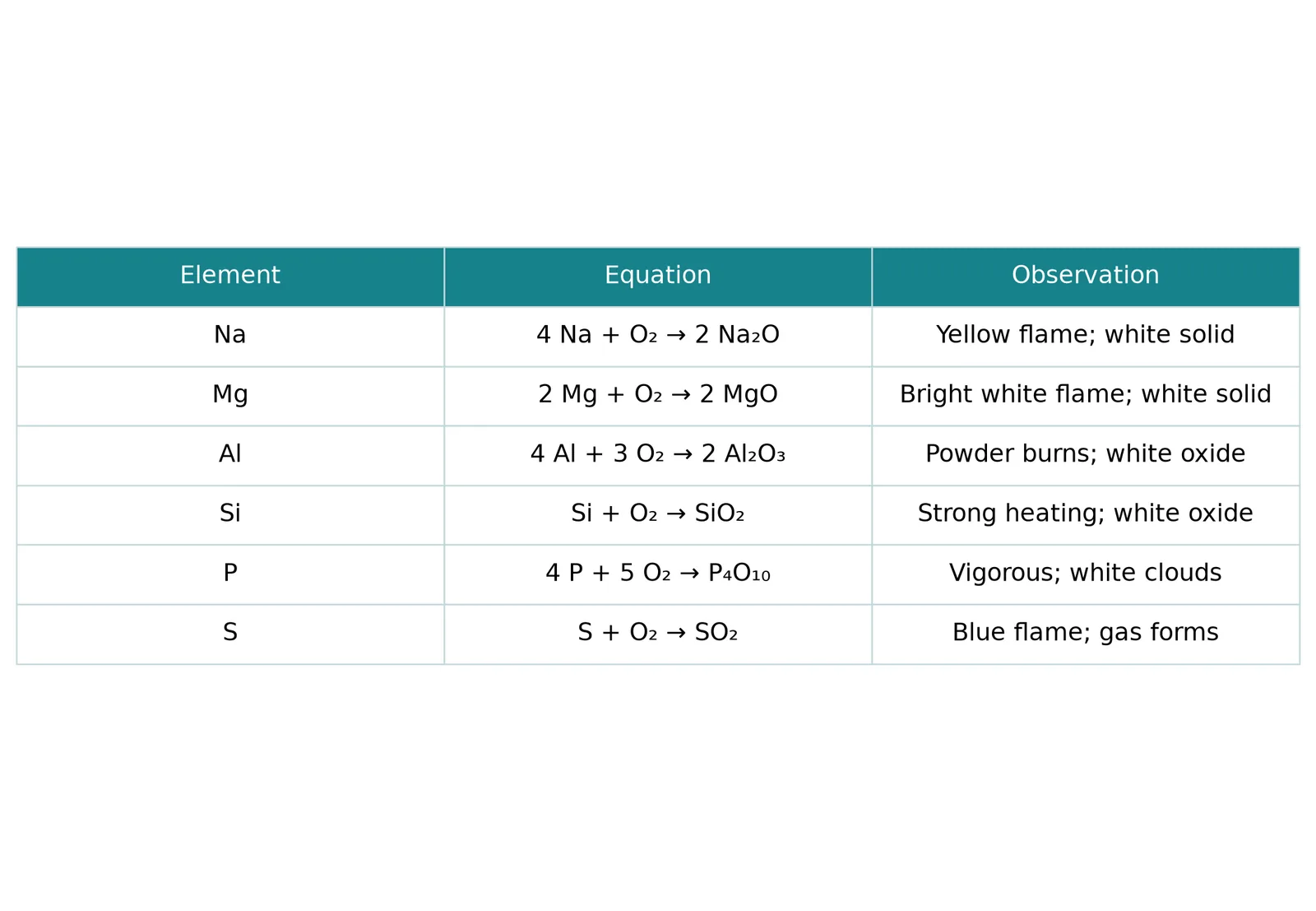
- Principle Magnesium burns in air: 2Mg + O2 → 2MgO. The solid gains mass because oxygen from the air joins it.
- The mass of oxygen is found by subtraction, and the mole ratio of the two elements gives the formula.
Section 2 of 7Method
1
Weigh a clean, dry crucible with its lid and record the mass.
2
Add a coil of clean magnesium ribbon (cleaned with sandpaper) and weigh again.
3
Place the crucible on a pipe-clay triangle on a tripod and heat strongly with a Bunsen burner.
4
Lift the lid slightly and briefly every so often to let air in, but replace it quickly so that white smoke of magnesium oxide does not escape.
5
When the magnesium has stopped glowing, remove the lid, heat for a few more minutes, then let the crucible cool.
6
Weigh the crucible, lid and contents. Reheat and reweigh until two readings are the same, showing the reaction is complete.
Section 3 of 7Variables and safety
| Aspect | Detail |
|---|---|
| Independent variable | Mass of magnesium used |
| Dependent variable | Mass of magnesium oxide produced |
| Control variables | Heating until constant mass; same crucible; lid used each time |
| Hazard: bright light | Do not look directly at burning magnesium |
| Hazard: heat | Hot crucible; use tongs and let it cool on a heatproof mat; tie back hair; wear eye protection |
| Hazard: smoke | Magnesium oxide smoke is an irritant to the lungs, so keep the lid on |
Section 4 of 7Processing the results
1Masses
- Masses Mass of Mg = (crucible + Mg) − crucible. Mass of oxygen = (crucible + MgO) − (crucible + Mg).
2Moles
- Moles Divide each mass by its Ar: Mg is 24 and O is 16.
3Ratio
- Ratio Divide by the smaller number of moles to get the simplest ratio.
4Formula
- Formula For 0.24 g Mg and 0.16 g O: 0.010 mol each, so ratio 1 : 1 and the formula is MgO.
Section 5 of 7Sources of error
Mass too low
- Mass too low Smoke escaping lets magnesium oxide leave the crucible, so the oxygen mass appears too small.
Incomplete reaction
- Incomplete reaction Magnesium that has not fully reacted also gives a low oxygen mass, which is why heating to constant mass matters.
Nitrogen reaction
- Nitrogen reaction Magnesium can also react with nitrogen in air, forming magnesium nitride, which affects the results.
Section 6 of 7Key terms
| Term | Meaning |
|---|---|
| Crucible | A small heat-resistant pot used to heat solids strongly. |
| Constant mass | Mass that does not change on further heating, showing the reaction has finished. |
| Oxidation | A reaction in which a substance gains oxygen. |
| Mole | The amount of substance containing 6.02 × 10²³ particles. |
Section 7 of 7Exam technique
1
Subtracting the wrong masses, for example using the crucible mass instead of crucible plus magnesium when finding the oxygen mass.
2
Letting the lid come off completely, allowing smoke to escape and giving too little oxygen.
3
Stopping heating before the mass is constant, which means the magnesium has not all reacted.
4
Forgetting that the mass increase comes from oxygen taken from the air, not from the magnesium itself.