Section 1 of 6Why gas tests matter
Gases are products of common reactions
- Gases are products of common reactions Metals reacting with acids give hydrogen, while carbonates reacting with acids give carbon dioxide.
- Identifying the gas lets you confirm which reaction has taken place.
Each gas has a specific test
- Each gas has a specific test A good test gives a clear, unique observation, so that no other common gas could give the same result.
- You must always state both the test and the positive result in an exam answer.
Collect the gas safely
- Collect the gas safely Collect the gas in an upturned test tube or a gas syringe,
- or bubble it straight into a second test tube containing the reagent.
- Wear eye protection, because acids and flames are both involved.
Section 2 of 6Test for hydrogen
1
Collect a test tube of the gas, keeping the tube upside down because hydrogen is less dense than air and would escape.
2
Light a wooden splint so that it is burning with a flame.
3
Hold the lit splint at the mouth of the test tube; do not push it far inside, because the burning needs oxygen from the air.
4
A positive result is a loud squeaky pop.
5
The pop is the rapid combustion of hydrogen with oxygen: 2H2(g) + O2(g) → 2H2O(l).
Section 3 of 6Test for carbon dioxide
1
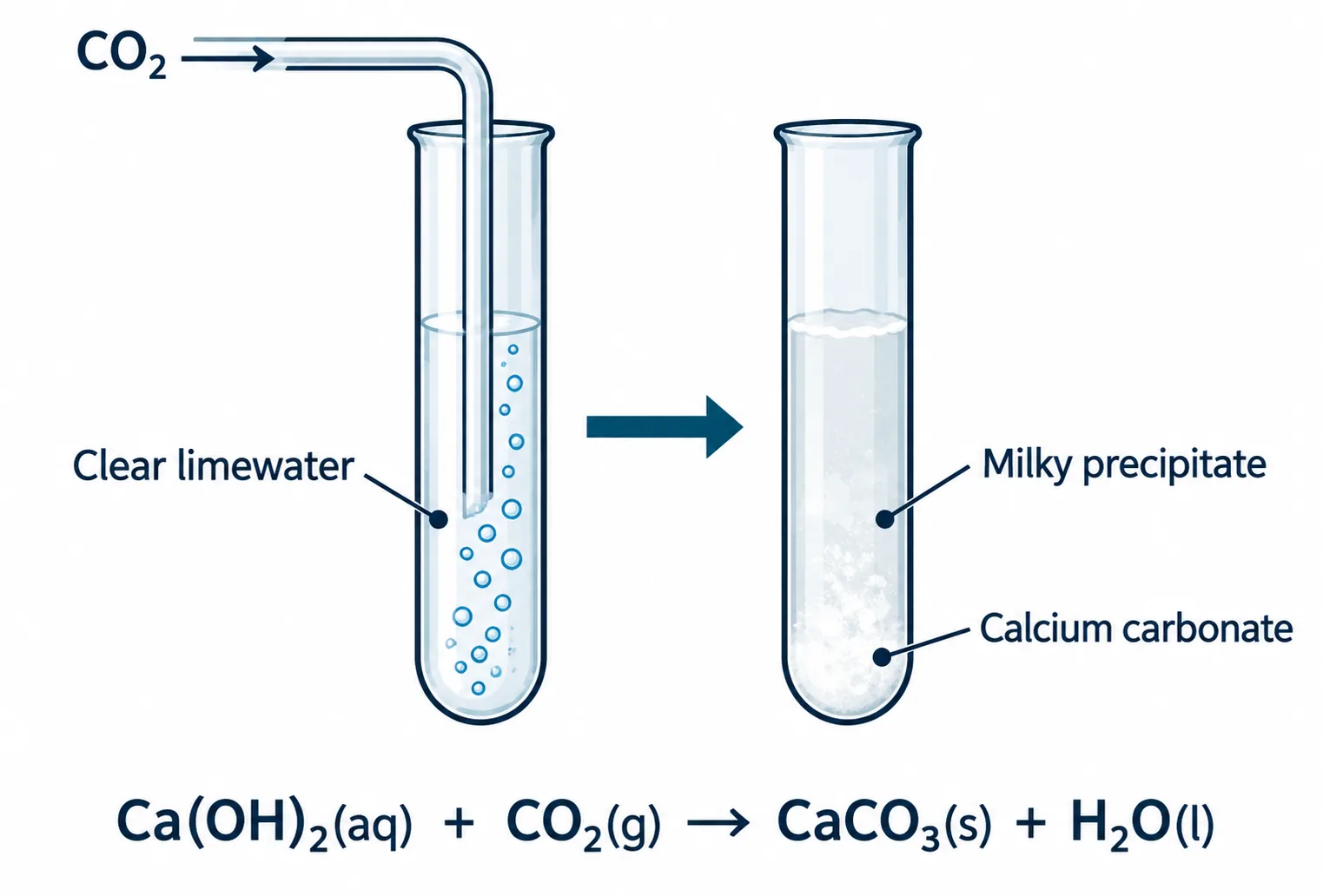
Pour a little limewater (a solution of calcium hydroxide) into a clean test tube.
2
Bubble the gas through the limewater, for example using a delivery tube from the reaction vessel.
3
A positive result is that the limewater turns milky (cloudy).
4
Carbon dioxide reacts with calcium hydroxide to make insoluble calcium carbonate, which is the white solid that clouds the liquid: Ca(OH)2(aq) + CO2(g) → CaCO3(s) + H2O(l).
5
If carbon dioxide continues to bubble in for a long time, the cloudiness can disappear again as soluble calcium hydrogencarbonate forms, so use a short burst.
Section 4 of 6Linking tests to reactions

Where the gases come from
Metal + acid
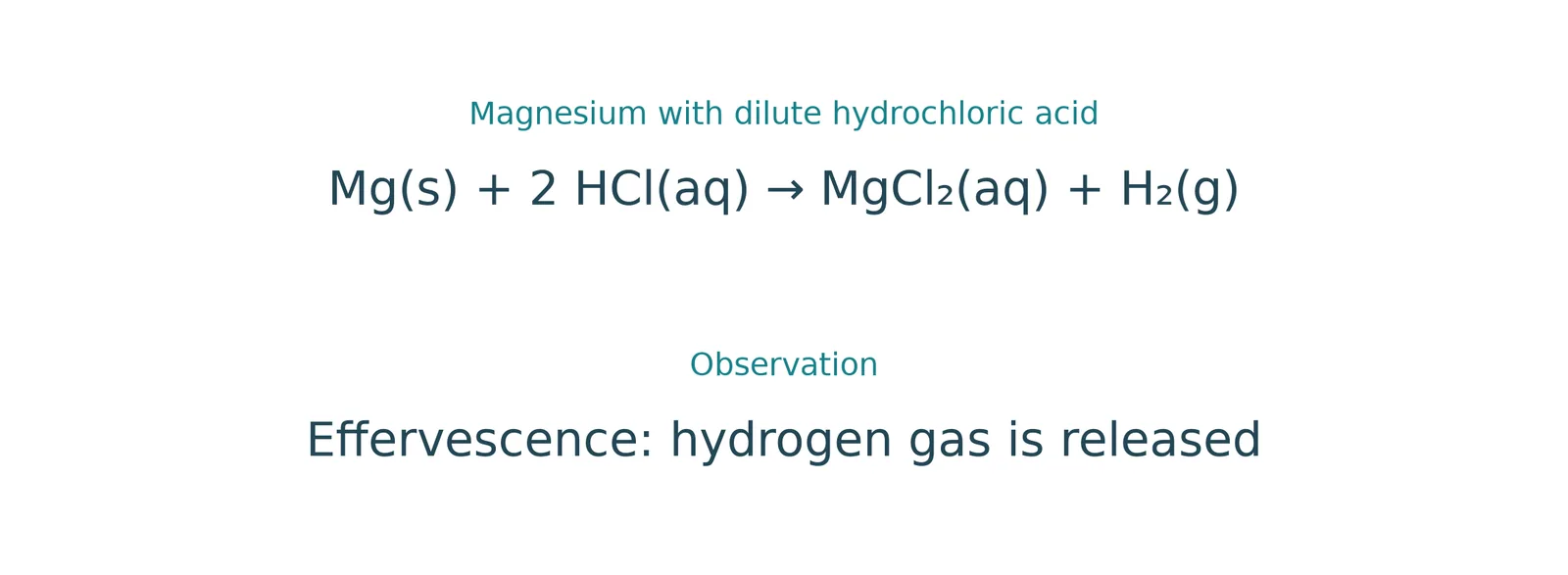
- Metal + acid A reactive metal such as magnesium and dilute acid give a salt and hydrogen, so the gas gives a squeaky pop.
Carbonate + acid
- Carbonate + acid A metal carbonate and an acid give a salt, water and carbon dioxide, so the gas turns limewater milky.
Why the test is chosen
- Why the test is chosen The test must be selective: a gas that merely puts out a flame could be nitrogen or carbon dioxide, so it proves nothing.
Section 5 of 6Key terms
| Term | Meaning |
|---|---|
| Limewater | A dilute solution of calcium hydroxide in water, used to detect carbon dioxide. |
| Squeaky pop | The small explosion heard when hydrogen burns rapidly with the oxygen in air. |
| Precipitate | A solid that forms when two solutions react; here it is calcium carbonate in limewater. |
| Positive result | The observation that confirms a gas is present. |
| Lit splint | A wooden splint with a flame, used in the hydrogen test. |
Section 6 of 6Exam technique
1
Confusing the hydrogen and oxygen testsa lit (burning) splint pops with hydrogen, but a glowing splint relights in oxygen.
2
Saying a flame going out proves carbon dioxide; nitrogen and other gases do this too, so only the limewater test counts.
3
Writing that limewater 'goes white' without the word milky or cloudy; also forgetting to name limewater or calcium hydroxide.
4
Pushing the burning splint deep into the tube so that it goes out without enough air to burn the hydrogen.