Section 1 of 6The reactivity series

Order of metals
- Order of metals From most to least reactive: potassium, sodium, calcium, magnesium, aluminium, zinc, iron, hydrogen (for comparison), copper.
What it tells you
- What it tells you The higher a metal is, the more readily it forms positive ions and the more vigorously it reacts.
- Evidence for the order comes from observing reactions with water, acid and salt solutions.
Hydrogen's place
- Hydrogen's place Only metals above hydrogen in the series react with dilute acids to release hydrogen gas.
Section 2 of 6Reactions with water and acid

| Metal | With cold water | With dilute acid |
|---|---|---|
| Potassium | Violent | Violent, explosive |
| Sodium | Fast reaction | Violent, explosive |
| Calcium | Steady fizzing | Vigorous |
| Magnesium | Very slow | Vigorous fizzing |
| Zinc | Very slow | Moderate fizzing |
| Iron | Very slow | Slow fizzing |
| Copper | No reaction | No reaction |
Section 3 of 6General equations
Metal reactions
Metal + water
- Metal + water Forms a metal hydroxide and hydrogen: Ca(s) + 2H2O(l) → Ca(OH)2(aq) + H2(g).
Metal + acid
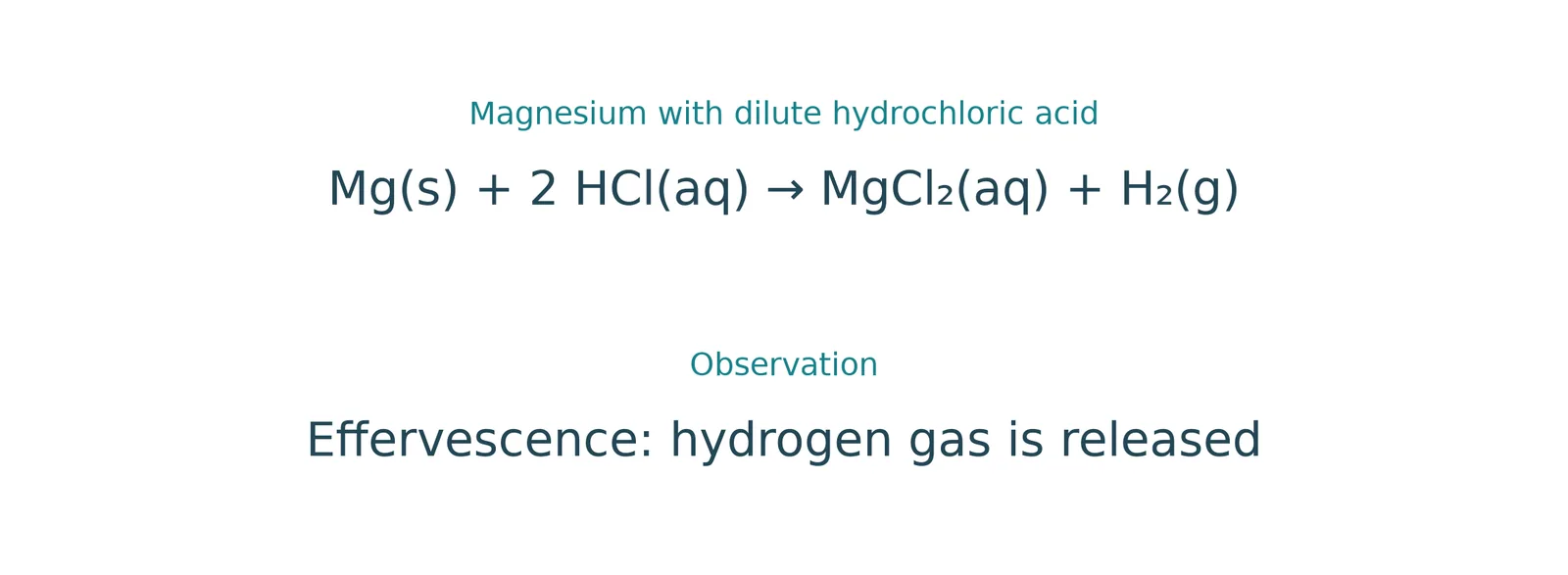
- Metal + acid Forms a salt and hydrogen: Mg(s) + 2HCl(aq) → MgCl2(aq) + H2(g).
- Zn(s) + H2SO4(aq) → ZnSO4(aq) + H2(g).
Metal + salt solution
- Metal + salt solution A more reactive metal displaces a less reactive one: Mg(s) + CuSO4(aq) → MgSO4(aq) + Cu(s).
Section 4 of 6Using displacement to rank metals
1
Place each metal in a solution of a salt of a different metal.
2
Look for signs of reaction: a new coloured coating, a colour change in the solution or a temperature rise.
3
If the added metal is more reactive it displaces the other, so the solid coats the surface and the solution fades from its original colour.
4
If no change occurs, the added metal is less reactive than the metal in the salt.
5
Combine many results to produce the order of reactivity.
Section 5 of 6Key terms
| Term | Meaning |
|---|---|
| Reactivity series | A list of metals in order of how readily they react. |
| Displacement | A reaction in which a more reactive element takes the place of a less reactive one in a compound. |
| Metal hydroxide | The compound formed, with hydrogen, when a reactive metal reacts with water. |
| Vigorous | Fast, with lots of fizzing or heat. |
| Salt | A compound formed when a metal replaces the hydrogen of an acid. |
Section 6 of 6Exam technique
1
Saying copper reacts slowly with acid; it is below hydrogen so it does not react at all.
2
Forgetting to balance equations such as Mg + 2HCl, where two HCl are needed.
3
Claiming a less reactive metal displaces a more reactive one; displacement only works the other way.
4
Writing that metals react with water to form oxides; with cold water the products are hydroxides and hydrogen.