4.1.2Extracting Metals and Equilibria
Metal Displacement Reactions and Redox
5 min read 9 parts Lesson 3 of 10 1 quiz
Section 1 of 9Recap and link
Displacement
- Displacement A more reactive metal pushes a less reactive metal out of its salt solution.
Redox definition
- Redox definition Oxidation is loss of electrons and reduction is gain of electrons.
The link
- The link The metal atoms lose electrons to become ions while the ions of the other metal gain electrons to become atoms, so electrons are transferred.
Section 2 of 9Worked example: zinc and copper(II) sulfate

1
Write the full equation: Zn(s) + CuSO4(aq) → ZnSO4(aq) + Cu(s).
2
Write it as ions: Zn + Cu2+ + SO42− → Zn2+ + SO42− + Cu.
3
Cross out the sulfate ions, which are spectator ions and appear unchanged on both sides.
4
The net ionic equation is Zn + Cu2+ → Zn2+ + Cu.
5
Split into half equations: Zn → Zn2+ + 2e− (oxidation) and Cu2+ + 2e− → Cu (reduction).
Section 3 of 9Spotting oxidation and reduction
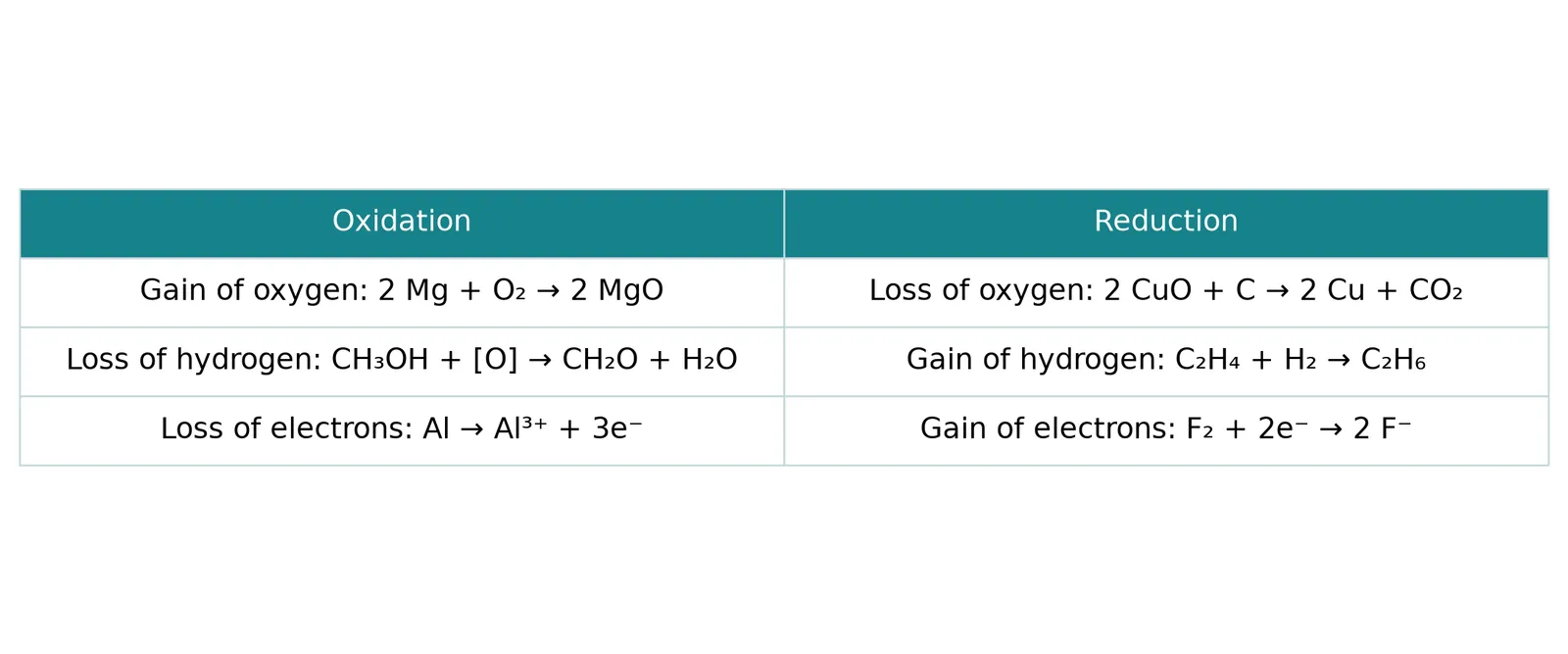


| Species | What happens | Process |
|---|---|---|
| Zinc atoms | Lose 2 electrons to become Zn2+ | Oxidation |
| Copper(II) ions | Gain 2 electrons to become Cu atoms | Reduction |
| Sulfate ions | No change | Spectators |
| Zinc overall | Acts as the reducing agent | Gives electrons |
| Copper(II) ions overall | Act as the oxidising agent | Accept electrons |
Section 4 of 9Observations in this reaction
1Zinc added
- Zinc added A piece of zinc is placed in blue copper sulfate solution.
2Electron transfer
- Electron transfer Zinc atoms give electrons to copper ions in the solution.
3Copper forms
- Copper forms Brown copper metal coats the zinc.
4Solution fades
- Solution fades As blue Cu2+ ions are used up, the solution becomes colourless.
Section 5 of 9More displacement reactions as redox
| Reaction | Net ionic equation | Species oxidised |
|---|---|---|
| Magnesium + copper(II) sulfate | Mg + Cu2+ → Mg2+ + Cu | Magnesium |
| Iron + copper(II) sulfate | Fe + Cu2+ → Fe2+ + Cu | Iron |
| Copper + silver nitrate | Cu + 2Ag+ → Cu2+ + 2Ag | Copper |
| Zinc + magnesium sulfate | No reaction, because zinc is less reactive than magnesium | None |
Section 6 of 9Remembering redox
OIL RIG
- OIL RIG Oxidation Is Loss of electrons and Reduction Is Gain of electrons.
Reactivity series link
- Reactivity series link The more reactive metal is the one that loses electrons more easily, so it is oxidised and displaces the less reactive metal.
Balancing electrons
- Balancing electrons In the copper and silver nitrate reaction each copper atom loses 2 electrons but each silver ion gains only 1,
- so two silver ions are needed for every copper atom.
Section 7 of 9Method: displacement of copper by a metal
1
Measure about 25 cm3 of copper(II) sulfate solution into a beaker and record its temperature and colour.
2
Add a small amount of the metal powder, such as zinc, and stir.
3
Observe the colour of the solution and the solid that forms, and record the highest temperature reached.
4
A temperature rise shows that the displacement reaction is exothermic.
5
Repeat with other metals to rank them in order of reactivity.
Section 8 of 9Key terms
| Term | Meaning |
|---|---|
| Spectator ion | An ion present in the mixture that does not take part in the reaction. |
| Ionic equation | An equation showing only the particles that change during the reaction. |
| Oxidation | Loss of electrons. |
| Reduction | Gain of electrons. |
| Half equation | An equation showing electron loss or gain by one species only. |
Section 9 of 9Exam technique
1
Leaving spectator ions in the net ionic equation.
2
Mixing up which species is oxidisedthe more reactive metal loses electrons, so it is oxidised.
3
Writing half equations where the electrons do not balance the charge; check that both sides have the same total charge.
4
Saying electrons are gained by the zinc; zinc loses them to the copper ions.