6.2.4Rates of Reaction and Energy Changes
Reaction Profiles
5 min read 7 parts Lesson 10 of 10 1 quiz
Section 1 of 7Activation energy
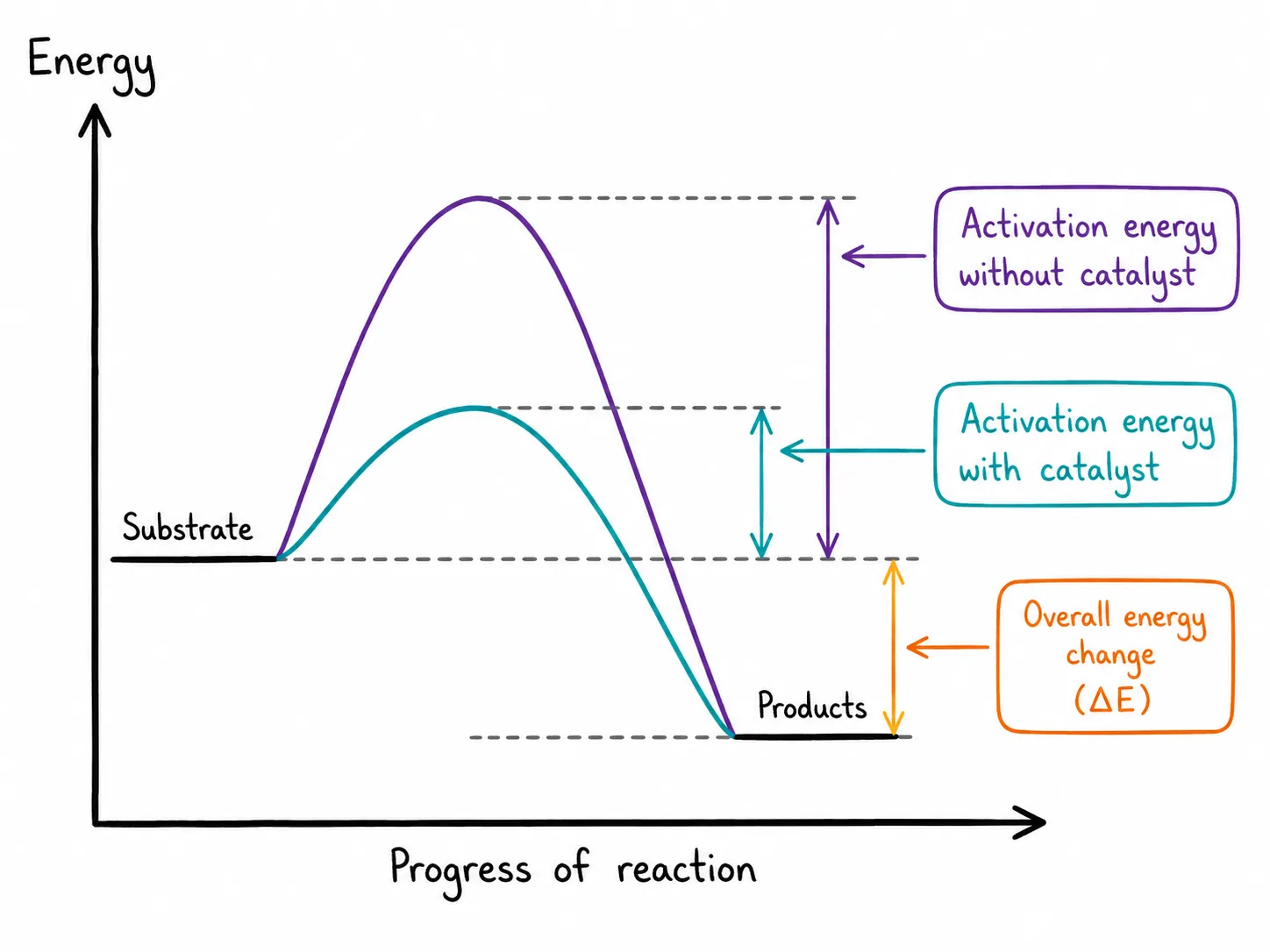
Collisions are needed
- Collisions are needed Particles must collide with the correct orientation and enough energy to react.
Minimum energy
- Minimum energy The smallest energy colliding particles need to react is the activation energy, Ea.
- Bonds in the reactants must be partly broken before new bonds form.
Different reactions, different Ea
- Different reactions, different Ea A high activation energy means few collisions are successful, so the reaction is slow at room temperature.
Section 2 of 7Features of a reaction profile
| Feature | What it shows |
|---|---|
| y-axis | Relative energy of the chemicals |
| x-axis | Progress of reaction |
| Start level | Energy of the reactants |
| Peak | Energy needed for the transition state |
| Height from reactants to peak | Activation energy |
| Difference between reactants and products | Overall energy change, ΔH |
Section 3 of 7Exothermic profile
1Reactants start high
- Reactants start high They begin at a higher energy level than the products.
2Climb to the peak
- Climb to the peak Energy is needed to break bonds, the activation energy.
3Fall to products
- Fall to products Energy is released as bonds form, ending lower than the start.
4Overall change
- Overall change The downward arrow shows a negative energy change; heat goes to the surroundings.
Section 4 of 7Endothermic profile
1Reactants start low
- Reactants start low They begin at a lower energy than the products.
2Climb to the peak
- Climb to the peak Activation energy is again supplied to start the reaction.
3Settle higher
- Settle higher Products finish at a higher energy than the reactants.
4Overall change
- Overall change The upward arrow shows a positive energy change; heat is taken from the surroundings.
Section 5 of 7Drawing a reaction profile
1
Draw axes: energy on the vertical, progress of reaction on the horizontal.
2
Mark the reactants on the left at the correct height and the products on the right.
3
Draw a smooth curve over a peak between them.
4
Add a vertical arrow from the reactants to the peak and label it activation energy.
5
Add a vertical arrow between the reactant and product levels and label it overall energy change, pointing down for exothermic and up for endothermic.
Section 6 of 7Key terms
| Term | Meaning |
|---|---|
| Activation energy | The minimum energy colliding particles need for a reaction to occur. |
| Reaction profile | A graph showing energy of reactants, transition state and products during a reaction. |
| Overall energy change | The difference between the energy of products and reactants. |
| Exothermic | Products have less energy than the reactants. |
| Endothermic | Products have more energy than the reactants. |
Section 7 of 7Exam technique
1
Drawing the activation energy arrow from the products rather than the reactants.
2
Forgetting that exothermic reactions also have an activation energy.
3
Showing the overall energy change arrow from the base of the axes instead of between reactant and product levels.
4
Confusing the energy change with the activation energy; they are different measurements.