7.1.2Fuels and Earth Science
Fractional Distillation of Crude Oil
5 min read 10 parts Lesson 3 of 11 1 quiz
Section 1 of 10Crude oil and fractions
A mixture
- A mixture Crude oil is a mixture of many hydrocarbons, most of them alkanes with only single carbon-carbon bonds.
Fractions
- Fractions Each fraction is a group of hydrocarbons with similar chain lengths and so similar boiling points.
Why separate
- Why separate The crude mixture is of little use, but each fraction has its own applications as a fuel or raw material.
Section 2 of 10How the column works
1
Crude oil is heated until it vaporises and the vapour enters the fractionating column near the bottom.
2
The column is hot at the bottom and cooler towards the top.
3
Vapours rise up the column until they reach a height where the temperature is below their boiling point, then they condense.
4
Large molecules with high boiling points condense low down and are drawn off as thick liquids.
5
Small molecules with low boiling points rise to the top and are drawn off as gases or light liquids.
Section 3 of 10Fractions and their uses
| Fraction | Chain length | Use |
|---|---|---|
| Refinery gases | Shortest | Heating and cooking fuel (LPG) |
| Petrol | Short | Fuel for cars |
| Kerosene | Medium | Aircraft fuel |
| Diesel | Longer | Fuel for lorries, trains and some cars |
| Fuel oil | Long | Ships and power stations |
| Bitumen | Longest | Road surfaces and roofing |
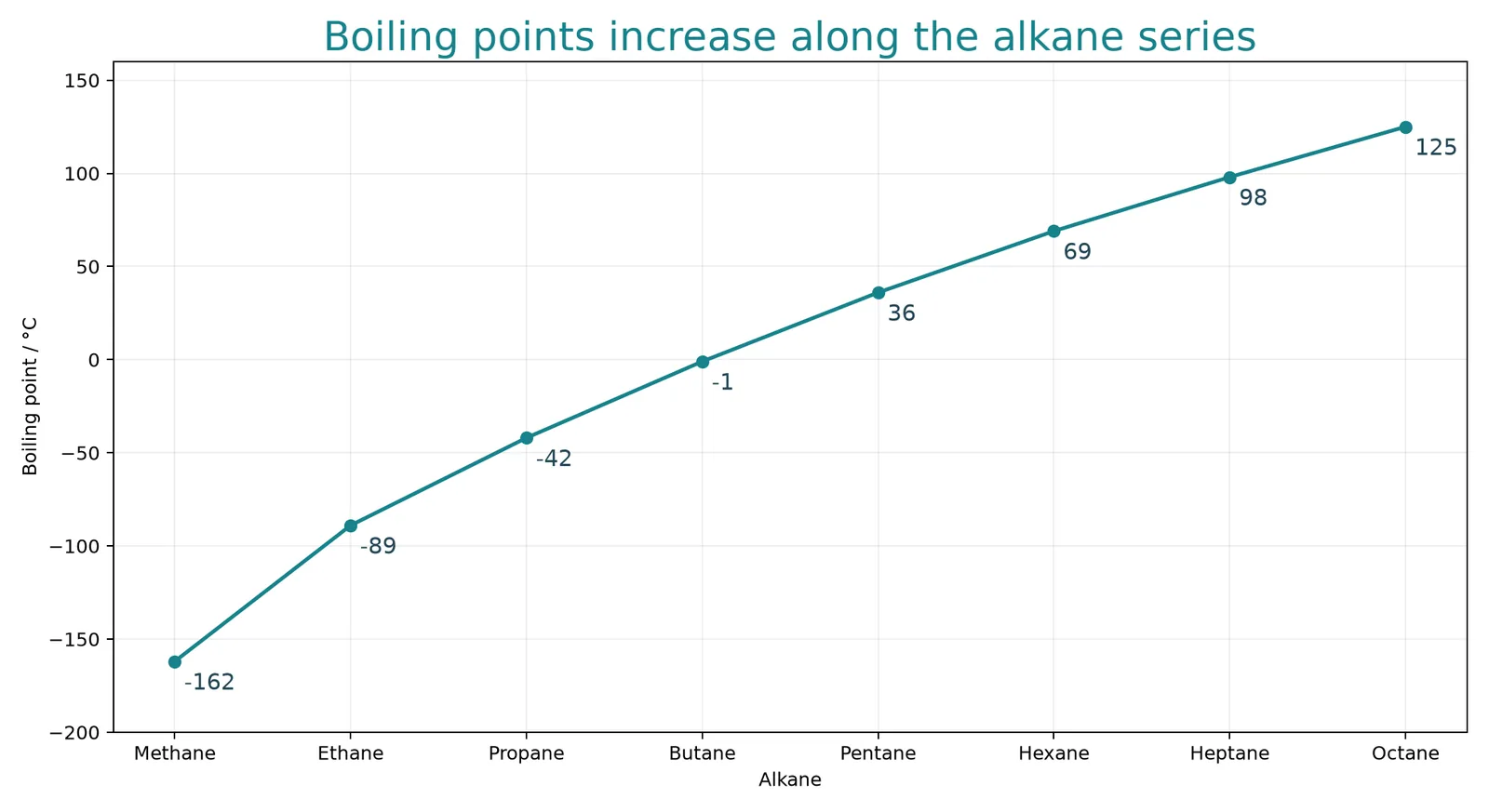
Section 4 of 10Trends as chains get longer
1Stronger forces
- Stronger forces Longer molecules have stronger intermolecular forces between them.
2Higher boiling point
- Higher boiling point More energy is needed to separate the molecules.
3Less volatile and more viscous
- Less volatile and more viscous The liquid evaporates less easily and flows more slowly.
4Harder to ignite
- Harder to ignite The fraction is less flammable and burns with a smokier flame.
Section 5 of 10Approximate chain lengths in each fraction
| Fraction | Carbon atoms per molecule | Boiling point range |
|---|---|---|
| Refinery gases | 1 to 4 | Below about 25 °C |
| Petrol | About 5 to 10 | Low |
| Kerosene | About 10 to 16 | Medium |
| Diesel | About 14 to 20 | Higher |
| Fuel oil | About 20 to 70 | High |
| Bitumen | More than about 70 | Highest; a thick residue left at the bottom |
Section 6 of 10Burning the fractions
Combustion of hydrocarbons
Complete combustion
- Complete combustion With plenty of oxygen a hydrocarbon forms carbon dioxide and water, for example C3H8 + 5O2 → 3CO2 + 4H2O.
Incomplete combustion
- Incomplete combustion With limited oxygen, carbon monoxide and carbon (soot) form as well.
- Longer chains have a higher proportion of carbon, so they burn with a smokier flame.
Energy released
- Energy released All hydrocarbon fuels release energy when they burn, which is why they are used for transport, heating and electricity generation.
Section 7 of 10Matching supply to demand
Imbalance
- Imbalance Crude oil contains more long-chain hydrocarbons than are needed, while there is greater demand for short-chain fuels such as petrol.
Cracking
- Cracking Long molecules are broken into shorter, more useful ones by cracking, which is a separate process carried out after distillation.
Section 8 of 10Fractional distillation in the laboratory
1
Heat the mixture of liquids gently in a flask connected to a fractionating column.
2
Vapours rise and the column provides a temperature gradient, with the coolest region at the top.
3
Collect the liquid that comes off in separate containers at different temperature ranges.
4
Each container holds a fraction with a similar boiling point, and the fractions with the lowest boiling points come off first.
Section 9 of 10Key terms
| Term | Meaning |
|---|---|
| Hydrocarbon | A compound containing only hydrogen and carbon atoms. |
| Fraction | A mixture of hydrocarbons with similar boiling points collected together. |
| Fractional distillation | Separating a mixture of liquids by their different boiling points in a column. |
| Volatile | Evaporating easily because of a low boiling point. |
| Viscosity | How thick a liquid is and how slowly it flows. |
Section 10 of 10Exam technique
1
Thinking the hydrocarbons are separated chemically; the process is physical and uses boiling points.
2
Reversing the columnthe hottest part is at the bottom and the largest molecules are collected there.
3
Writing that fractions are pure compounds; each fraction is still a mixture.
4
Saying that boiling points rise because the molecules break apart; they rise because intermolecular forces get stronger.