Skip to content
Dabour HubLEARN · PRACTICE · EXPLORESign inStudent

2.5.3Structure and Function in Living Organisms

Leaf: Structure and Adaptations

5 min read 9 parts Lesson 16 of 55 1 quiz

0%read

Section 1 of 9The leaf as an organ

Leaf structure and function
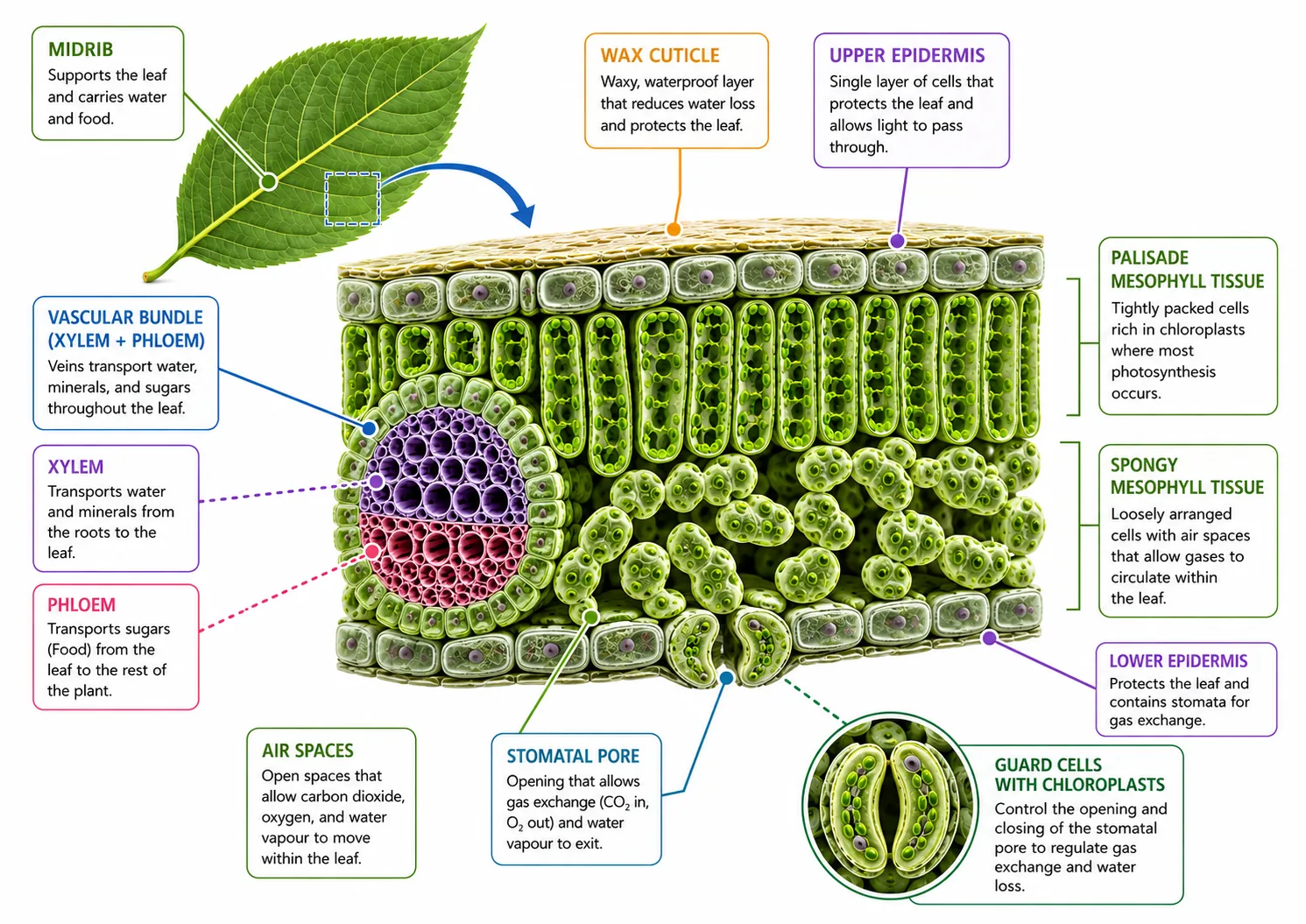
Leaf cross-section with guard cell detail
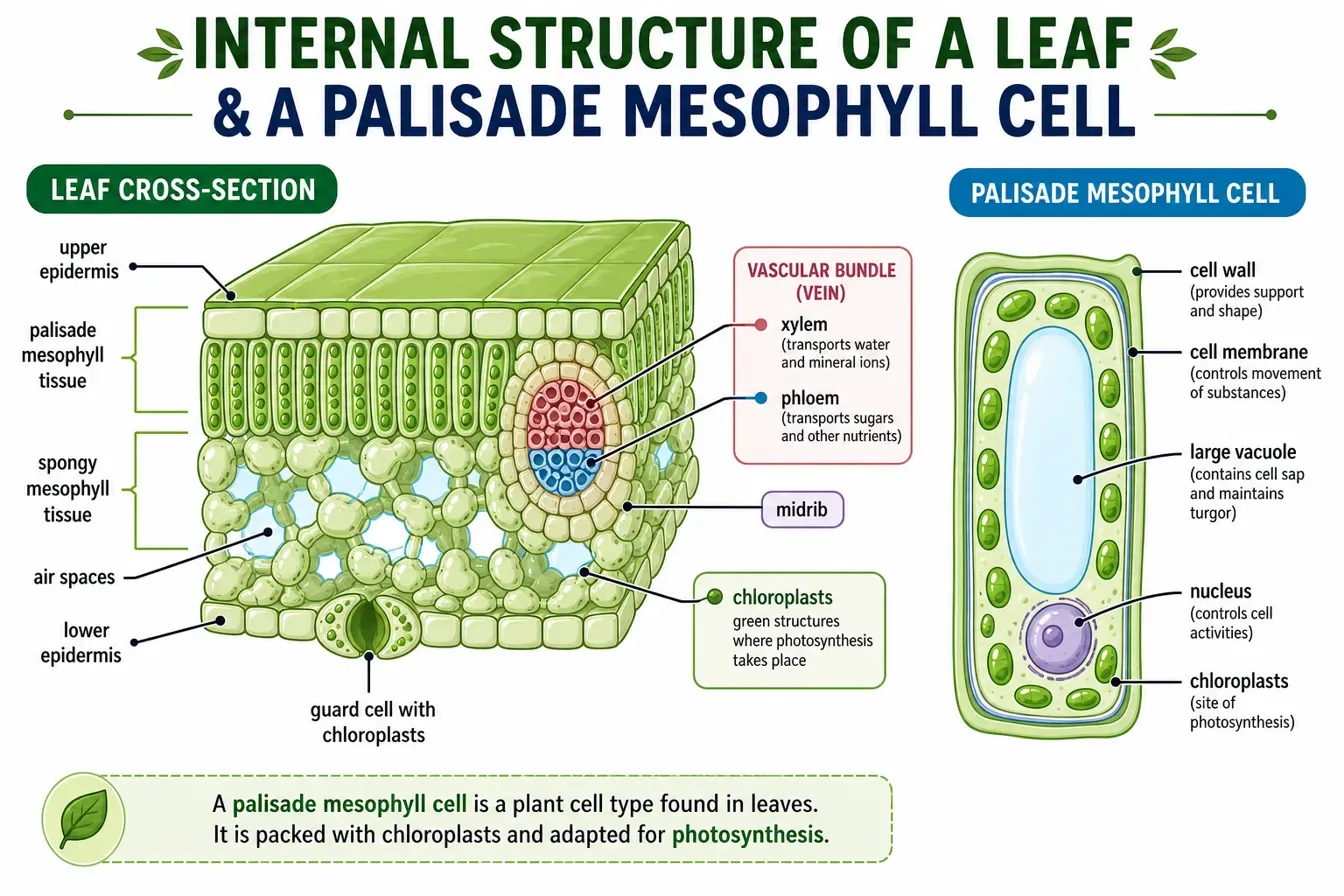
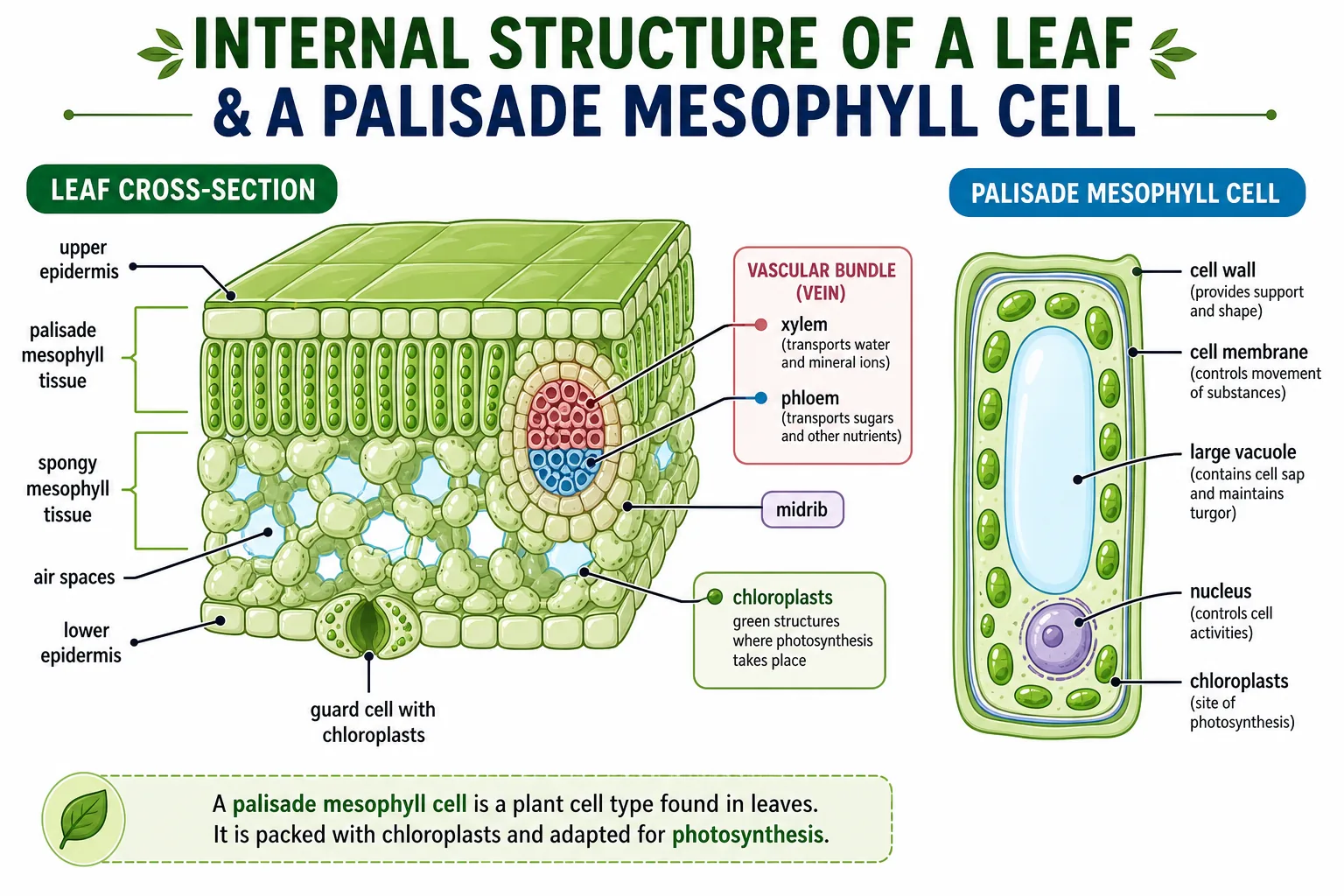
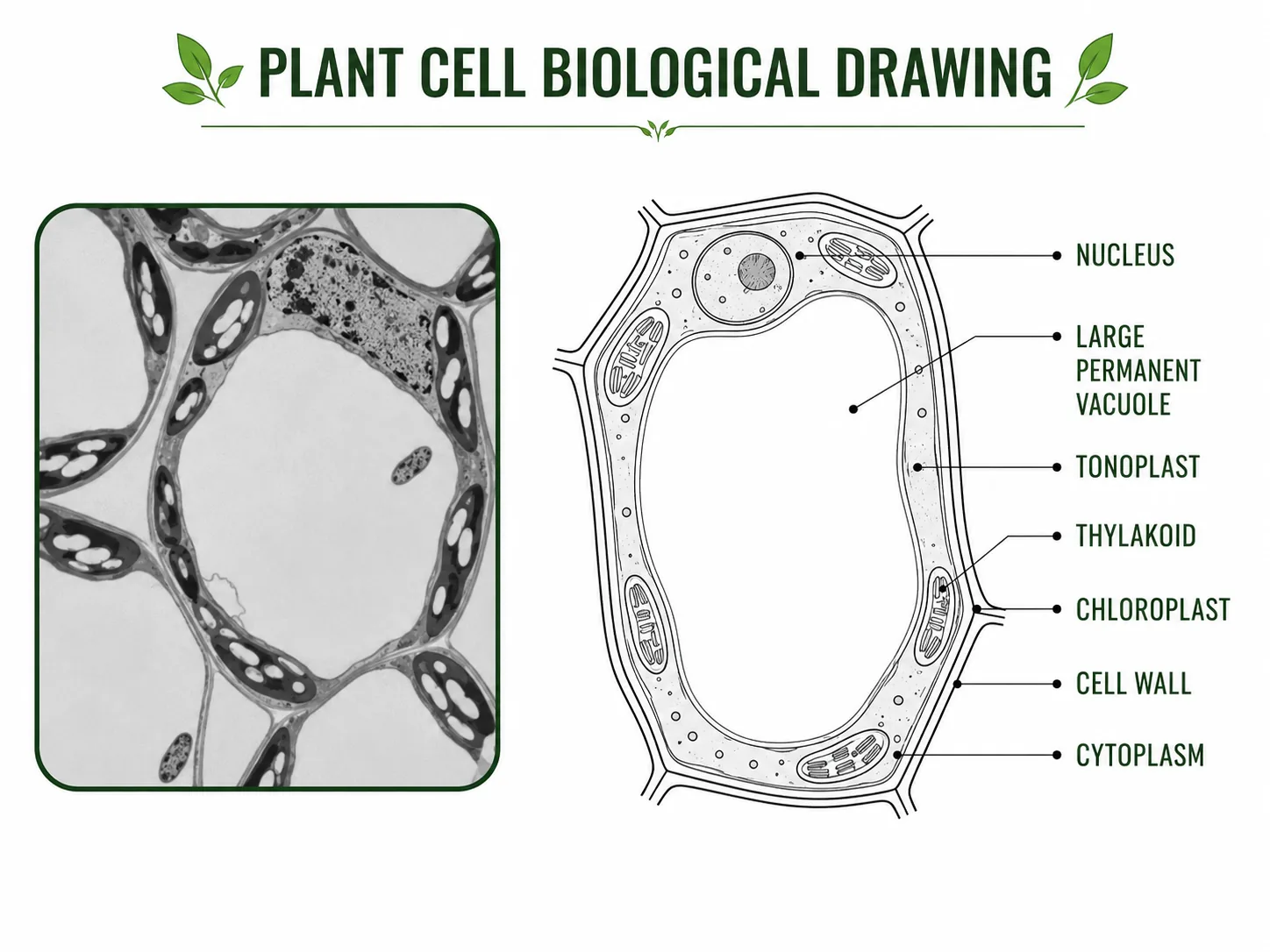
Internal Structure of a Leaf and a Palisade Mesophyll Cell
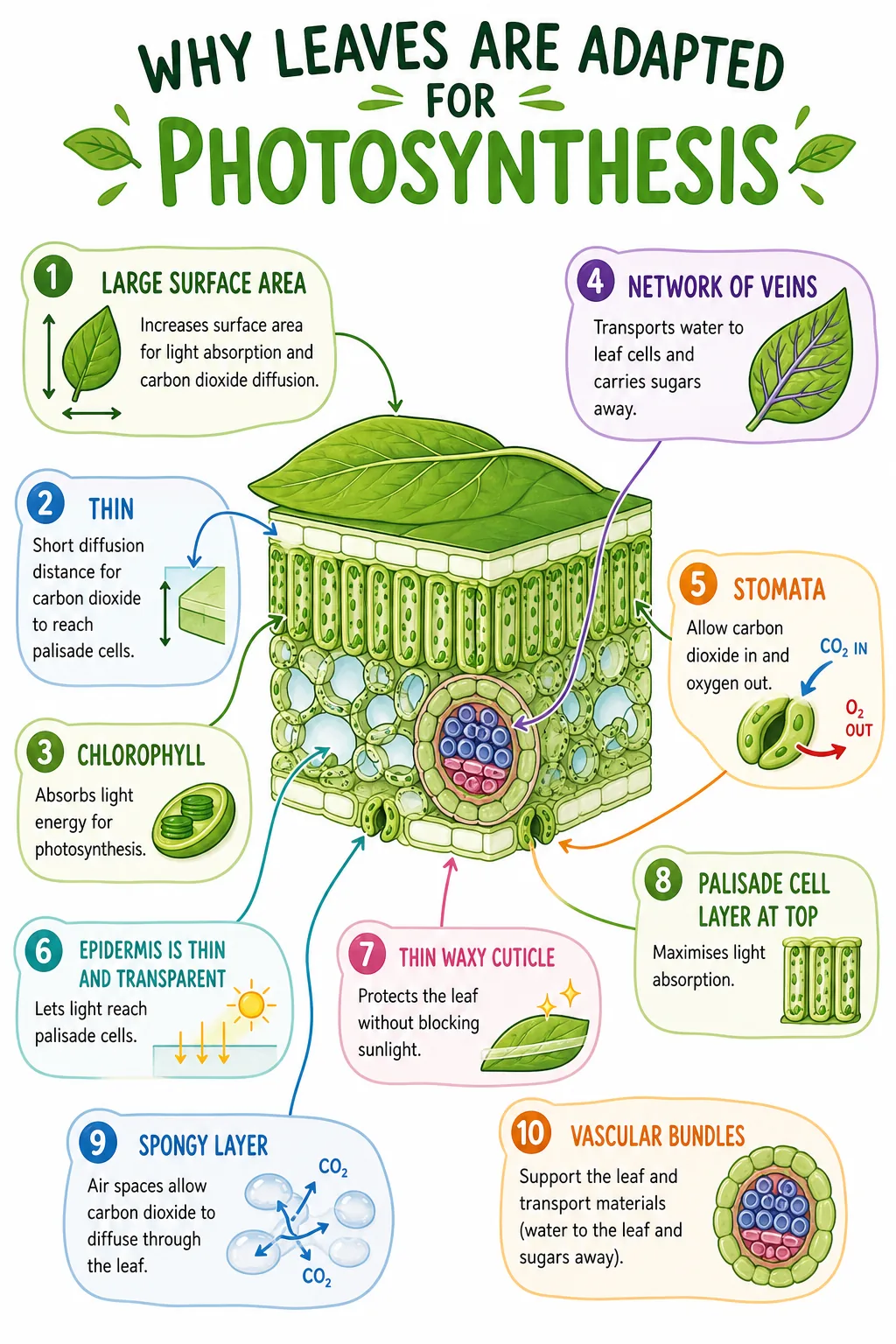
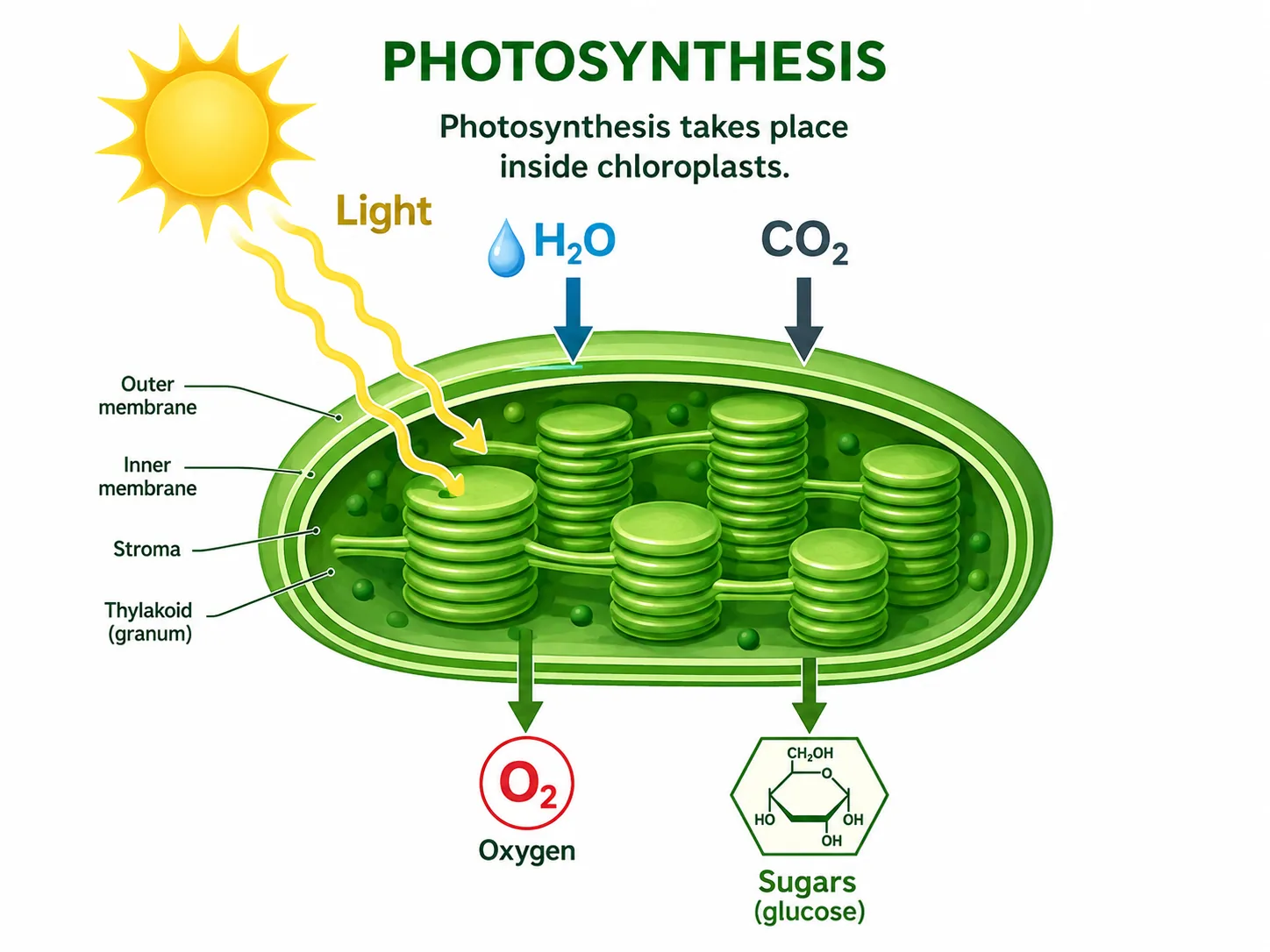
Why Leaves Are Adapted for Photosynthesis

A leaf is an organ whose main function is photosynthesis.

The leaf as an organ
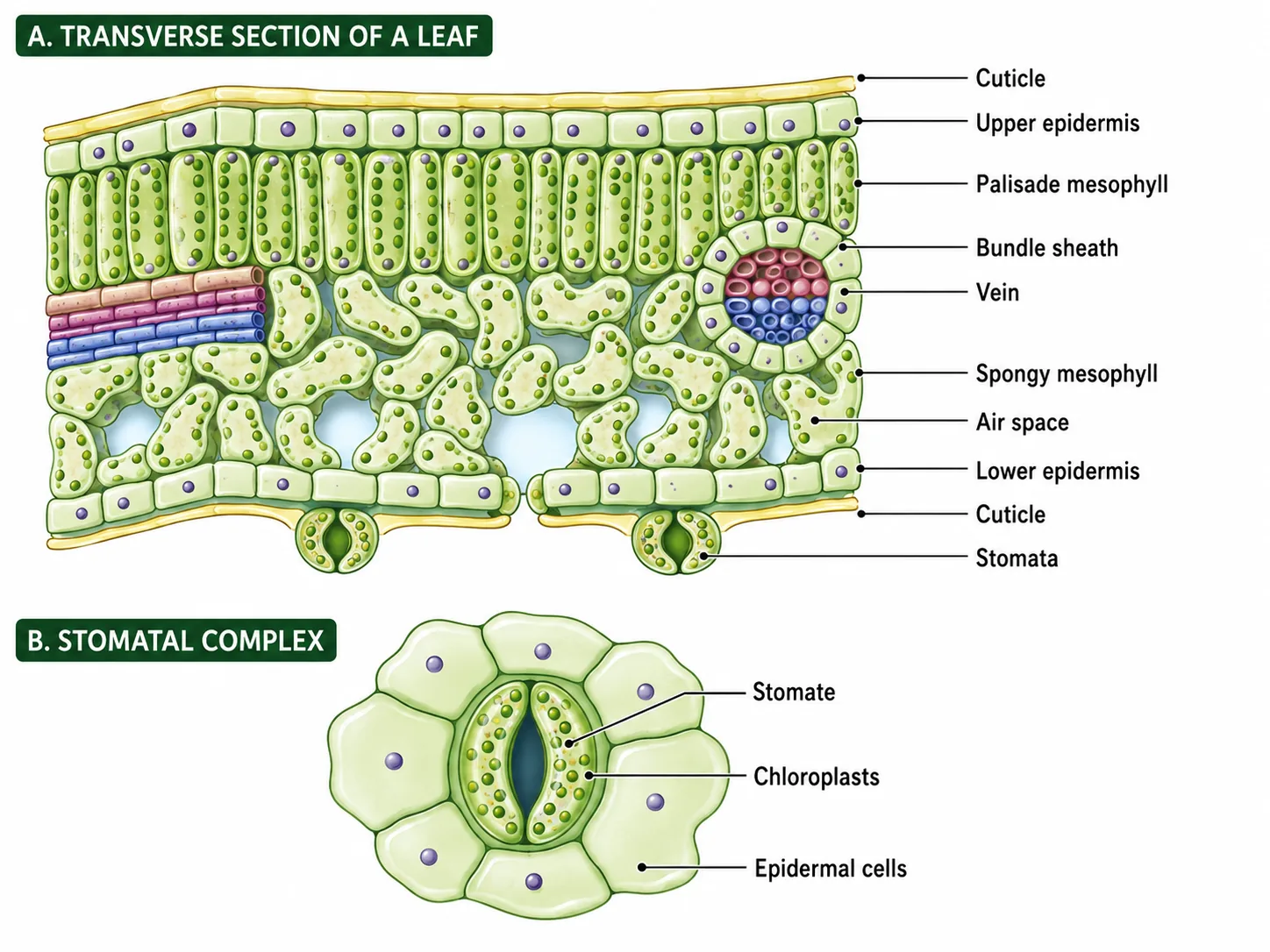
It is thin and flat, giving a large surface area to absorb light and a short diffusion distance for gases.
Its tissues are arranged in layers,
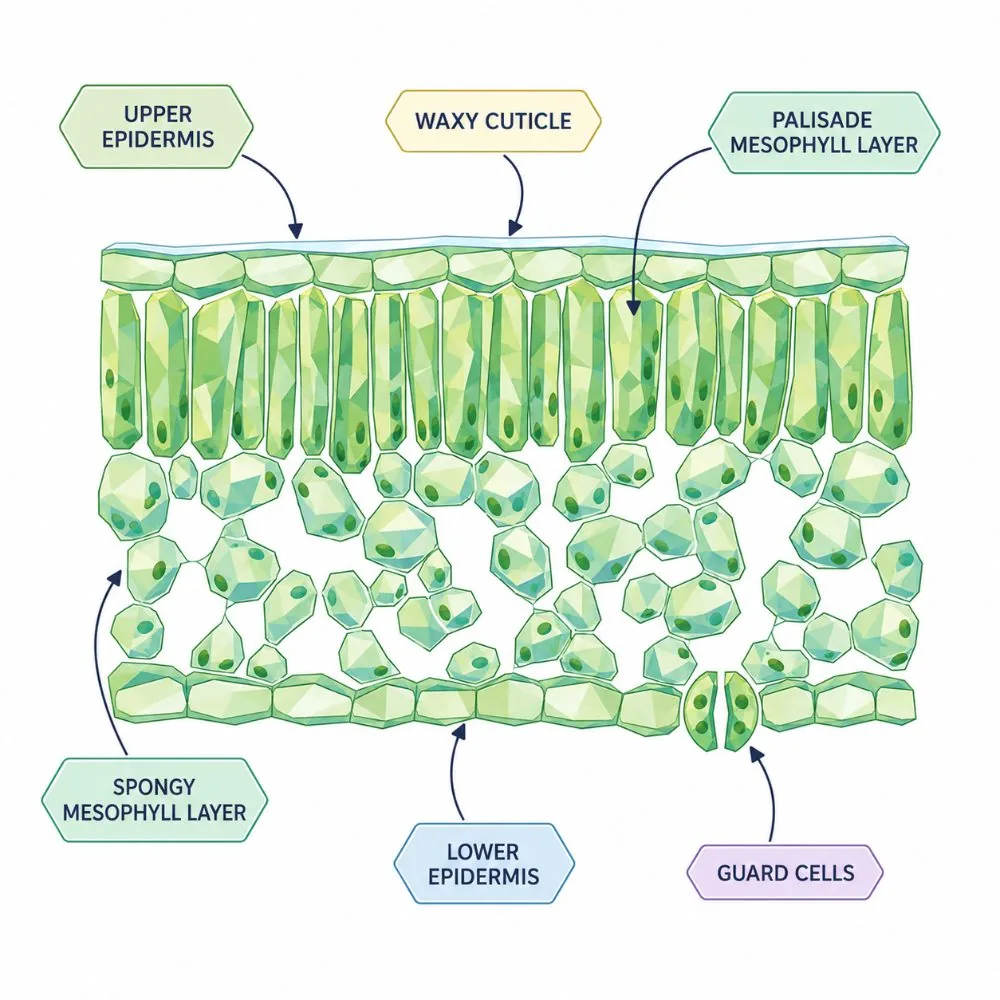
  • from the top downwards: the upper epidermis, the palisade mesophyll, the spongy mesophyll with air spaces, the lower epidermis with stomata,
    • and veins running through the middle.

Section 2 of 9Tissues and their adaptations
pasted 1782296700056 0
pasted 1782296718205 0
TissueStructureFunction and adaptation
Waxy cuticleWaterproof layer on the outsideReduces water loss by evaporation
Upper epidermisThin, transparent layer of cellsProtects the leaf and lets light through to the cells below
Palisade mesophyllTall, tightly packed cells with many chloroplasts, near the topMain site of photosynthesis, as it receives the most light
Spongy mesophyllRounded cells with large air spaces between themAllows gases to diffuse through the leaf to the cells; some photosynthesis
Lower epidermis with stomataContains pores and guard cellsGas exchange: carbon dioxide in, oxygen and water vapour out
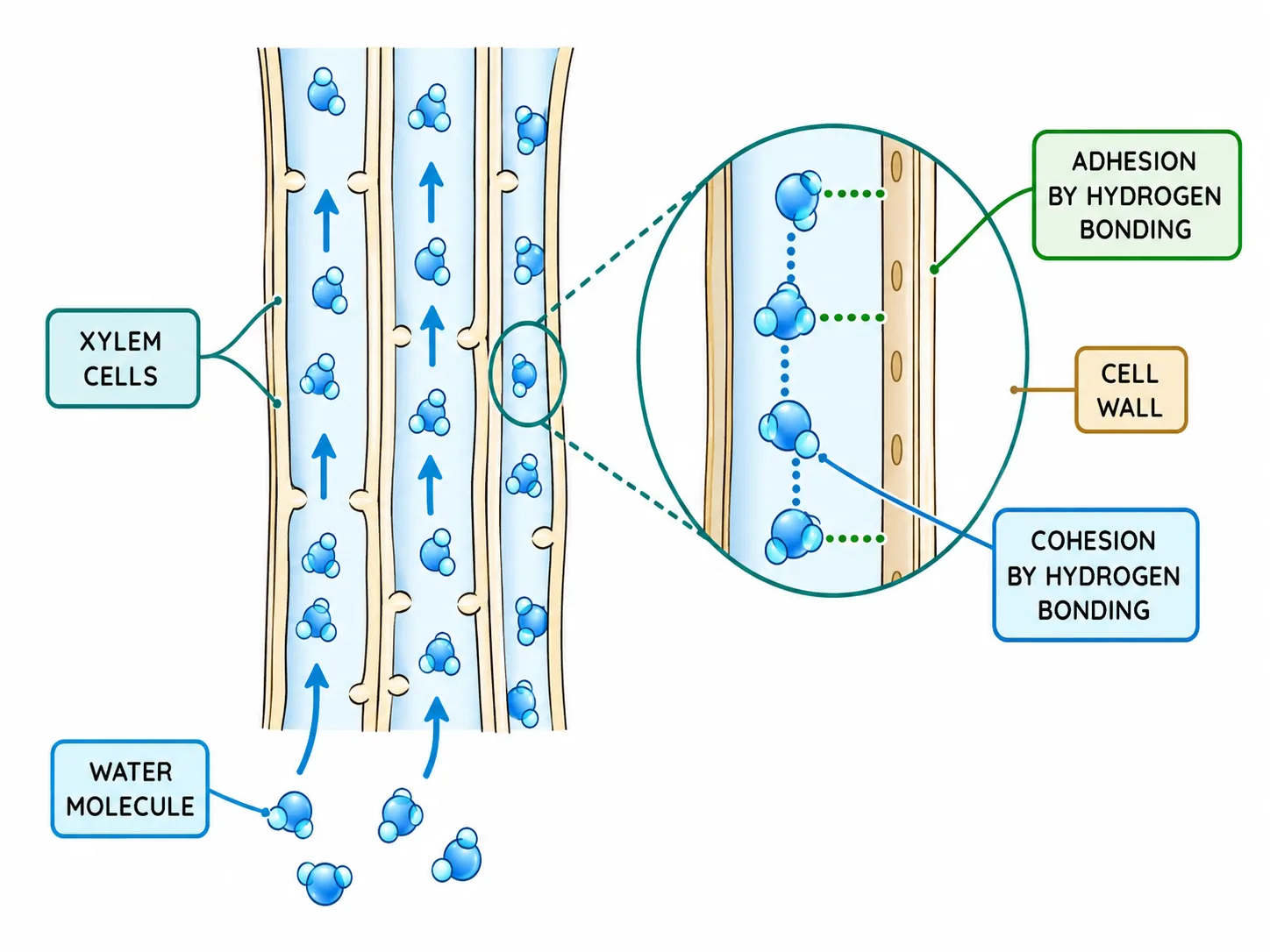
Xylem and phloem in veinsVascular bundlesBring water and take away sugar; the veins support the leaf

Section 3 of 9Stomata and guard cells
Stomata open and closed (guard cells turgid/flaccid)
pasted 1782294394198 0
stoma open closed guard cells
pasted 1782548875669 0
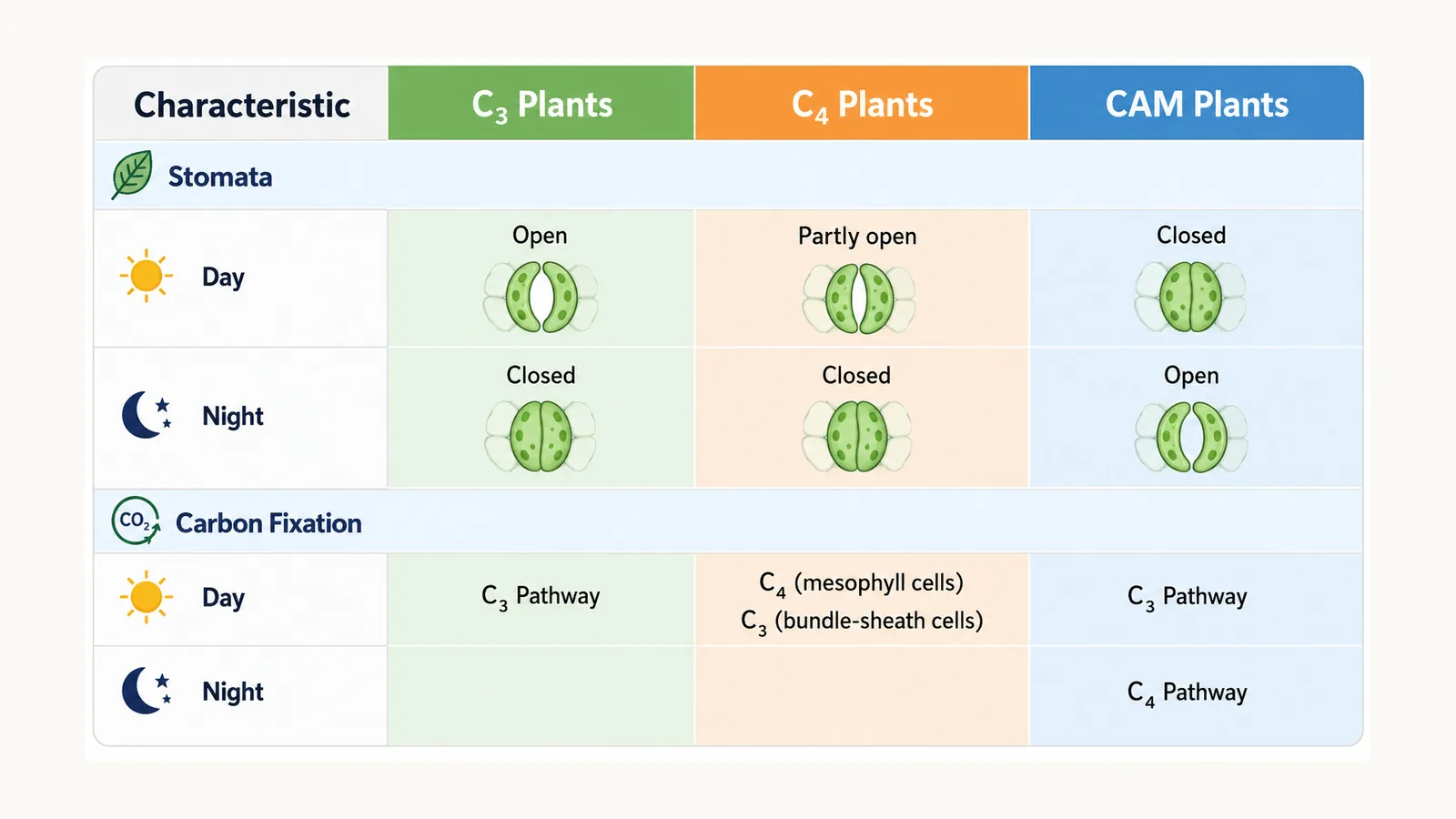
stomata carbon fixation landscape
pasted 1782548880713 0

Stomata are small pores, mostly on the underside of the leaf, where it is cooler and less water is lost.

Guard cells
Each stoma is surrounded by two guard cells.
When water enters the guard cells by osmosis, they swell and become turgid.
Their inner walls are thicker, so they bend and curve apart, opening the pore.
When they lose water, they become flaccid, and close.
This opening and closing controls gas exchange and water loss.
Stomata are usually open in daylight so that carbon dioxide can enter for photosynthesis,
  • and close at night or when the plant is short of water, to avoid wilting.
Because a closed stoma stops carbon dioxide entering, hot dry conditions can slow photosynthesis.

Section 4 of 9Gas exchange and diffusion

The Human Gas-Exchange System
The Human Gas Exchange System
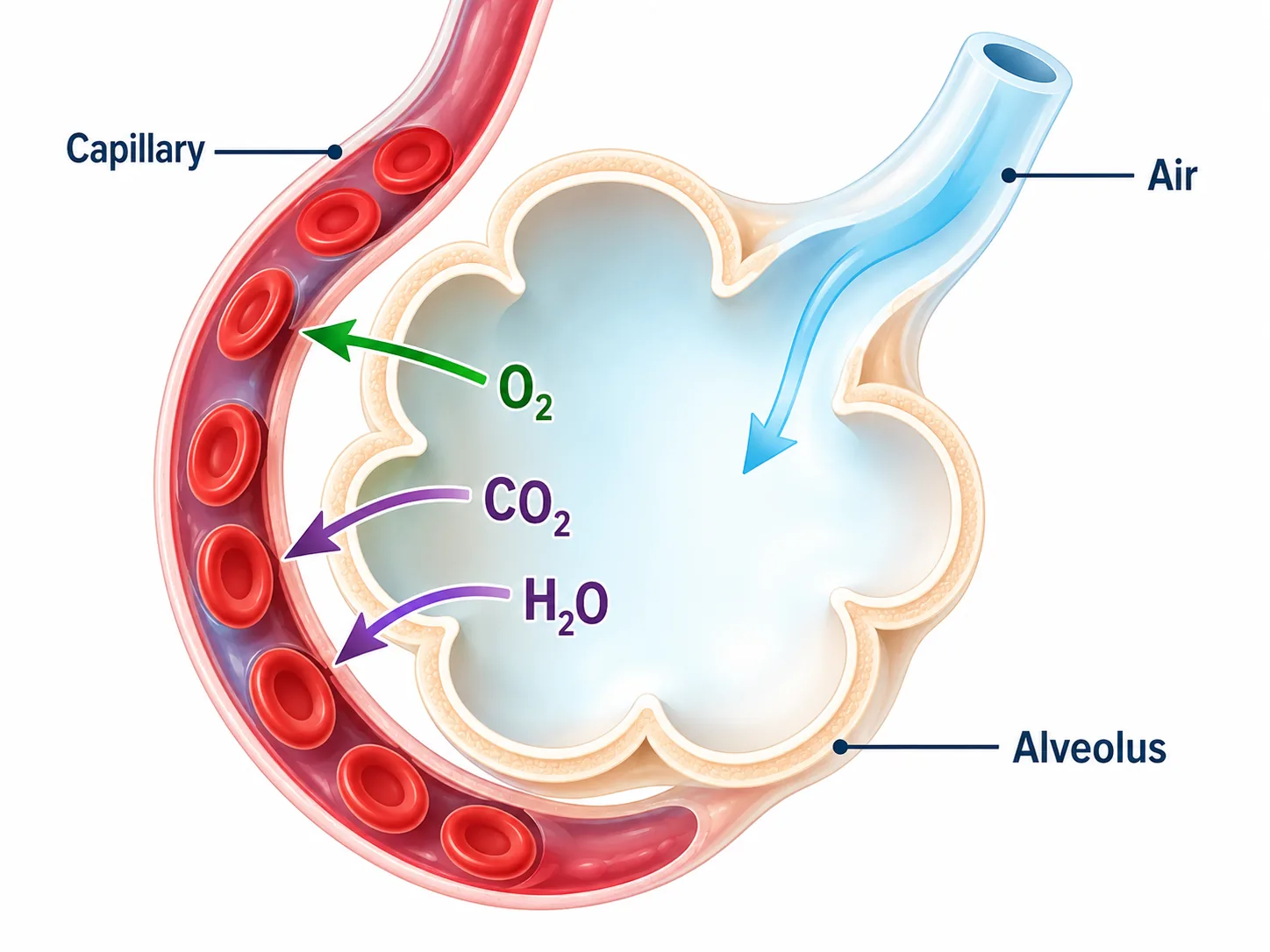
Gas Exchange at an Alveolus
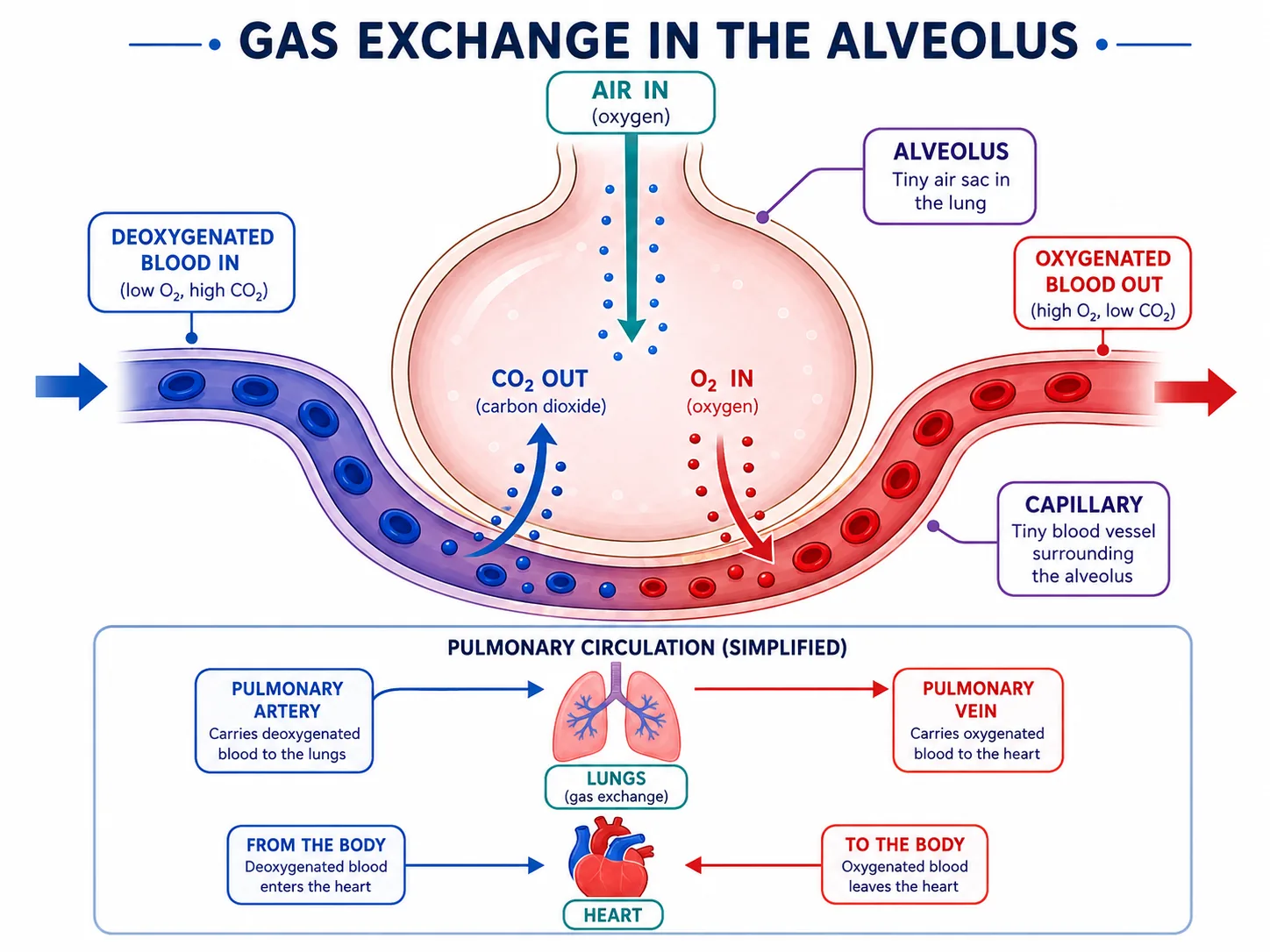
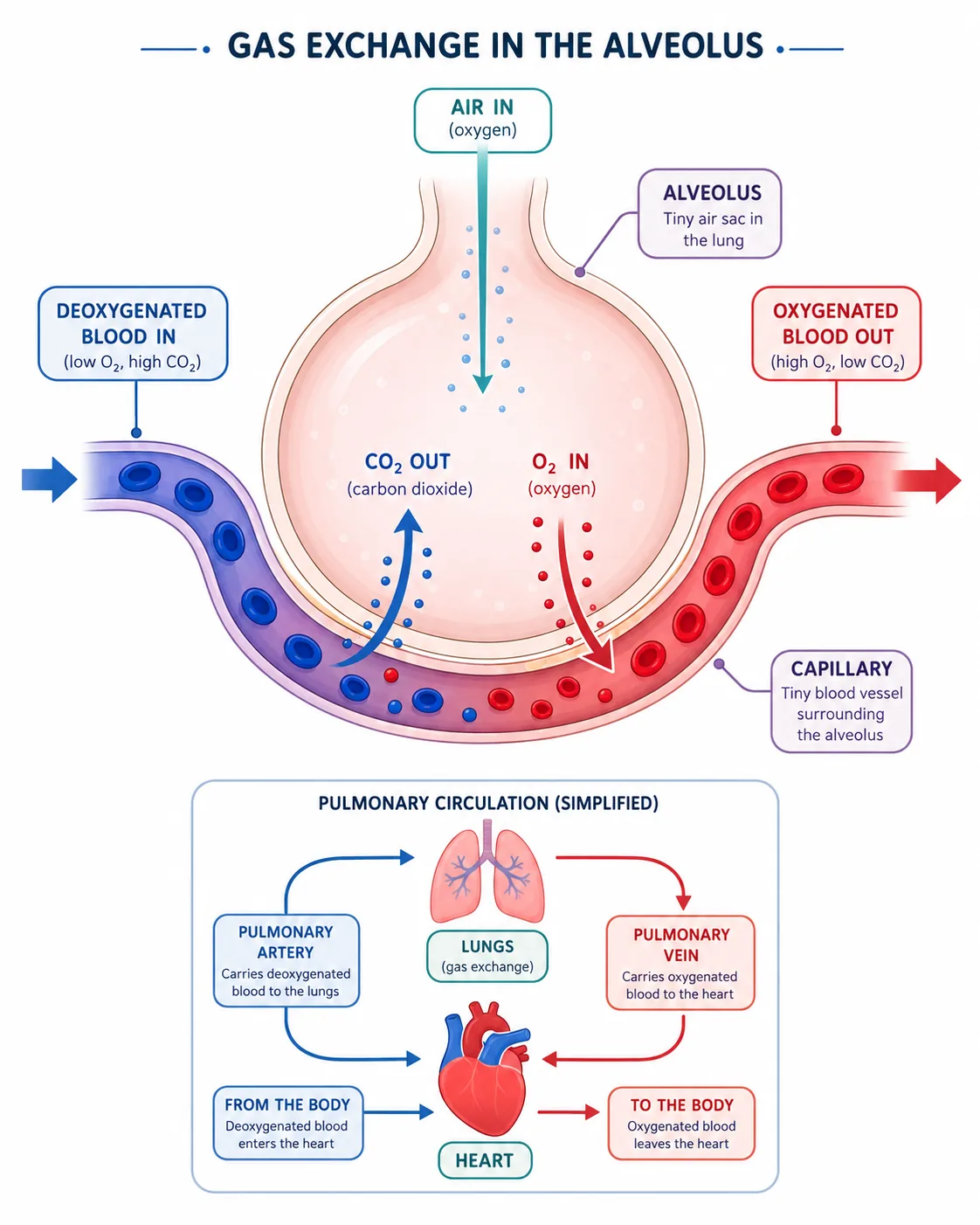
Gas Exchange in the Alveolus
Gas Exchange at an Alveolus
alveolus gas exchange landscape
pasted 1782296383125 0
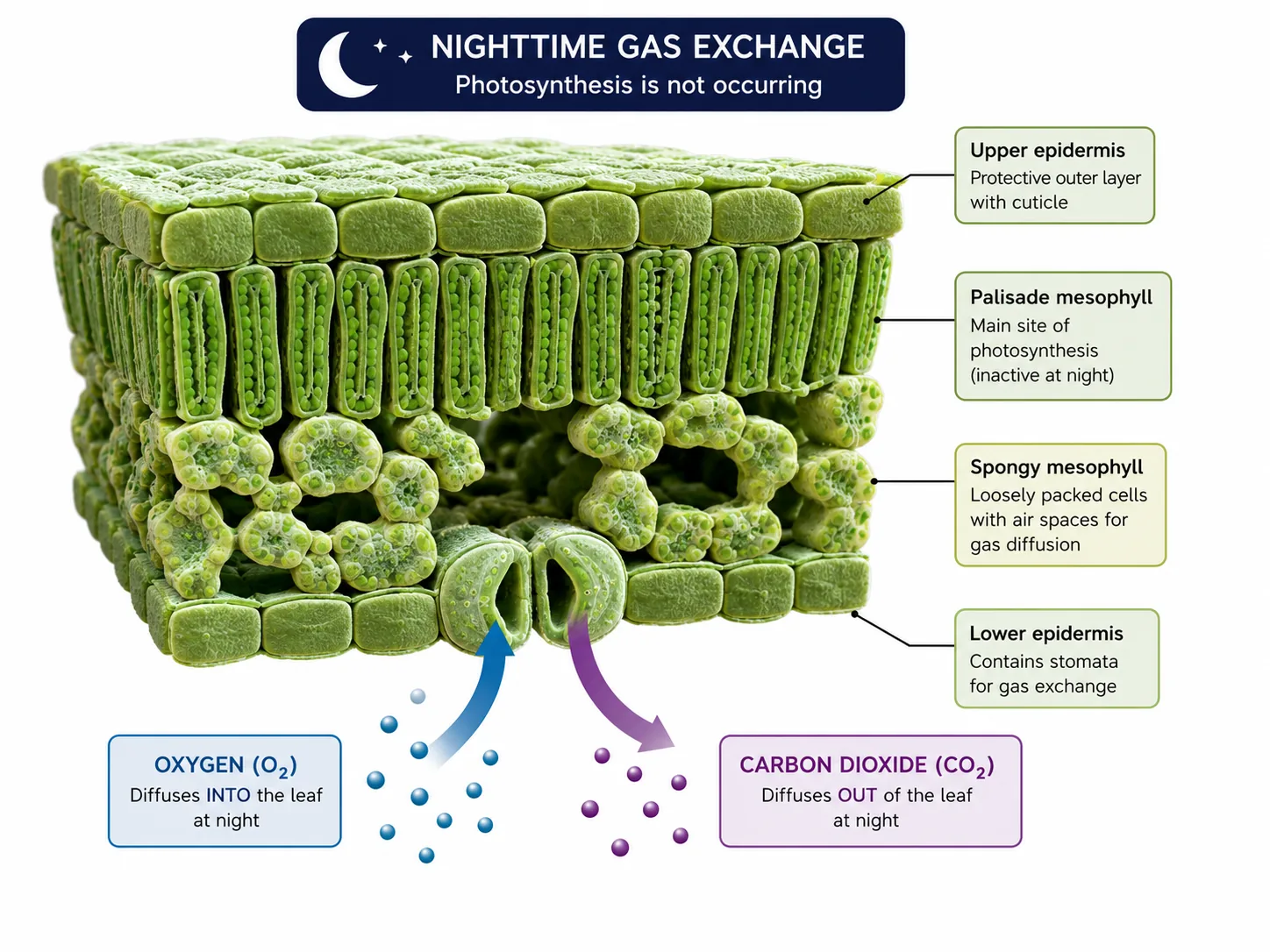
Nighttime gas exchange in a leaf
Gas exchange at an alveolus
Alveolus — Gas Exchange (Continuous Simulation)
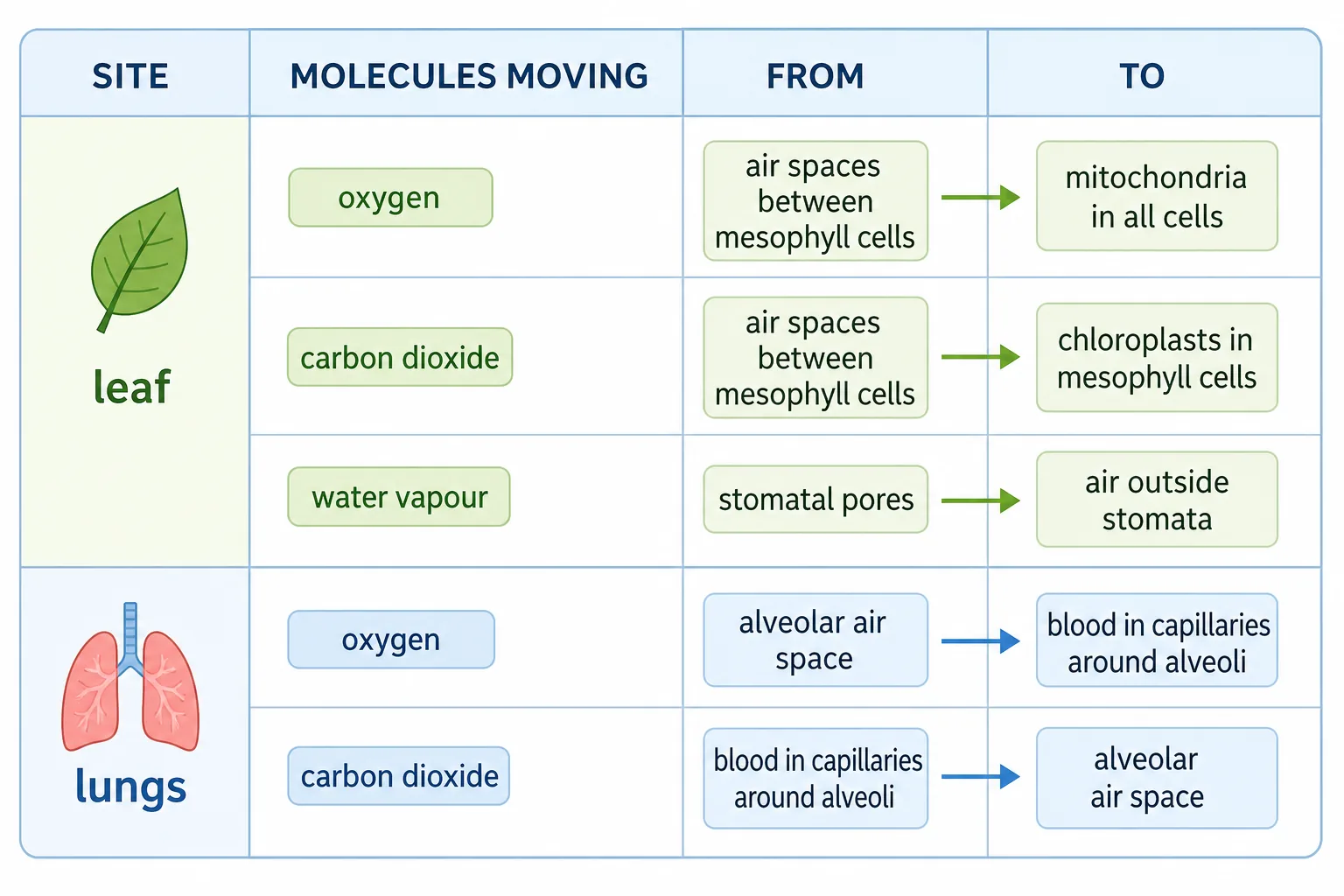
Gas exchange table
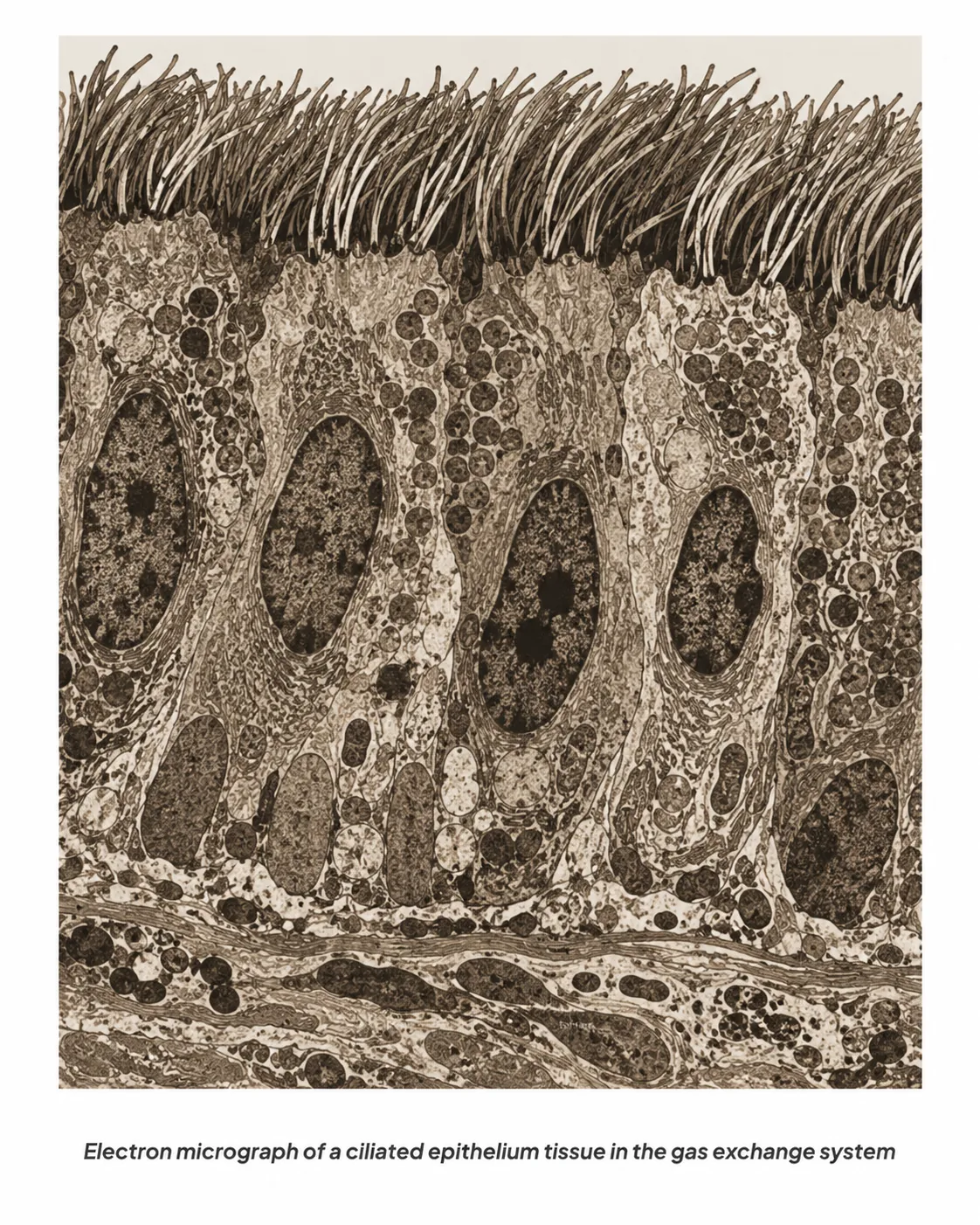
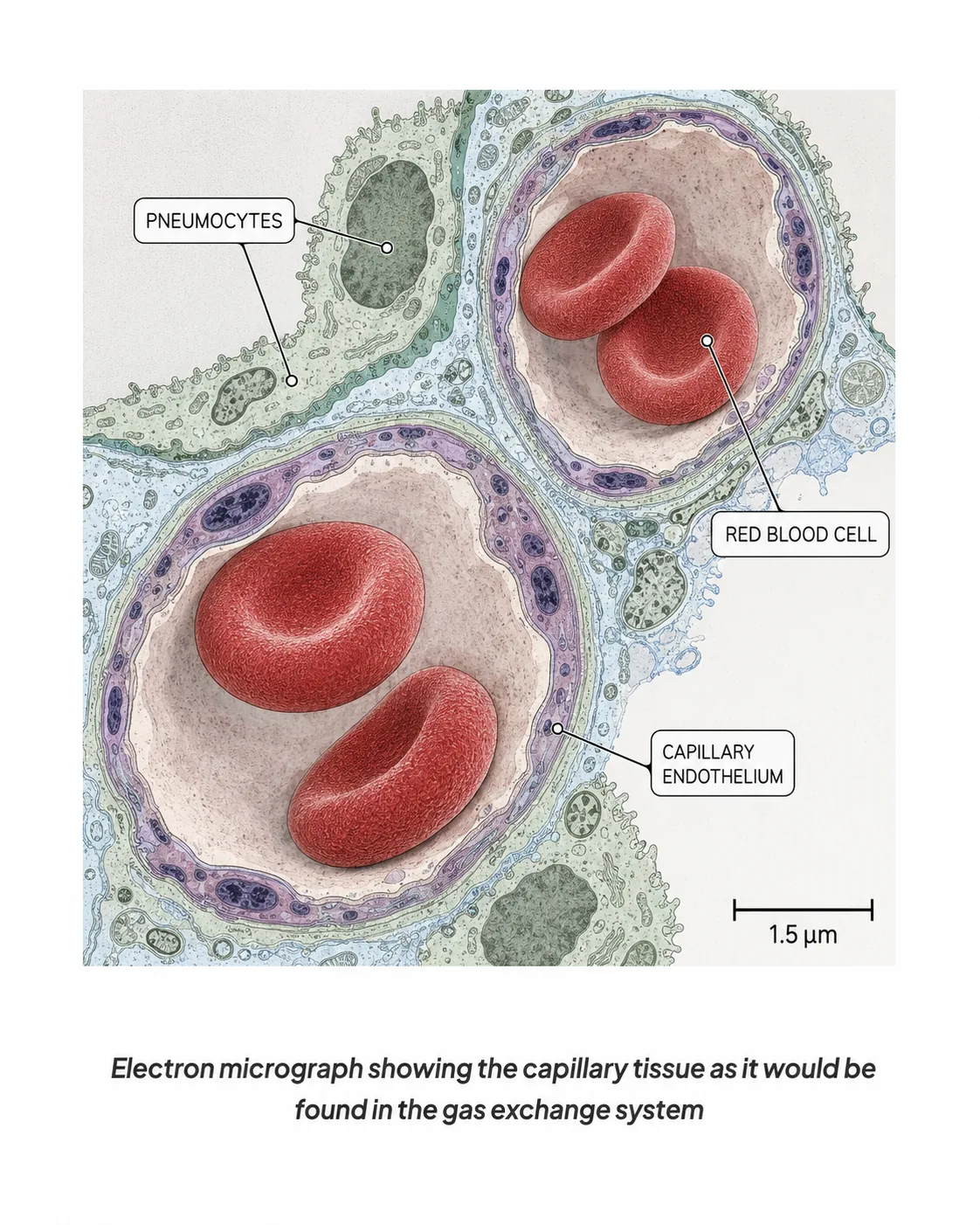
Capillary tissue in the gas exchange system
The Human Gas Exchange System
Alveoli specialised for gas exchange
Single-celled protist: gas exchange by diffusion
Alveoli: specialised for gas exchange
Leaf Gas Exchange – Hydrogen Carbonate Indicator Simulation

Carbon dioxide diffuses into the leaf through the stomata and moves through the air spaces of the spongy mesophyll to the palisade cells, down a concentration gradient maintained because palisade cells use it up.

Gas exchange and diffusion
Oxygen produced in photosynthesis diffuses out the other way.
The cells are covered by a thin film of water, in which gases dissolve before entering.
The large surface area of the mesophyll cells in contact with air spaces speeds up this diffusion, a feature you can compare with alveoli in lungs.

Section 5 of 9Leaf adaptations for different environments
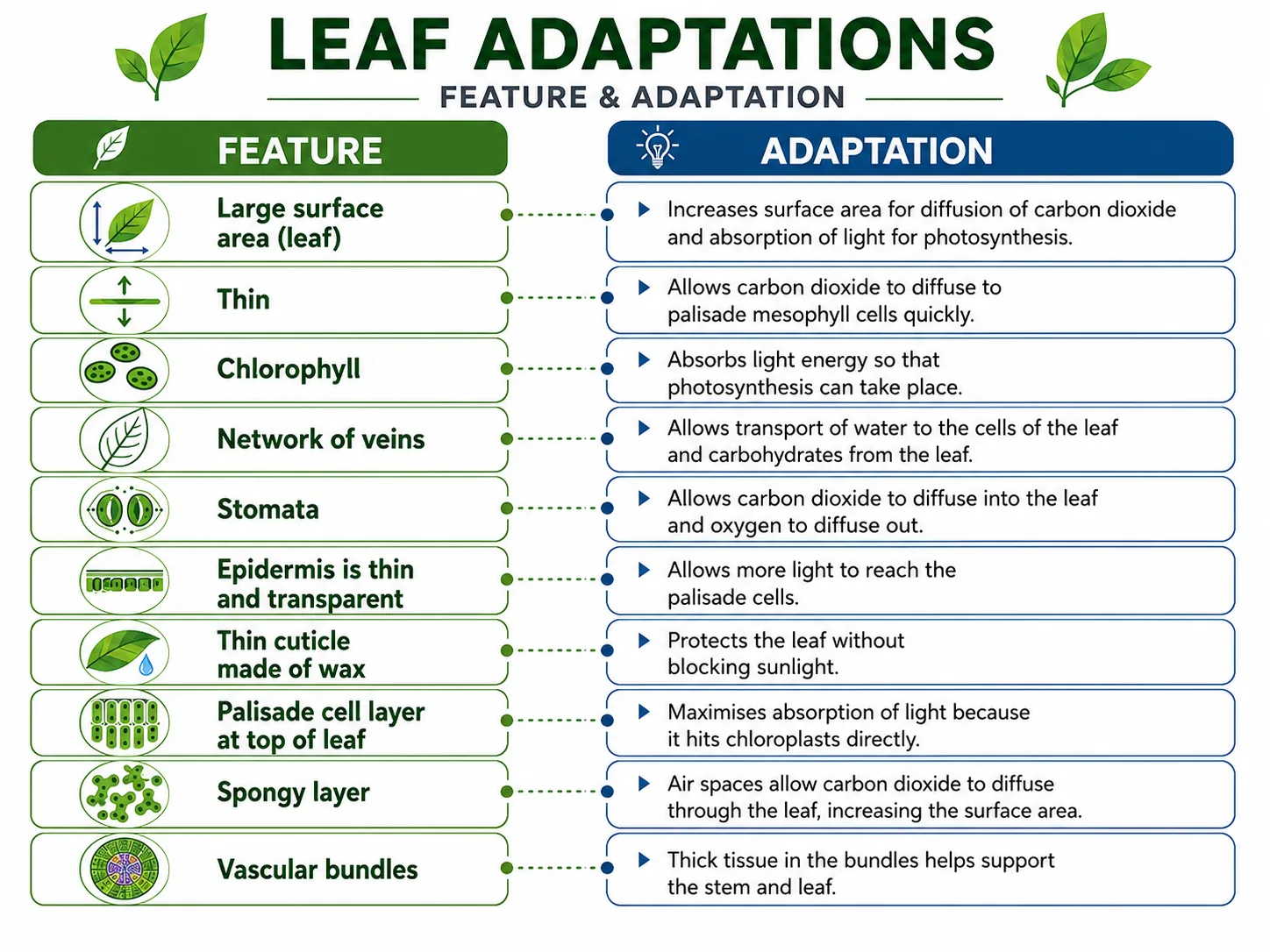
Leaf adaptations
Leaf section showing water loss through an open stoma
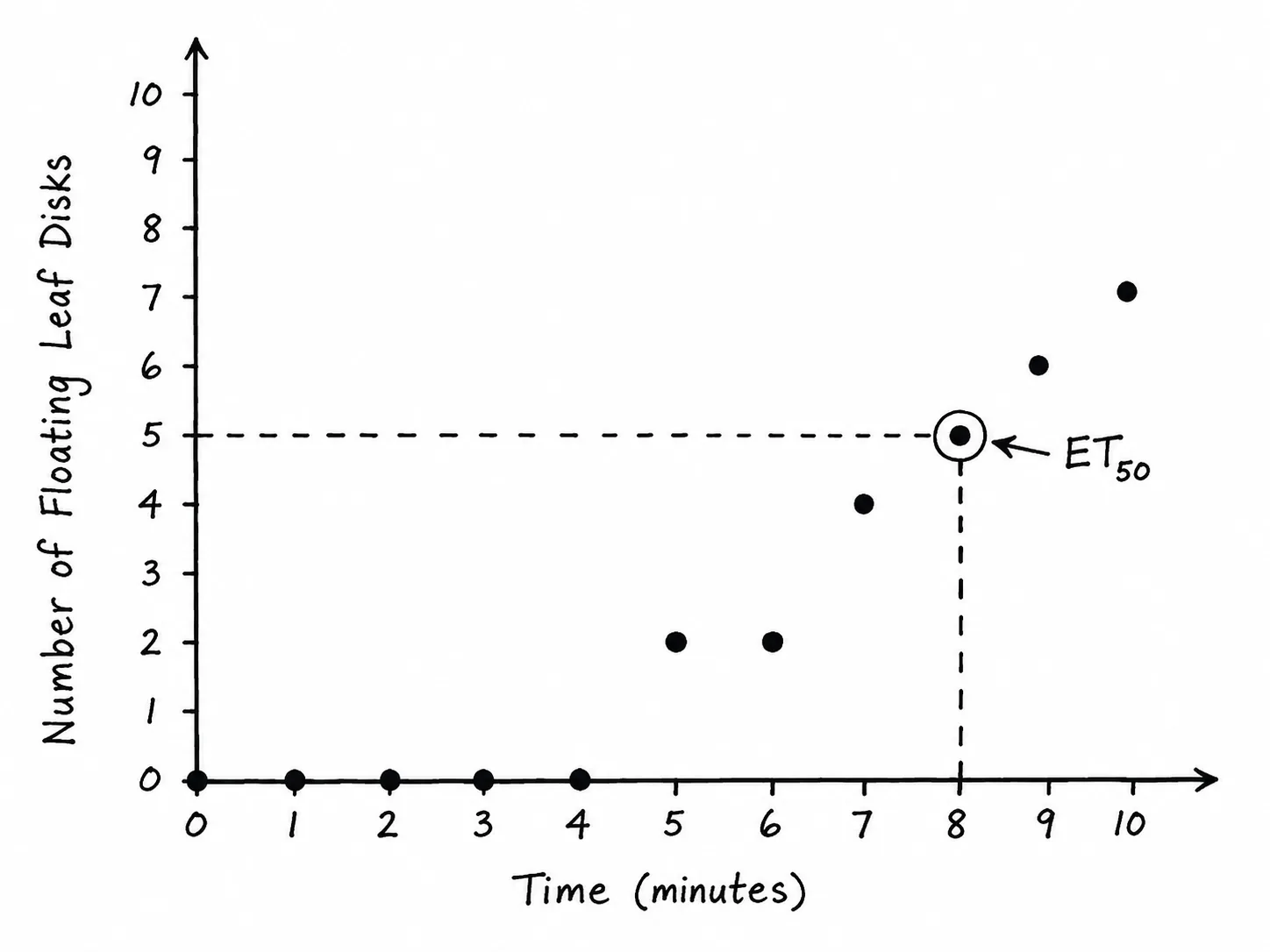
Floating Leaf Disk ET50
How leaves are adapted for photosynthesis

Leaf structure varies with habitat.

Leaf adaptations for different environments
Plants of dry places have thicker cuticles and fewer or sunken stomata,
  • which reduces water loss,
  • while plants floating on water have stomata on the upper surface,
  • because the lower surface is in contact with the water.
Shade plants tend to have thinner leaves and larger surface area to catch weak light.
More about these adaptations appears in the lesson on extreme conditions.

Section 6 of 9Drawing and calculating from leaf sections

Cross-section of a leaf (labelled layers)
Leaf cross-section (labelled layers)
Leaf cross-section (labelled)
Leaf cross-section with labelled tissues
leaf cross section landscape
Plant Cell Biological Drawing — Click-by-Click Animation
Magnification calculation: leaf cross-section
Leaf cross-section with enlarged palisade mesophyll cell
Leaf cross-section and magnified palisade mesophyll cell
Leaf cross-section (labelled layers)
Artery vs vein cross-section (tunica layers)

Questions often provide a micrograph of a leaf cross-section and ask you to label tissues or calculate magnification.

Drawing and calculating from leaf sections
To identify the palisade layer, look for elongated cells just below the upper epidermis with dark green chloroplasts; spongy mesophyll cells are rounder with gaps.
Magnification = size of image / size of real object,
  • so if a palisade cell measures 30 mm in the image and its real length is 0.06 mm, magnification = 30 / 0.06 = x500.
  • Remember to convert units consistently.
Stomatal density, the number of stomata per mm2, can be counted from nail varnish impressions of the leaf surface under the microscope.

Different leaf layers also affect the rate of photosynthesis in the practical context.

1
Because the upper epidermis is transparent and has no chloroplasts (except guard cells), light passes straight through.
2
The cuticle is thicker on the upper surface, where the Sun heats the leaf.
3
The lower epidermis has many stomata,
  • which can open and close;
    • the opening is controlled by the water content of guard cells and by light level and carbon dioxide concentration.
4
If the plant is losing too much water, a hormone signal causes the guard cells to lose water, so the stomata close.
5
This protects the plant from wilting but reduces photosynthesis.
6
The cooling effect of evaporation from the leaf also helps keep the leaf from overheating.
7
The veins branch through the leaf so that every cell is close to a vessel, meaning that water and sugar travel only a short distance by diffusion.

Section 7 of 9Exam-style questions
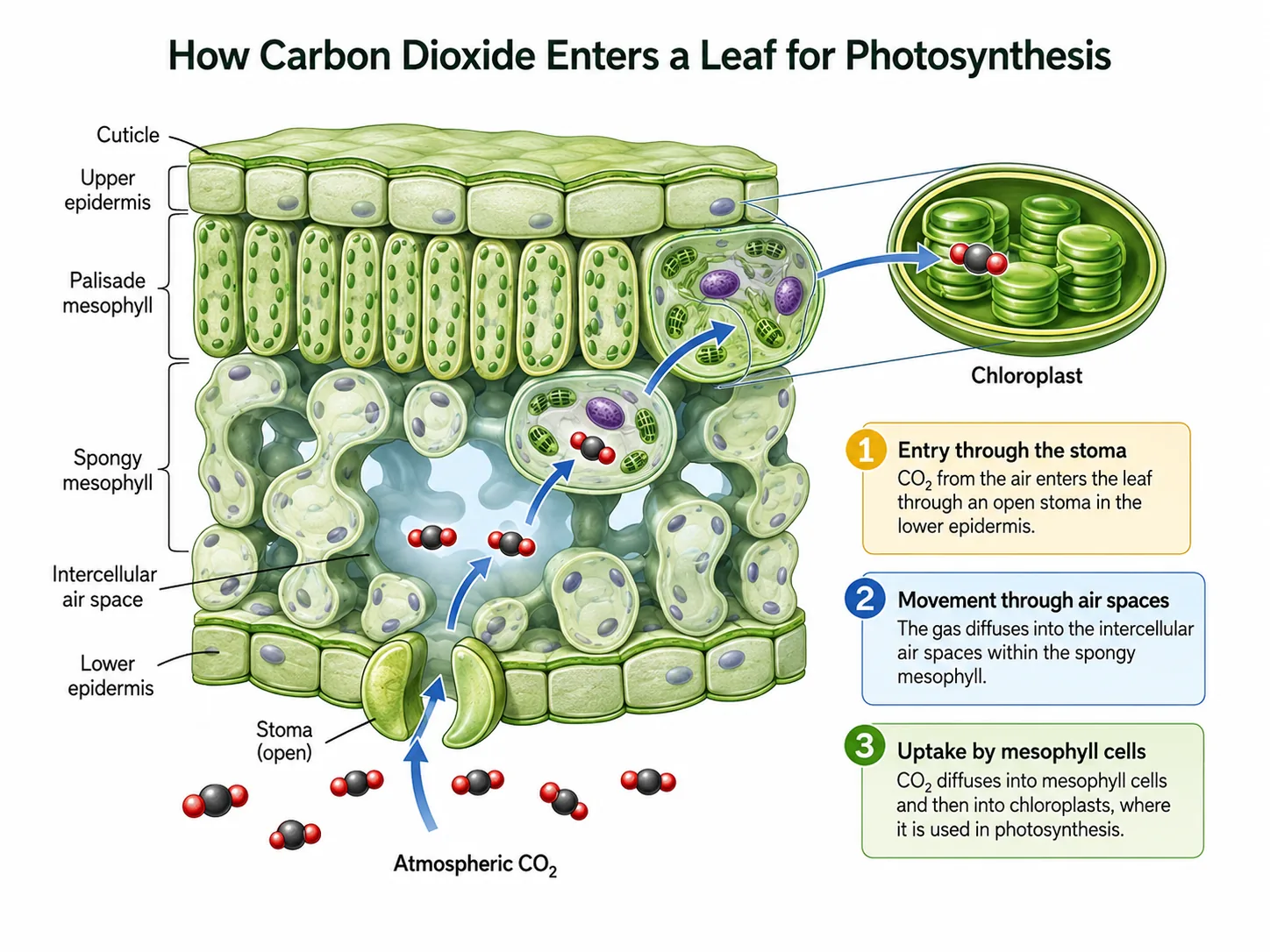
How carbon dioxide enters a leaf for photosynthesis
photosynthesis chloroplast
Leaf cross-section: carbon dioxide enters, oxygen exits
  1. Explain why most chloroplasts are in the palisade layer. [2]2 marks

  2. Describe how guard cells open a stoma. [3]3 marks

  3. Explain why the leaf has air spaces in the spongy mesophyll. [2]2 marks

Section 8 of 9Key terms

Water movement through a leaf (xylem, spongy mesophyll, stoma)
leaf cross section and stomatal complex
leaf cross section stomata
TermMeaning
Palisade mesophyllThe layer of tall cells with many chloroplasts where most photosynthesis occurs.
Spongy mesophyllA layer of loosely packed cells with air spaces.
StomaA pore in the leaf epidermis for gas exchange.
Guard cellOne of a pair of cells that control the opening of a stoma.
CuticleA waxy waterproof layer on the leaf surface.
TurgidSwollen and firm because of water pressure inside the cell.
EpidermisThe outer layer of cells of a leaf.

Section 9 of 9Exam technique

1
Saying stomata are in the cuticle. They are pores in the epidermis.
2
Stating that guard cells open when they lose water.
3
Saying that all the leaf cells have the same number of chloroplasts. Palisade cells have the most.
4
Thinking oxygen enters the leaf in photosynthesis. Oxygen leaves; carbon dioxide enters.
\n