2.6.3Structure and Function in Living Organisms
Practical: Investigating Respiration
5 min read 9 parts Lesson 27 of 55 Unit quiz
Section 1 of 9What can be measured?


The rate of respiration can be investigated by measuring the product made or the reactant used. Common methods are:
These methods allow you to investigate how a factor such as temperature, type of sugar or the species affects the rate.
Section 2 of 9Germinating seeds in a vacuum flask
Respiring seeds release heat energy. Equipment: two vacuum flasks, a thermometer in each, germinating peas (live) in one flask and boiled or dead peas (control) in the other. To prevent microbial growth the seeds are first washed in a disinfectant solution. The cotton wool plug is used to allow gas exchange but reduce heat loss.
The temperature in the flask with the living peas rises because respiration releases heat, while the boiled peas show no rise. This is evidence that respiration releases heat energy.
Section 3 of 9Yeast and carbon dioxide production
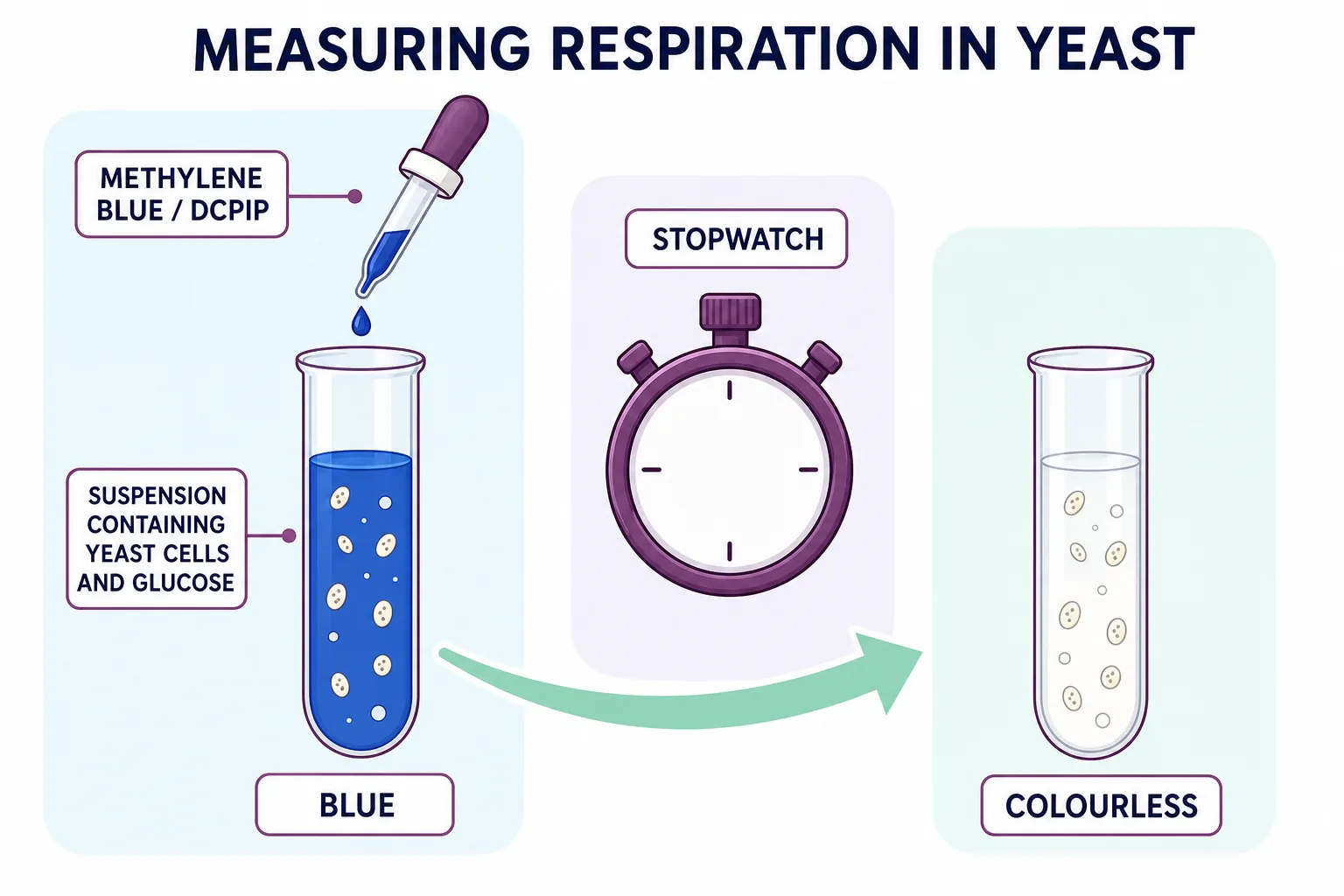

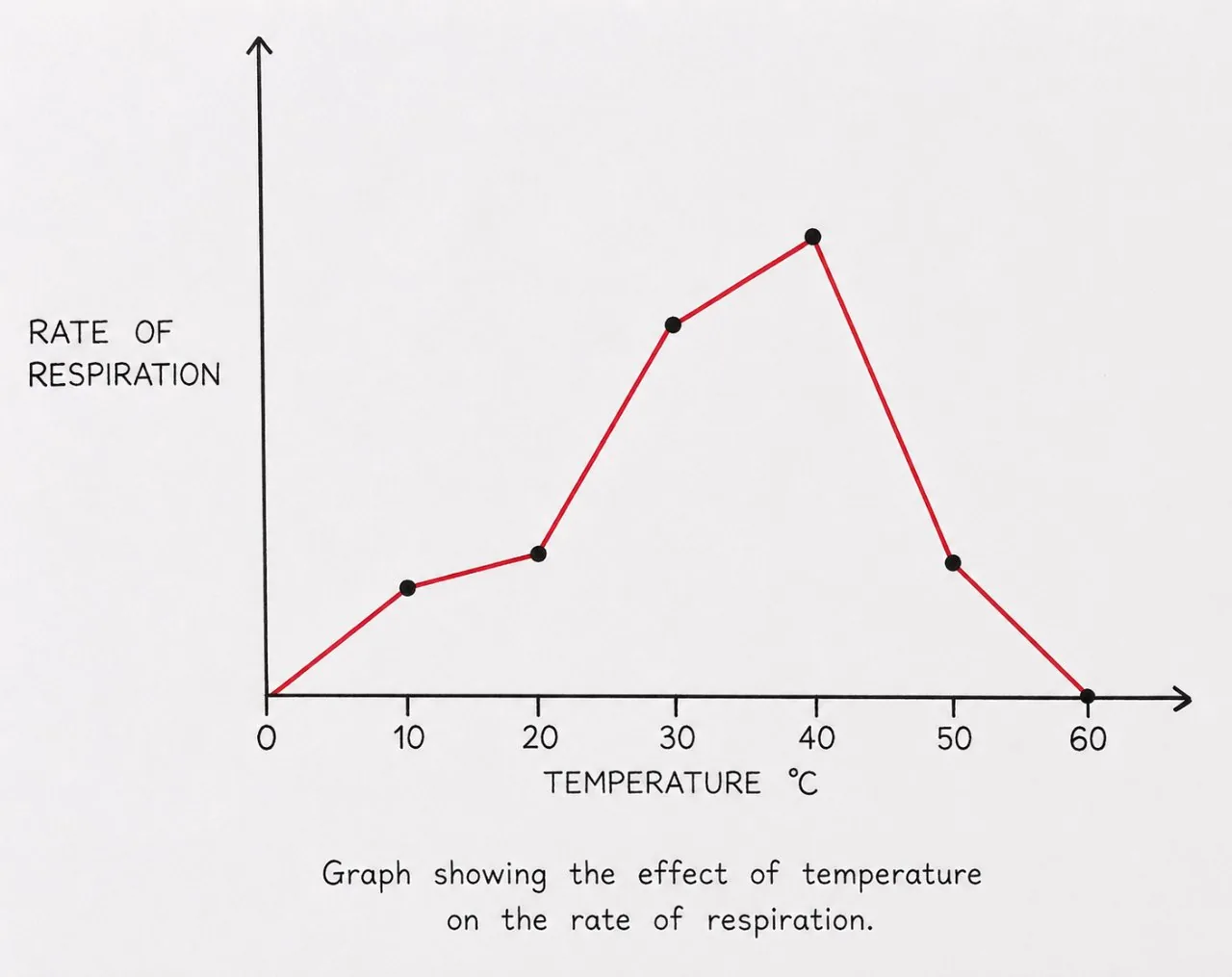


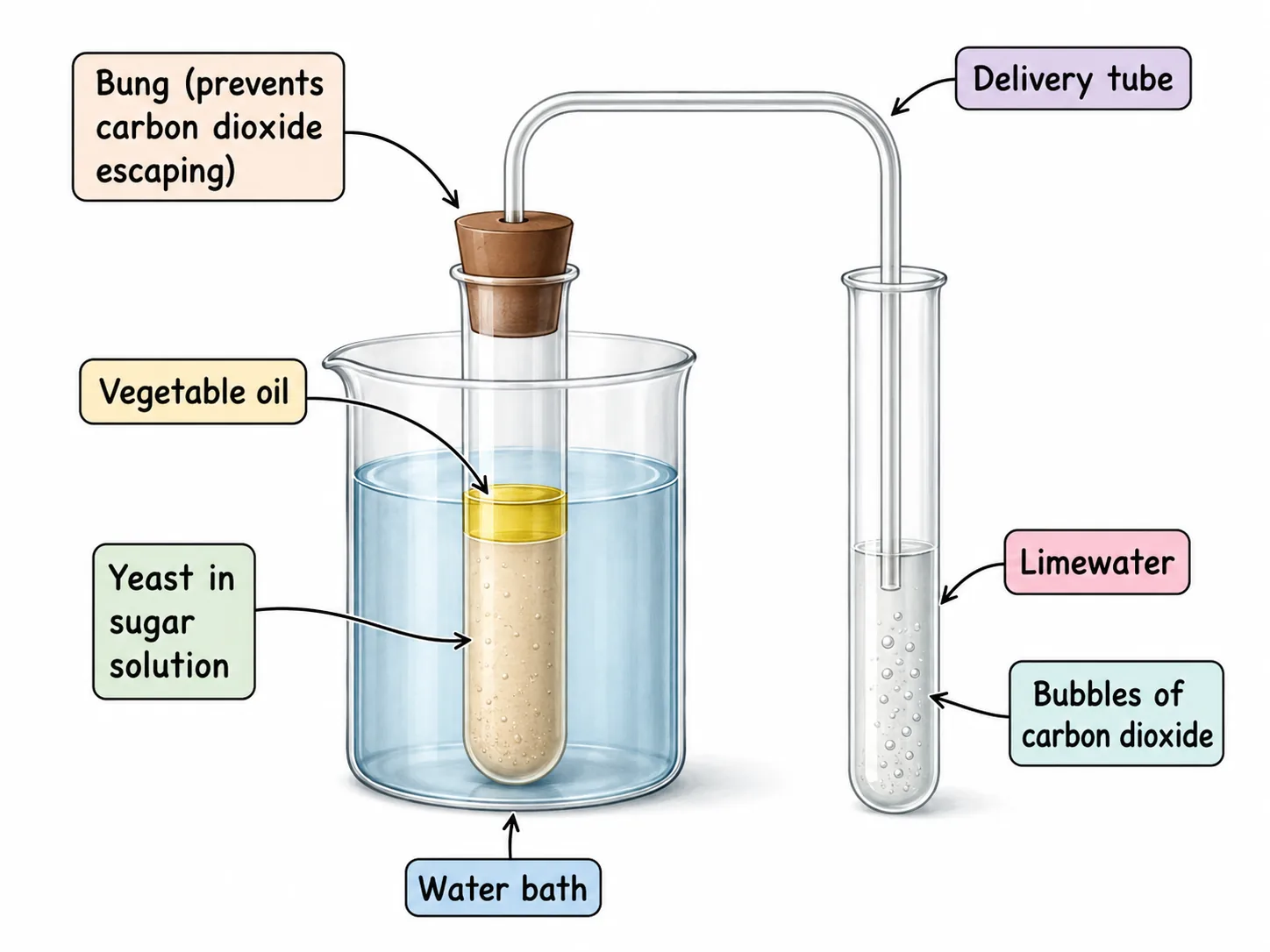
Yeast is a single-celled fungus that respires anaerobically if oxygen is absent.
- and measure the volume of gas collected in an upturned measuring cylinder,
- or count bubbles through a delivery tube into water.
Section 4 of 9Hydrogencarbonate indicator and limewater

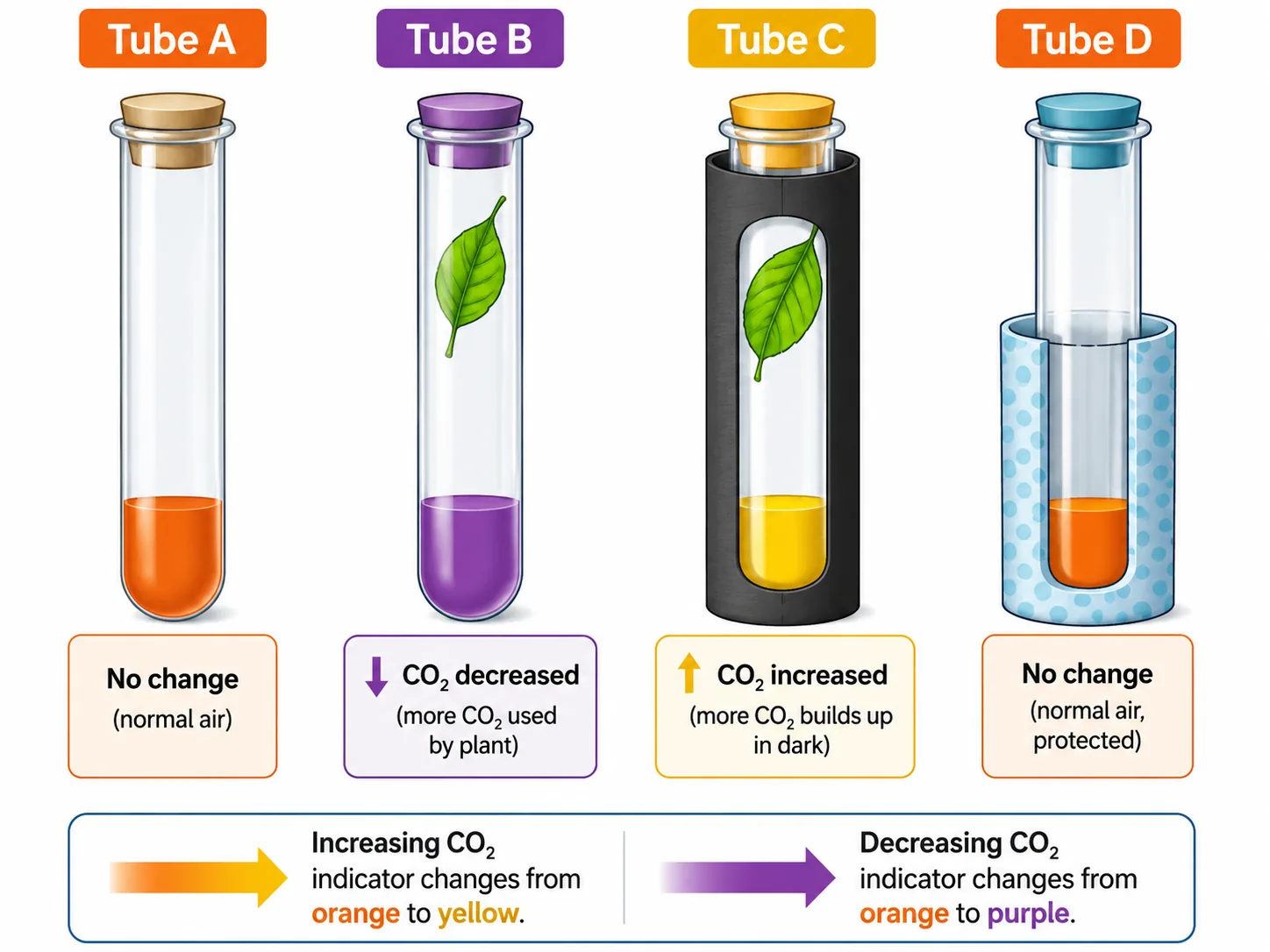
Hydrogencarbonate indicator is red at atmospheric CO2 concentration, turns yellow when more CO2 is present (acidic) and purple when less CO2 is present.
| Variable | How to control |
|---|---|
| Independent | Temperature (water bath), type of sugar |
| Dependent | Volume of CO2 or temperature rise, or time for colour change |
| Control | Mass of seeds or yeast, volume and concentration of solution, time |
Section 5 of 9Respirometer method and safety and ethics
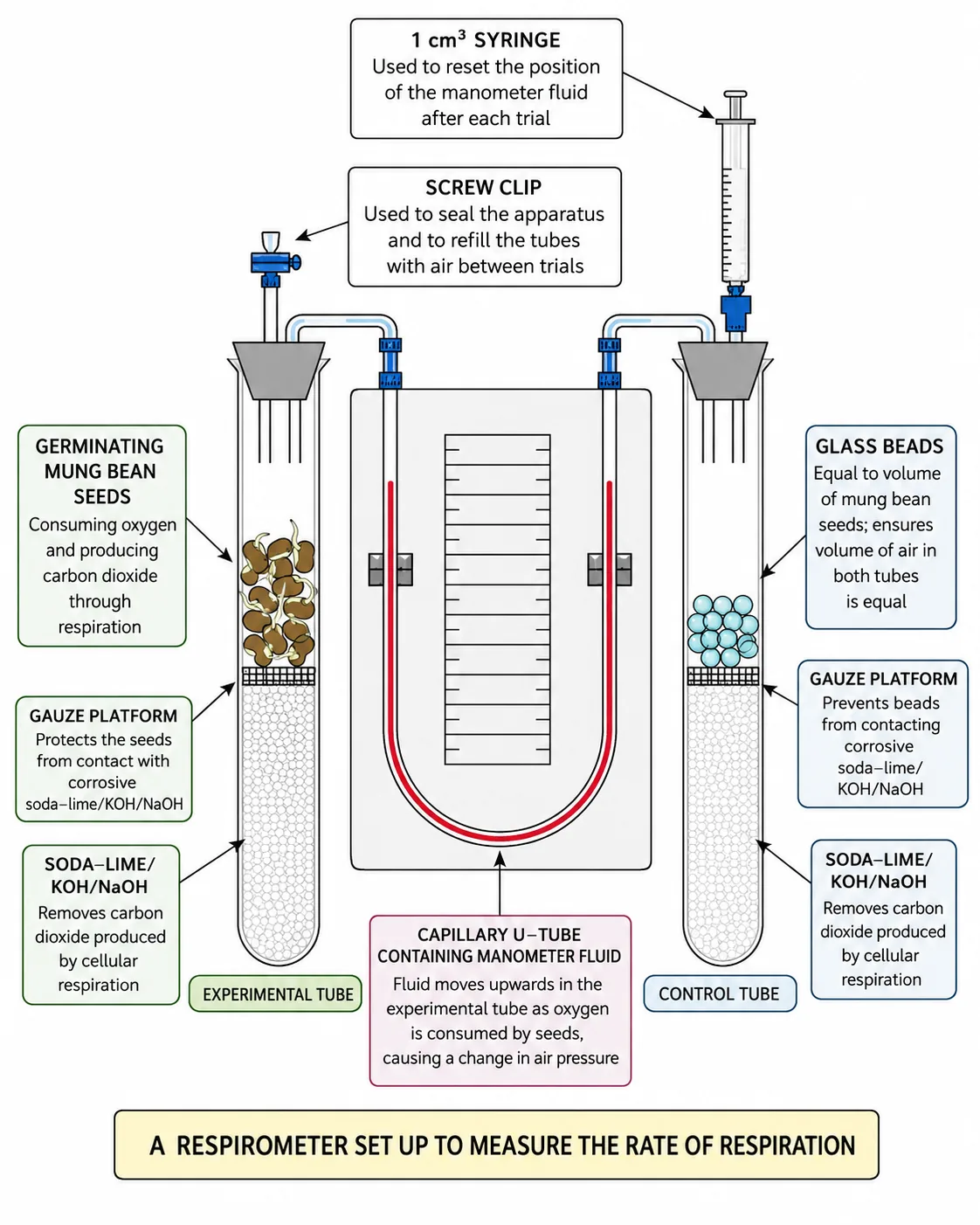
A simple respirometer consists of a boiling tube containing small organisms such as woodlice or germinating seeds, with a small beaker of soda lime or potassium hydroxide solution to absorb the carbon dioxide produced.
Wash hands after handling germinating seeds, and use disinfectant carefully, as it can irritate skin.
Section 6 of 9Improving reliability and drawing conclusions
To obtain valid and reliable data, repeat each condition at least three times and calculate a mean, ignoring anomalies.
- then explain with kinetic energy of molecules and enzyme activity.
Section 7 of 9Exam-style questions
A student put germinating peas in one flask and boiled peas in another. Explain why the boiled peas are used. [2]2 marks
The boiled peas are dead and cannot respire, so they act as a control [1]. This shows any temperature rise in the other flask is caused by respiration in the living peas, not other factors [1].
Describe a method to investigate how temperature affects the rate of respiration of yeast. [4]4 marks
Mix yeast and sugar solution in tubes [1]. Place tubes in water baths at different temperatures [1]. Collect and measure the carbon dioxide produced in a fixed time (or count bubbles) [1]. Keep the volume, concentration and mass of yeast constant and repeat to calculate a mean [1].
A tube of yeast at 30 °C produced 24 cm3 of gas in 8 minutes. Calculate the rate in cm3 per minute. [2]2 marks
24 / 8 = 3 [1] cm3 per minute [1].
Section 8 of 9Key terms
| Term | Meaning |
|---|---|
| Control | A sample treated identically but without the factor being tested. |
| Respirometer | Apparatus used to measure oxygen uptake. |
| Hydrogencarbonate indicator | Indicator that changes colour with carbon dioxide concentration. |
| Limewater | Solution that turns cloudy in the presence of carbon dioxide. |
| Water bath | Container of water used to maintain a constant temperature. |
| Reliability | The extent to which results can be repeated. |