2.9.2Structure and Function in Living Organisms
Excretion in Humans
10 min read 8 parts Lesson 43 of 55 Unit quiz
Section 1 of 8Excretion in Humans


Essential knowledge
What is the excretory system?
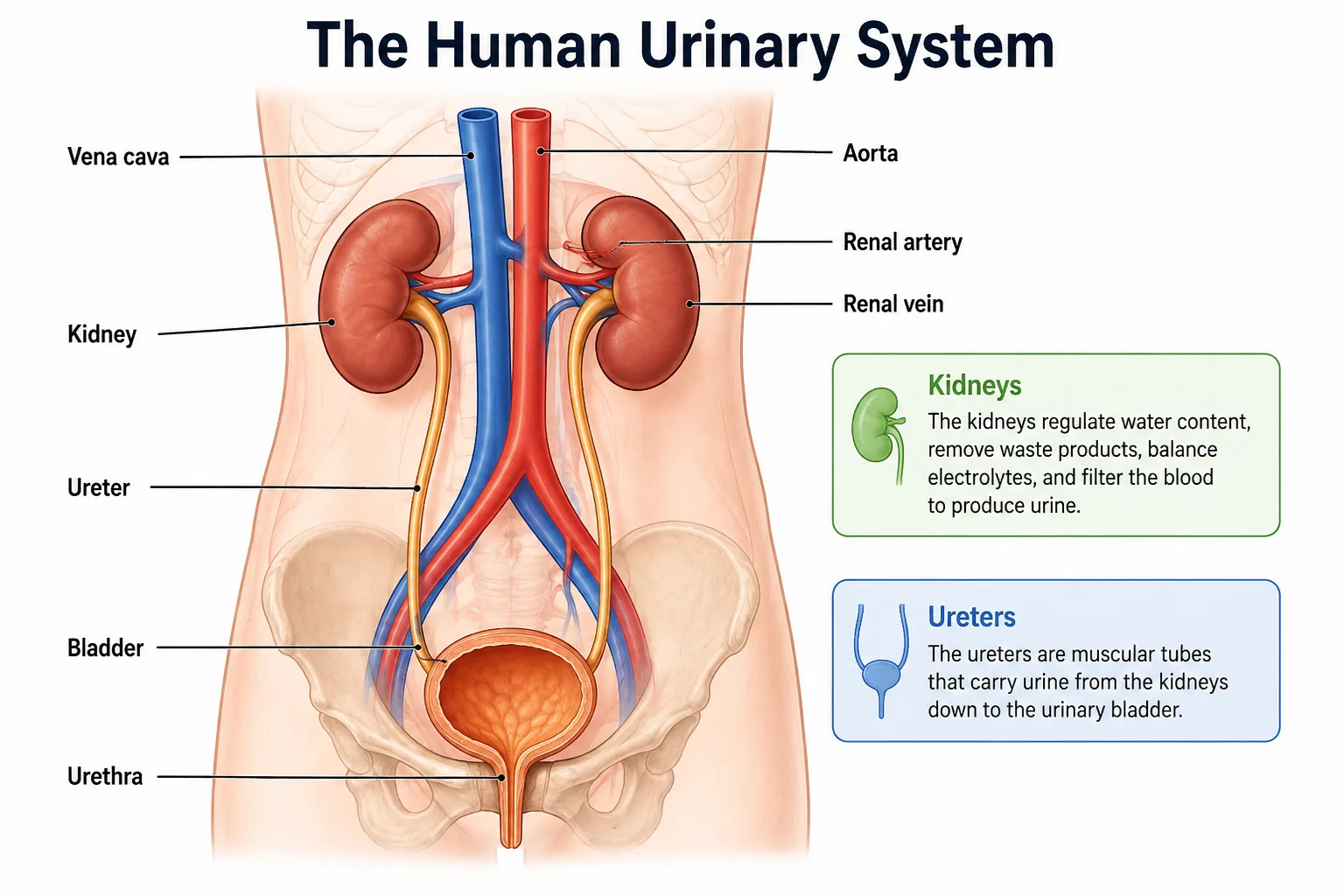
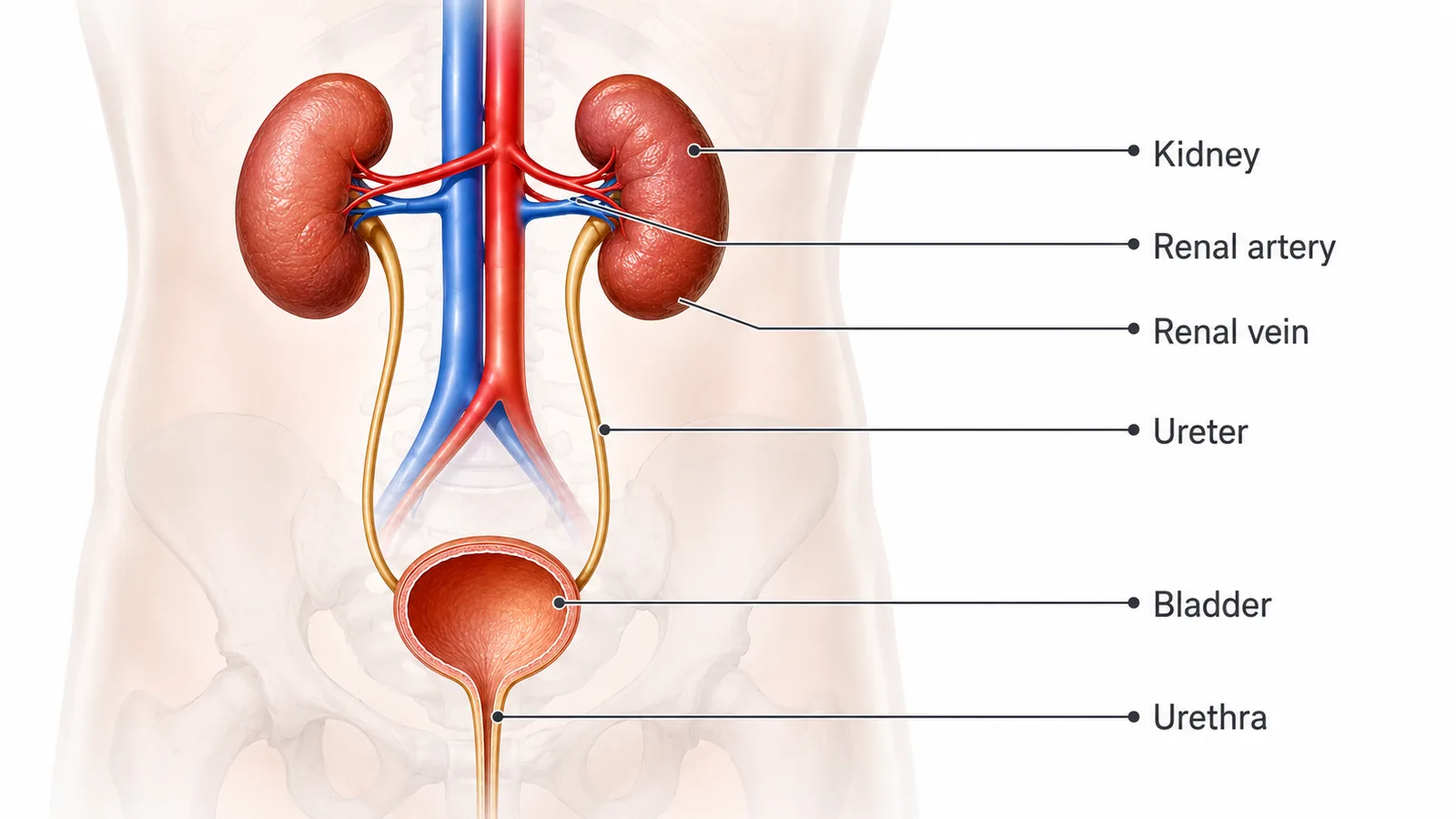
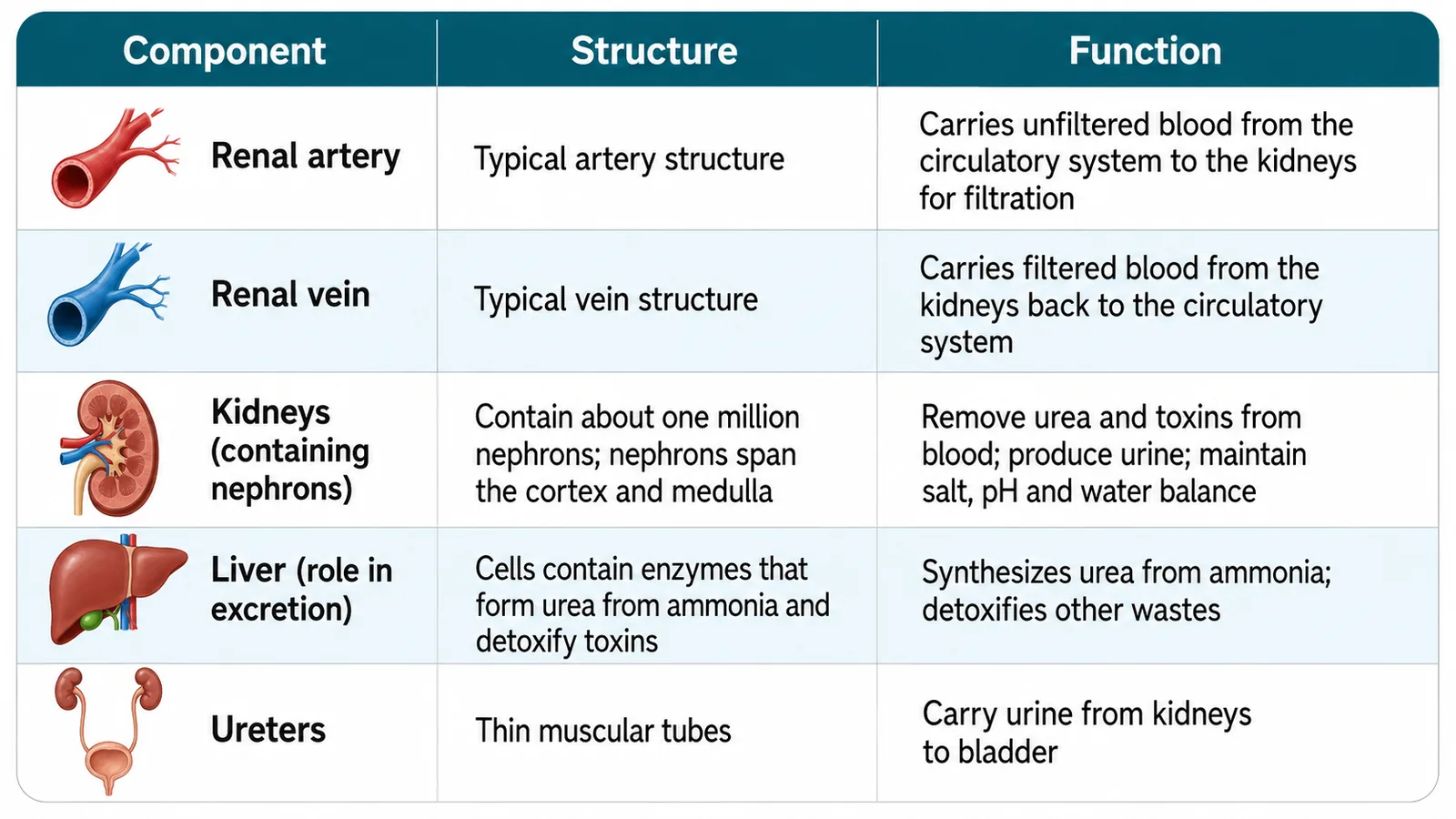
The kidneys, ureters, bladder and urethra make up the urinary system. Together with the lungs, skin and liver, they remove metabolic wastes and substances in excess.
Excretion of carbon dioxide
CO2 is made in aerobic respiration. It diffuses from cells into blood, is carried to the lungs and diffuses into alveoli to be breathed out. Excess CO2 dissolves to form an acid, which lowers blood pH and can disrupt enzymes.
Excretion of urea
Excretion of urea the body cannot store excess amino acids. The liver removes the nitrogen part (deamination), making urea. Urea travels in blood plasma to the kidneys and is removed in urine. Urea is toxic in excess.
The role of the liver
The role of the liver deamination, forming urea; converting some amino acids into proteins (e.g. fibrinogen); breaking down hormones, alcohol and drugs; storing glycogen.
The kidney
The kidney outer cortex, inner medulla, and pelvis where urine collects. Each kidney has about a million nephrons. Blood arrives in the renal artery and leaves in the renal vein.
Nephron function
Nephron function ultrafiltration at the glomerulus forms filtrate; selective reabsorption returns all glucose, some salts and much water to the blood; the remaining urea, salts and water form urine, which drains to the ureter.
Kidney failure
Kidney failure dialysis uses a partially permeable membrane and dialysis fluid with normal concentrations of glucose and salts but no urea, so urea diffuses out of the blood. A kidney transplant offers a long-term cure but risks rejection.
Glucose in urine
In uncontrolled diabetes, blood glucose is so high that the tubule cannot reabsorb all the filtered glucose, so some ends up in the urine. A urine test for glucose is an early check for diabetes.
Ammonia to urea
Deamination removes the nitrogen-containing amino group from excess amino acids, forming ammonia, which is very toxic. The liver at once converts it into less toxic urea; the rest of the molecule can be used for energy or stored.
Reabsorbing salts and water
Further along the nephron, needed salts are reabsorbed by diffusion and active transport and water follows by osmosis. The collecting duct reabsorbs varying amounts of water depending on the body's needs.
Section 2 of 8Process & sequence

- Blood enters the kidney through the renal artery.
- Ultrafiltration in the glomerulus forces water, glucose, salts and urea into the Bowman's capsule.
- Blood cells and proteins stay in the blood as they are too large.
- All glucose and some salts are reabsorbed in the proximal tubule.
- Water is reabsorbed as needed along the tubule and collecting duct.
- Remaining urine (water, urea, salts) flows through the ureter to the bladder.
- Filtered blood leaves the kidney through the renal vein.
Urine formation in a nephronwrite these steps in this order; each step is a marking point.
- Blood enters glomerulus
- Ultrafiltration into Bowman's capsule
- Glucose reabsorbed
- Water reabsorbed as needed
- Urine to collecting duct
- Ureter carries to bladder
Section 3 of 8Compare
| Organ | Waste excreted | Origin |
|---|---|---|
| Lungs | Carbon dioxide (and some water) | Aerobic respiration in cells |
| Kidneys | Urea, excess water, excess ions | Deamination in liver; excess from diet |
| Skin | Water, salts, a little urea in sweat | Sweat glands |
| Liver | Bile pigments (from haemoglobin breakdown), urea made here | Old red blood cells; excess amino acids |
| Substance | Blood plasma | Filtrate in capsule | Urine |
|---|---|---|---|
| Protein | Present | Absent (too large) | Absent |
| Glucose | Present | Present | Absent (all reabsorbed) |
| Urea | Low | Low | High (concentrated) |
| Water | High | High | Variable, depends on body needs |
Section 4 of 8Worked examples
1
Explain why urine from a healthy person contains no glucose, although glucose is found in the filtrate.
- Glucose molecules are small enough to pass into the Bowman's capsule during ultrafiltration.
- However, all glucose is reabsorbed back into the blood by selective reabsorption in the first part of the tubule,
- (using active transport)
- so none remains in urine.
- However, all glucose is reabsorbed back into the blood by selective reabsorption in the first part of the tubule,
2Explain why urine contains no protein.
- Protein molecules are too large to pass through the walls of the glomerulus capillaries and the Bowman's capsule during ultrafiltration,
- so they stay in the blood.
Section 5 of 8Keep going
Excretion in Humans IGCSE Biology 0610: what to do next
These Excretion in Humans IGCSE Biology 0610 notes covered the key ideas, worked examples and exam technique for this topic. Check your Excretion in Humans IGCSE Biology 0610 understanding with the practice questions below, then reread any Excretion in Humans IGCSE Biology 0610 point you were unsure about before moving on.
Excretion in Humans IGCSE Biology 0610: revision checklist
- Revise the main Excretion in Humans IGCSE Biology 0610 definitions until you can write them from memory.
- Practise Excretion in Humans IGCSE Biology 0610 exam questions under timed conditions.
- Practice: Excretion in Humans IGCSE Biology 0610 practice questions
- Previous lesson: 3.2 Respiration — Notes
- Next lesson: 4.1 Coordination, Response & Homeostasis — Notes
- Course: Cambridge IGCSE Biology 0610 — all units
- Official syllabus: Cambridge IGCSE Biology 0610 syllabus
Section 6 of 8Key terms
Section 7 of 8Command terms
Command terms
State / Name
Give a short answer only; no explanation is needed (1 mark = 1 fact).
Define
Give the precise meaning. Learn the syllabus definitions word-for-word: every keyword in the definition is a marking point.
Describe
Say what happens / what the data show, with key features and figures. Do not give reasons.
Explain
Give reasonswhat happens AND why/how, linked with “because”, “so”, “therefore”.
Suggest
Apply knowledge to an unfamiliar situation; any sensible, scientifically-based answer can score.
Compare
Give similarities AND differences, each as a direct comparison (“X is … whereas Y is …”).
Outline
Set out the main points briefly.
Calculate
Work out from given facts; show working, give the unit and the requested significant figures.
Identify
Name/select from given information.
Predict
Give an expected result without a full justification.
Evaluate
Judge the importance or quality of the evidence/method, with reasons.
Section 8 of 8Exam technique
Keywords the mark scheme looks for in this lesson
Keywords the mark scheme looks for in this lesson
Excretion · Urea · Deamination · Kidney · Nephron · Glomerulus · Ultrafiltration · Selective reabsorption · Ureter · Urethra
Learn each definition in the Key words tab exactly; a missing keyword in a definition usually loses the mark.
How to get full marks (examiner guidance)
How to get full marks (examiner guidance)
Use the exact scientific term
“osmosis” must mention a partially permeable membrane and water potential gradient; “diffusion” must mention net movement down a concentration gradient.
Write “rate of … increases”, not “… increases” (e.g. rate of diffusion, rate of photosynthesis).
Say “concentration gradient”, never just “gradient”.
Name the type
“aerobic/anaerobic respiration”, not just “respiration”; respiration releases energy — never “produces/creates energy”.
Enzymes are not “killed” and are not “used up”
Enzymes are not “killed” and are not “used up” they are denatured (active site changes shape) at high temperature/extreme pH; low temperature only reduces kinetic energy.
Antibodies have a shape complementary to the antigen — not “the same shape”.
Particle/ion answers
Particle/ion answers say “particles/molecules/ions”, not “it”; give units with every numerical answer and use the significant figures asked for.
Compare = a similarity AND a difference; describe = what happens; explain = why it happens.
Repeats let you identify anomalies and calculate a mean — they do not make an experiment “valid”.