2.10.1Structure and Function in Living Organisms
Response to Changes in the Environment
5 min read 7 parts Lesson 44 of 55 Unit quiz
Section 1 of 7Detecting and responding
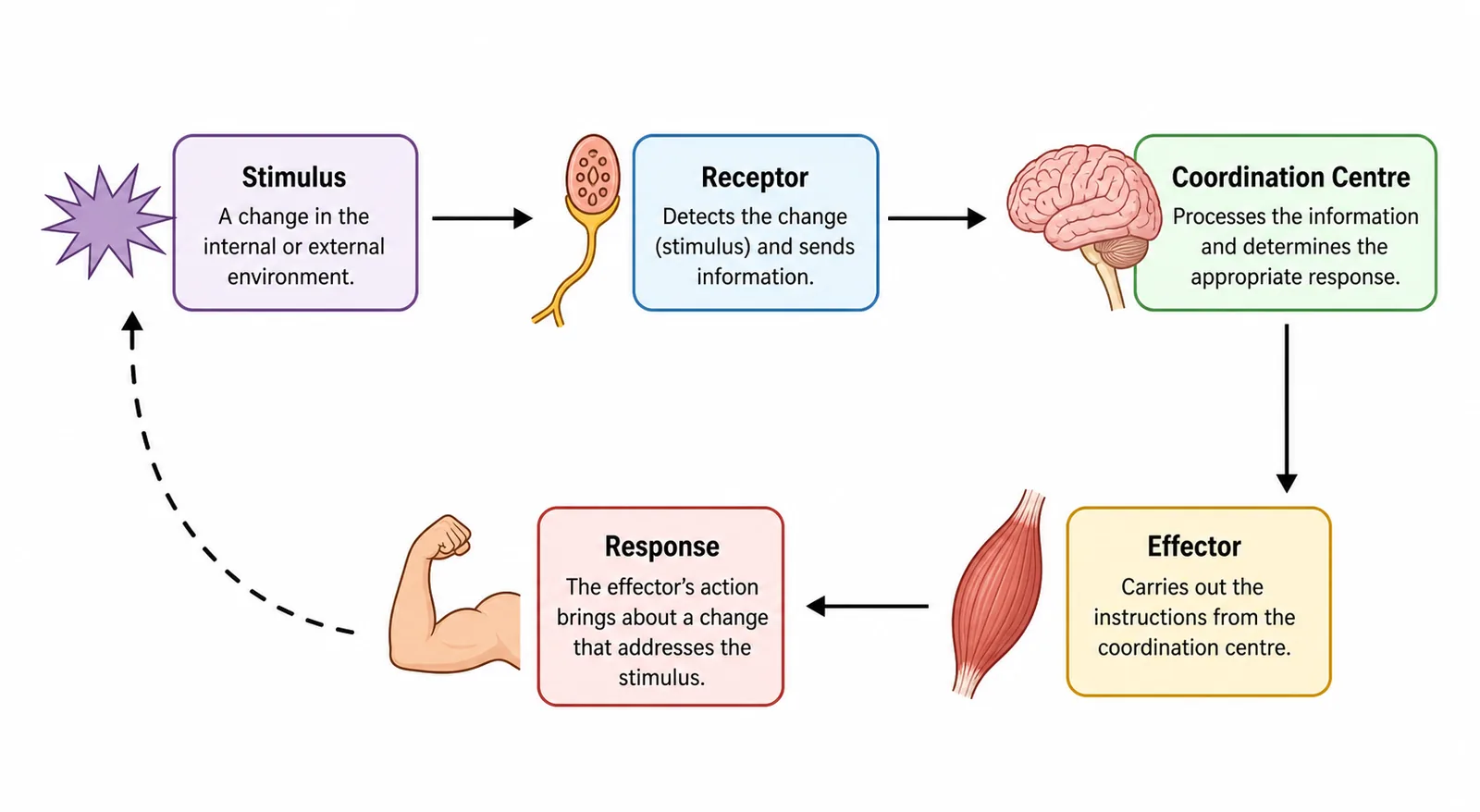
Stimulus
- Stimulus A stimulus is any change in the surroundings that an organism can detect.
- Examples include light, temperature, sound, chemicals, touch and pressure.
Receptors
- Receptors Receptors are the cells or organs that detect stimuli.
- In humans they are found in sense organs such as the eyes, ears, skin, nose and tongue.
Plant detection
- Plant detection Plants have no sense organs, but specialised cells can detect light, gravity and water.
Response
- Response After detecting a stimulus the organism produces a response, which is the action that follows.
Section 2 of 7Kinds of response
Responses
Movement
- Movement The organism may move towards a stimulus such as food, or away from one such as a predator or a hot object.
Secreting chemicals
- Secreting chemicals A gland may release a substance, for example a hormone or sweat.
Adjusting body processes
- Adjusting body processes Internal changes, such as altering breathing rate or heart rate, may follow a stimulus.
Section 3 of 7A response in sequence
1Stimulus
- Stimulus A change occurs, for example a loud bang nearby.
2Receptor
- Receptor Sensory cells in the ear detect the sound.
3Coordination
- Coordination Information is passed on and processed so that a decision is made.
4Response
- Response Muscles contract and the person ducks or moves away.
Section 4 of 7Why responding matters
| Stimulus | Possible response | Benefit to survival |
|---|---|---|
| Predator approaching | Run or hide | Avoids being eaten |
| Smell of food | Move towards the source | Finds a source of energy |
| Body gets too cold | Shivering and reduced heat loss | Keeps internal conditions suitable for enzymes |
| Light direction (plant) | Shoot grows towards the light | More light for photosynthesis |
Section 5 of 7Worked examples of stimulus and response
Hand on a hot surface
- Hand on a hot surface The stimulus is heat, which is detected by temperature receptors in the skin of the hand.
- The response is a rapid withdrawal of the hand, produced by muscles in the arm, and it prevents tissue damage.
Light in the eye
- Light in the eye Bright light is detected by receptor cells in the retina of the eye.
- The response is a narrowing of the pupil, which protects the retina from being damaged by too much light.
Plant roots and water
- Plant roots and water Specialised cells in the root detect water and gravity.
- The root grows downwards towards moisture, which gives the plant a steady supply of water and minerals.
Linking to survival
- Linking to survival Every response should be linked to why it helps: escaping predators, finding food, or keeping internal conditions stable.
- Organisms that respond well are more likely to survive and reproduce.
Section 6 of 7Key terms
| Term | Meaning |
|---|---|
| Stimulus | A change in the environment that can be detected by an organism. |
| Receptor | A cell or organ that detects a stimulus. |
| Response | The action an organism takes after detecting a stimulus. |
| Sense organ | A group of receptor cells forming an organ, such as the eye or ear. |
Section 7 of 7Exam technique
1
Confusing the stimulus with the receptorlight is the stimulus, while the retina contains the receptors.
2
Assuming only animals respond to stimuli; plants also respond, for instance by growing towards light.
3
Saying that organisms respond 'to be able to move' — the key idea is that responding increases the chance of survival.
4
Listing responses without linking them to a benefit, such as escaping danger, finding food or keeping conditions stable.