Section 1 of 7How a pedigree is drawn
Symbols
- Symbols Males are shown as squares and females as circles.
- Shading or colour marks the individuals who show the characteristic, usually a genetic disorder;
- unshaded individuals do not show it.
Lines
- Lines A horizontal line joining a square and a circle shows a couple who have had children.
- A vertical line leads down to their children, who are drawn together on the next row.
- Each row is one generation.
Purpose
- Purpose Pedigrees trace a characteristic through generations.
- They are used to work out how it is inherited and to estimate the chance that a future child will be affected.
Section 2 of 7Working out the pattern
1
Look for two unaffected parents who have an affected child. This can only happen if the affected trait is recessive, because the parents must each carry a hidden recessive allele.
2
If every affected child has at least one affected parent and the trait never skips a generation, a dominant allele is more likely.
3
Choose letters, for example N for the normal dominant allele and n for the recessive allele.
4
Give genotypes to the individuals you are sure about: anyone showing a recessive trait must be homozygous recessive.
5
Work out the rest from their parents and children. A parent of an affected child must carry at least one recessive allele.
Section 3 of 7Worked example: a recessive disorder
1Observation
- Observation Two unaffected parents have a daughter who is affected by a disorder.
2Deduction
- Deduction The daughter shows the trait, so she is nn. She received one n from each parent.
3Parents
- Parents Both parents show the dominant phenotype yet carry n, so both are Nn. They are called carriers.
4Probability
- Probability For a cross Nn × Nn, each new child has a 25% (1 in 4) chance of being nn and affected, and a 75% chance of being unaffected.
Section 4 of 7Comparing dominant and recessive patterns

| Feature in the pedigree | Suggests | Reason |
|---|---|---|
| Unaffected parents with an affected child | Recessive | Both parents must be carriers (heterozygous) |
| Every affected person has an affected parent | Dominant | One copy of the allele is enough to show the trait |
| Trait skips generations | Recessive | Carriers pass the allele on without showing it |
| Affected parent, all children unaffected | Recessive or dominant with a heterozygous parent | Depends on the other parent's genotype; check each family carefully |
Section 5 of 7Reading an example pedigree


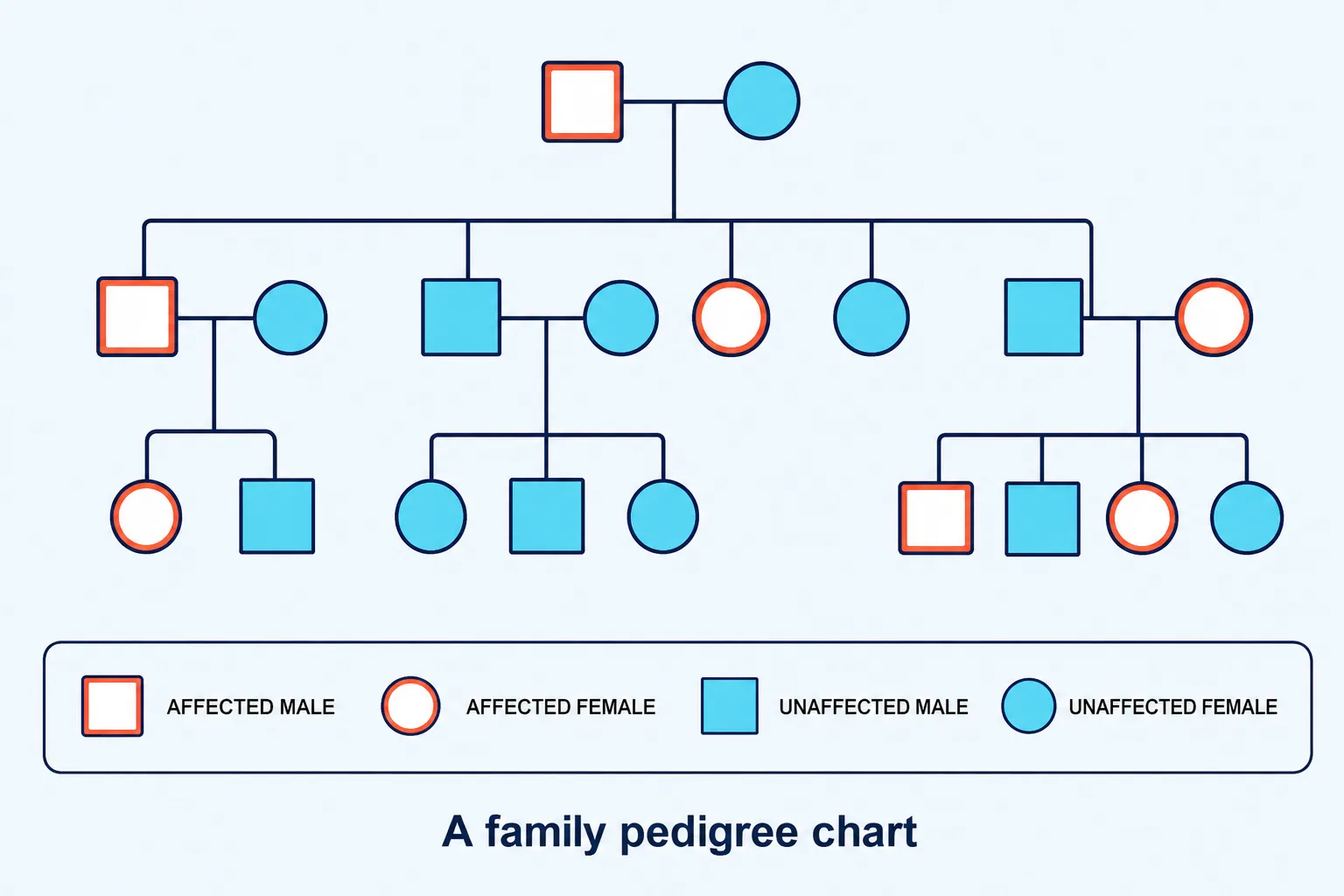

Both sexes affected
- Both sexes affected If males and females are both affected in similar numbers, the gene is likely to be on an ordinary chromosome rather than a sex chromosome.
Every generation affected
- Every generation affected Affected people appear in each row, which would fit a dominant allele.
A family with no affected people
- A family with no affected people A branch where neither parents nor children show the trait means those parents are probably homozygous for the normal allele.
Section 6 of 7Key terms
| Term | Meaning |
|---|---|
| Pedigree | A diagram showing family relationships and who shows a particular characteristic over several generations. |
| Carrier | A heterozygous person who has a recessive allele for a disorder but does not show it. |
| Genetic disorder | An inherited condition caused by a faulty allele. |
| Generation | A group of individuals at the same stage of descent, shown on one row of a pedigree. |
Section 7 of 7Exam technique
1
Writing that two unaffected parents cannot have an affected child; they can if both are carriers of a recessive allele.
2
Assuming every unaffected person is homozygous dominant. Unaffected people may be carriers unless the pedigree proves otherwise.
3
Confusing squares and circlessquares are males and circles are females.
4
Giving the probability for the whole family rather than for each child; each child has the same independent chance.