Section 1 of 8Chromosomes and the genome

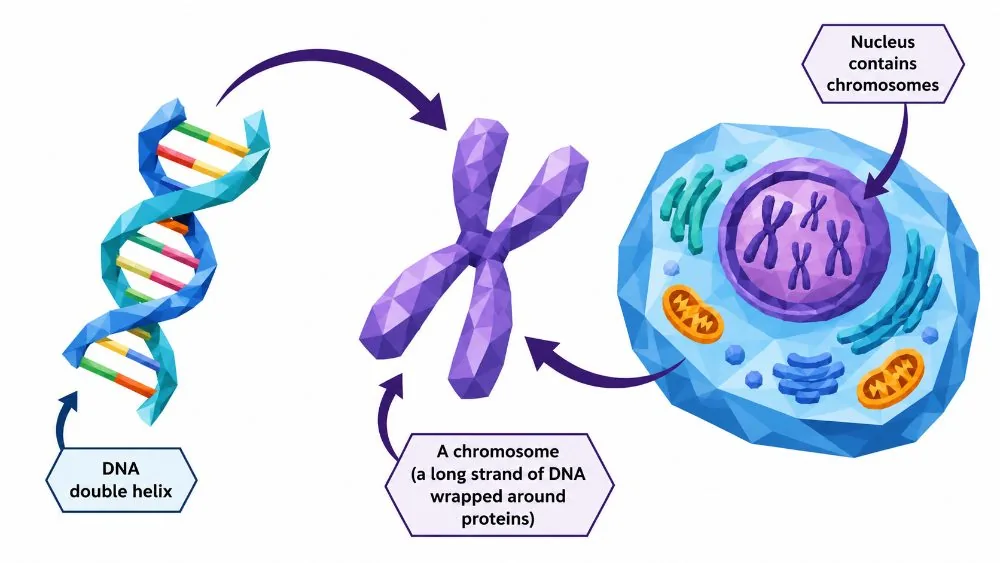

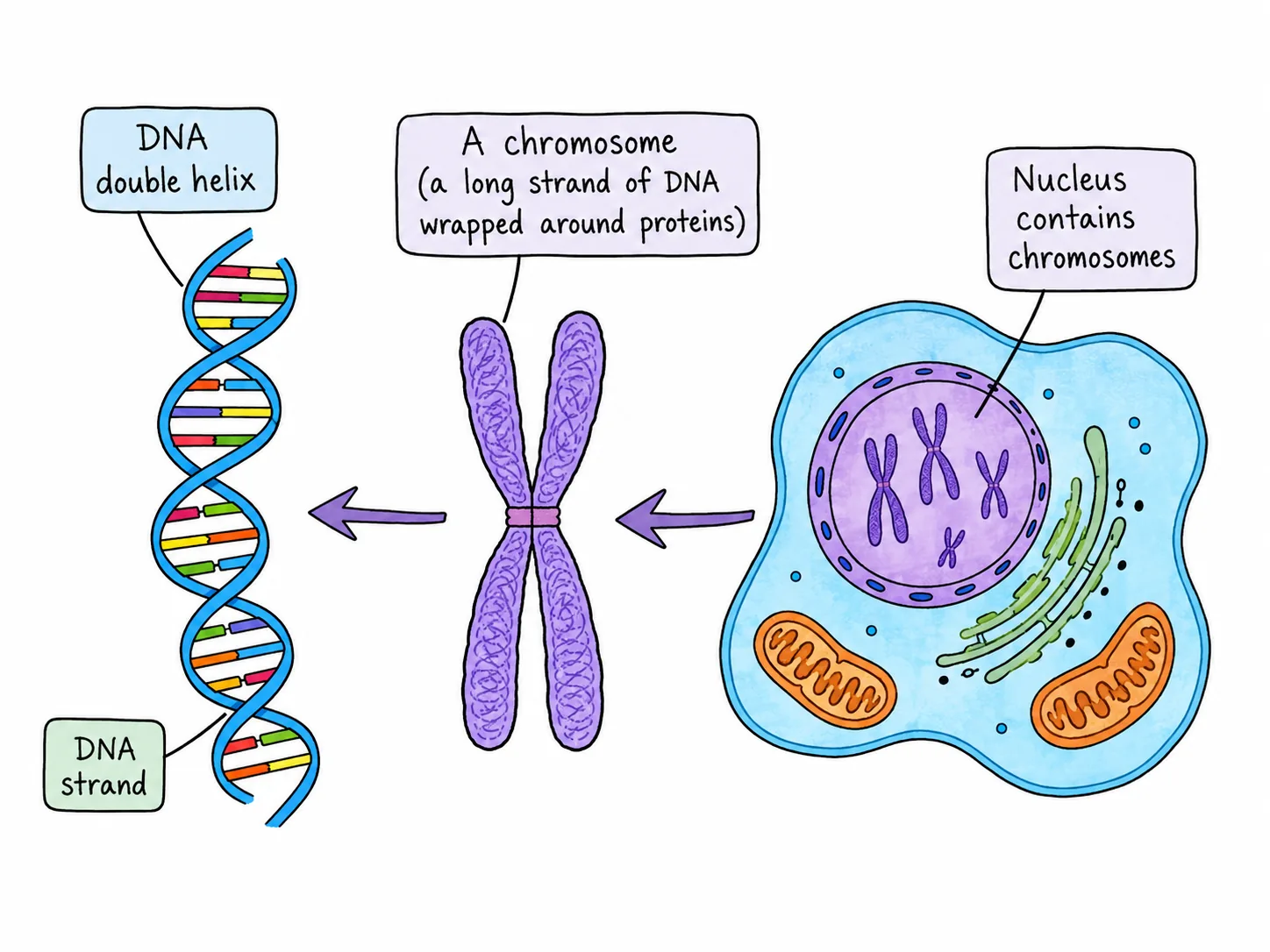
The nucleus of a eukaryotic cell contains the genetic material in the form of chromosomes.
- so a chromosome looks like an X made of two identical chromatids.
Section 2 of 8The cell cycle


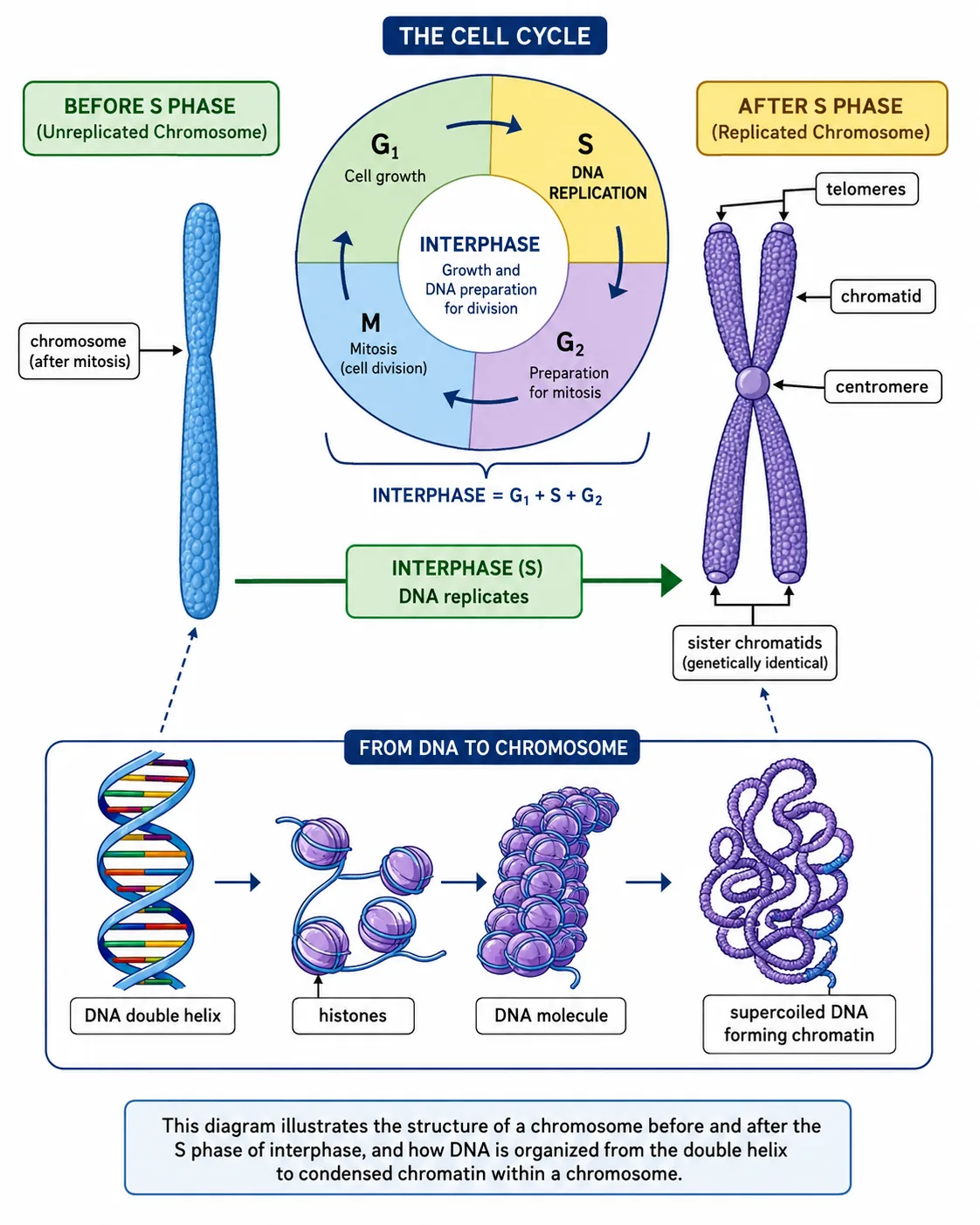
The cell cycle is the series of stages through which a cell passes between one division and the next. It has three parts.
- The cell grows, makes new organelles such as mitochondria and ribosomes, increases the amount of cytoplasm and synthesises proteins.
- The DNA is copied so that each chromosome has two identical chromatids.
The length of the cell cycle varies between cell types.
Section 3 of 8The stages of mitosis


Mitosis is a continuous process, but it is described in four stages.
The result is two daughter cells that are genetically identical to each other and to the parent cell. Each has the same number of chromosomes, 46 in human cells. Mitosis therefore produces clones of cells.
Section 4 of 8Why mitosis is important


| Role | Explanation |
|---|---|
| Growth | A zygote becomes a multicellular organism by repeated mitotic divisions, increasing the number of cells |
| Repair | Damaged or worn cells such as skin, and the lining of the gut, are replaced by new identical cells |
| Replacement | Red blood cells and other cells are constantly renewed from dividing stem cells |
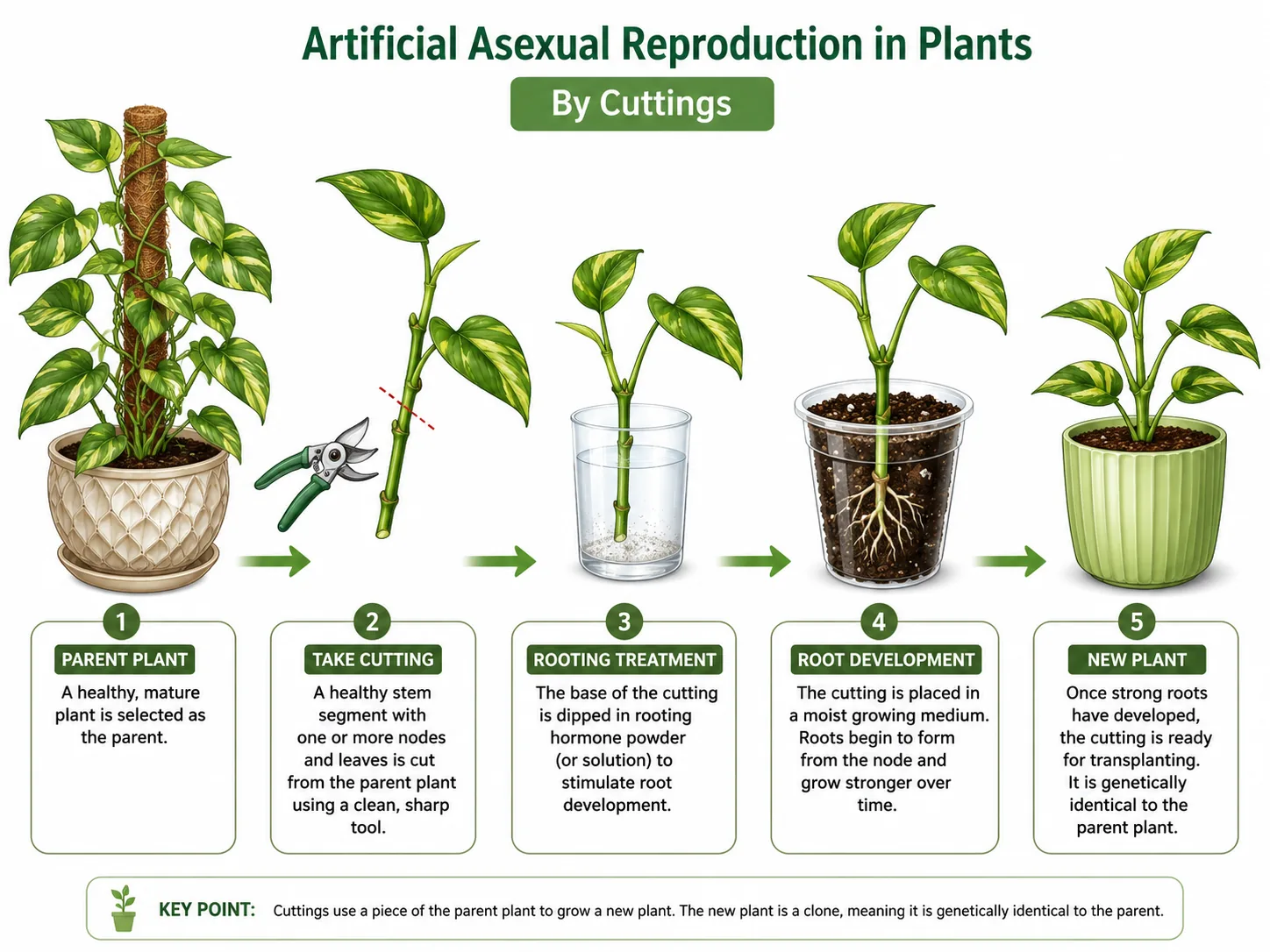
| Asexual reproduction | Single-celled organisms and many plants produce genetically identical offspring by mitosis |
Because the offspring are identical clones, asexual reproduction does not provide variation. Examples include yeast budding, strawberry runners and the growth of cuttings.
Section 5 of 8Observing mitosis and the cell cycle in practice


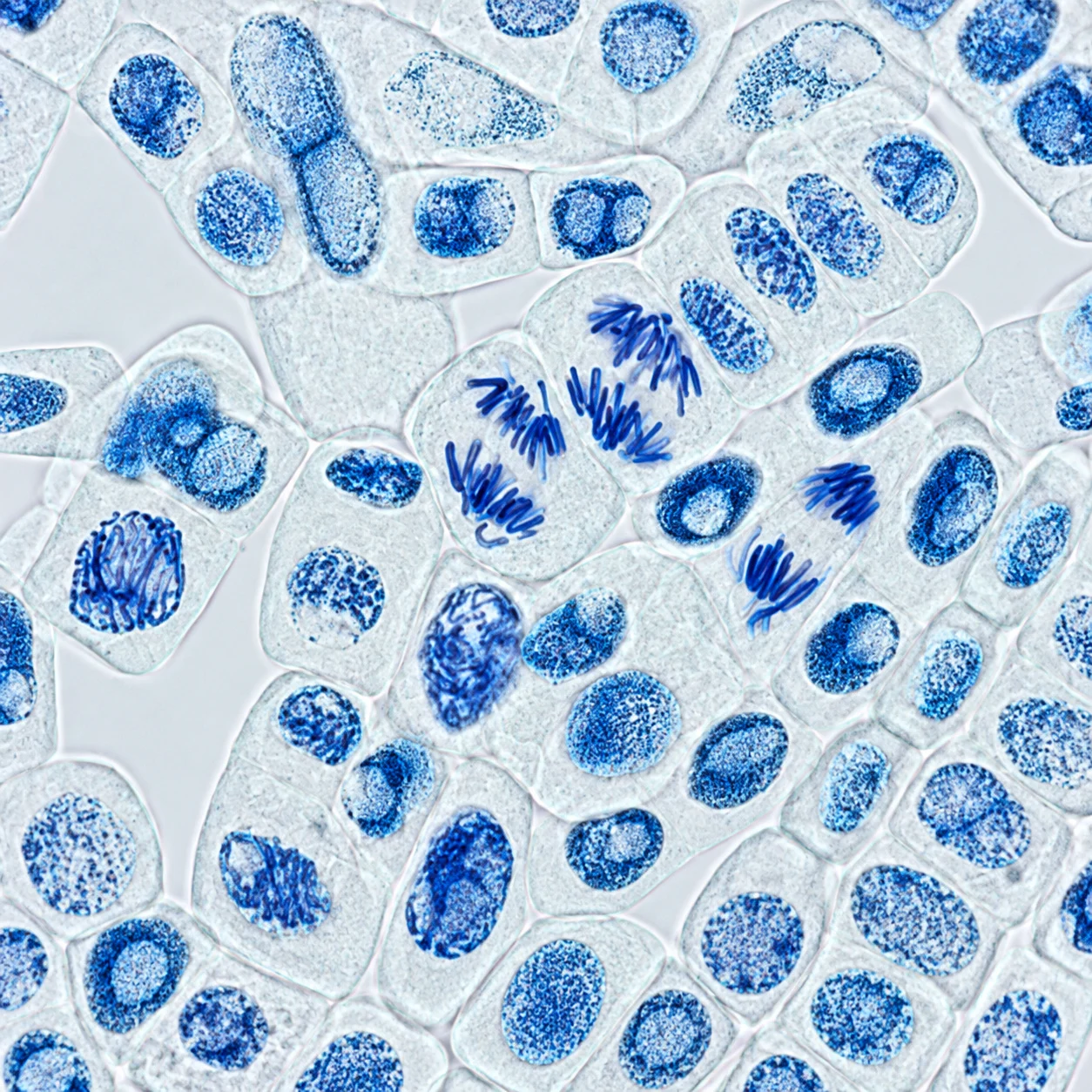
Mitosis can be observed in the tips of growing roots, where cells divide rapidly.
- and squashed flat on a slide under a coverslip.
- A high value suggests rapid growth.
Chromosomes are made of DNA that has been replicated before mitosis; this means that DNA replication is essential for the daughter cells to have a full set of genetic information. Stem cells in animals divide by mitosis and can then differentiate into specialised cells, which is why they are important in medicine.
When drawing mitosis stages from a micrograph, identify them by the position of the chromosomes: scattered with no nuclear membrane (prophase), a line across the centre (metaphase), two groups moving apart (anaphase), two new nuclei (telophase). Mitosis in a root tip can also be used to compare growth rates: a root tip in a warm, well-watered plant would be expected to have a higher mitotic index than one in dry cold soil, because the cells divide more often when conditions are favourable.
Section 6 of 8Exam-style questions


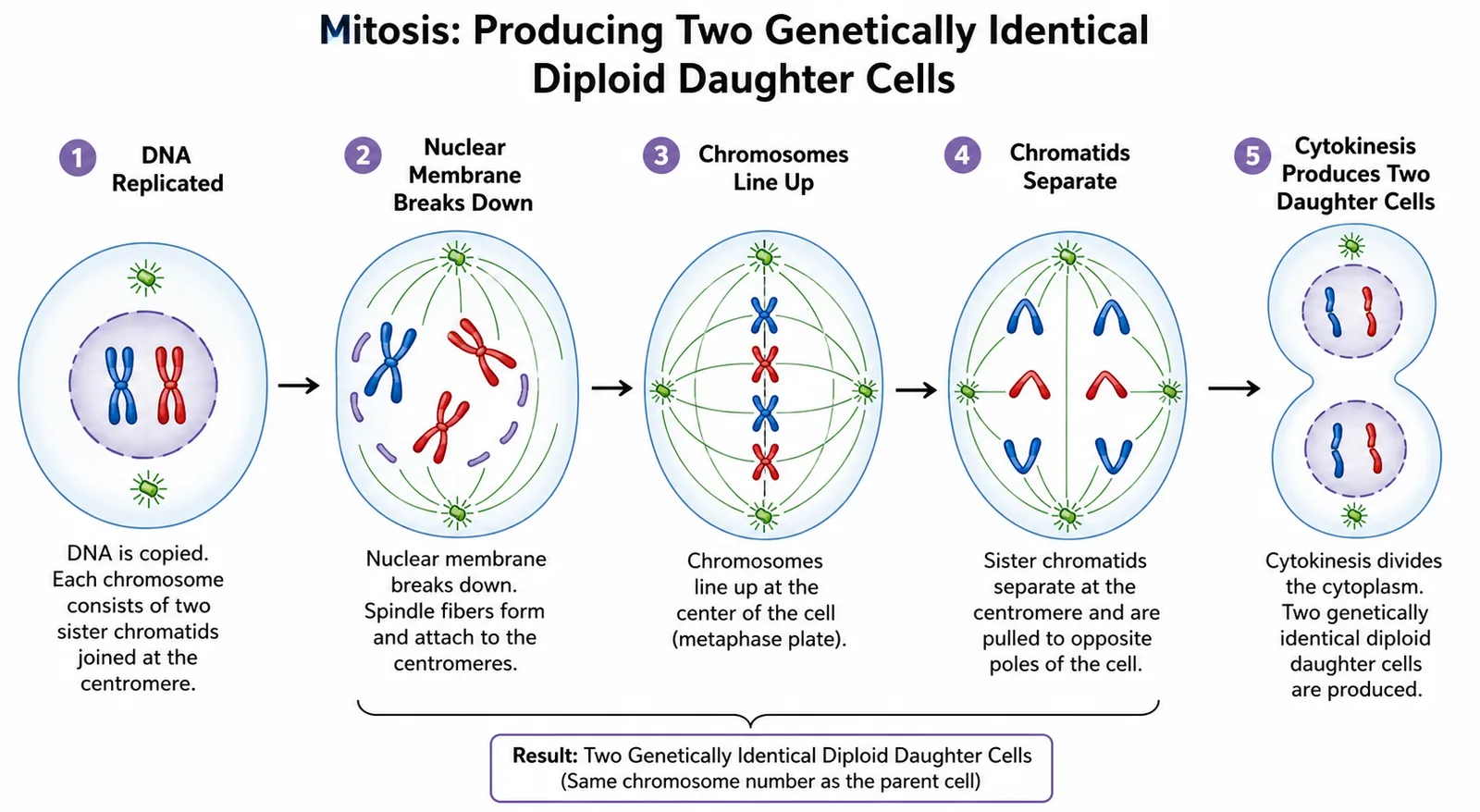
A human skin cell undergoes mitosis. State the number of chromosomes in each daughter cell and explain your answer. [2]2 marks
46 [1]; mitosis produces genetically identical cells with the same chromosome number as the parent cell [1].
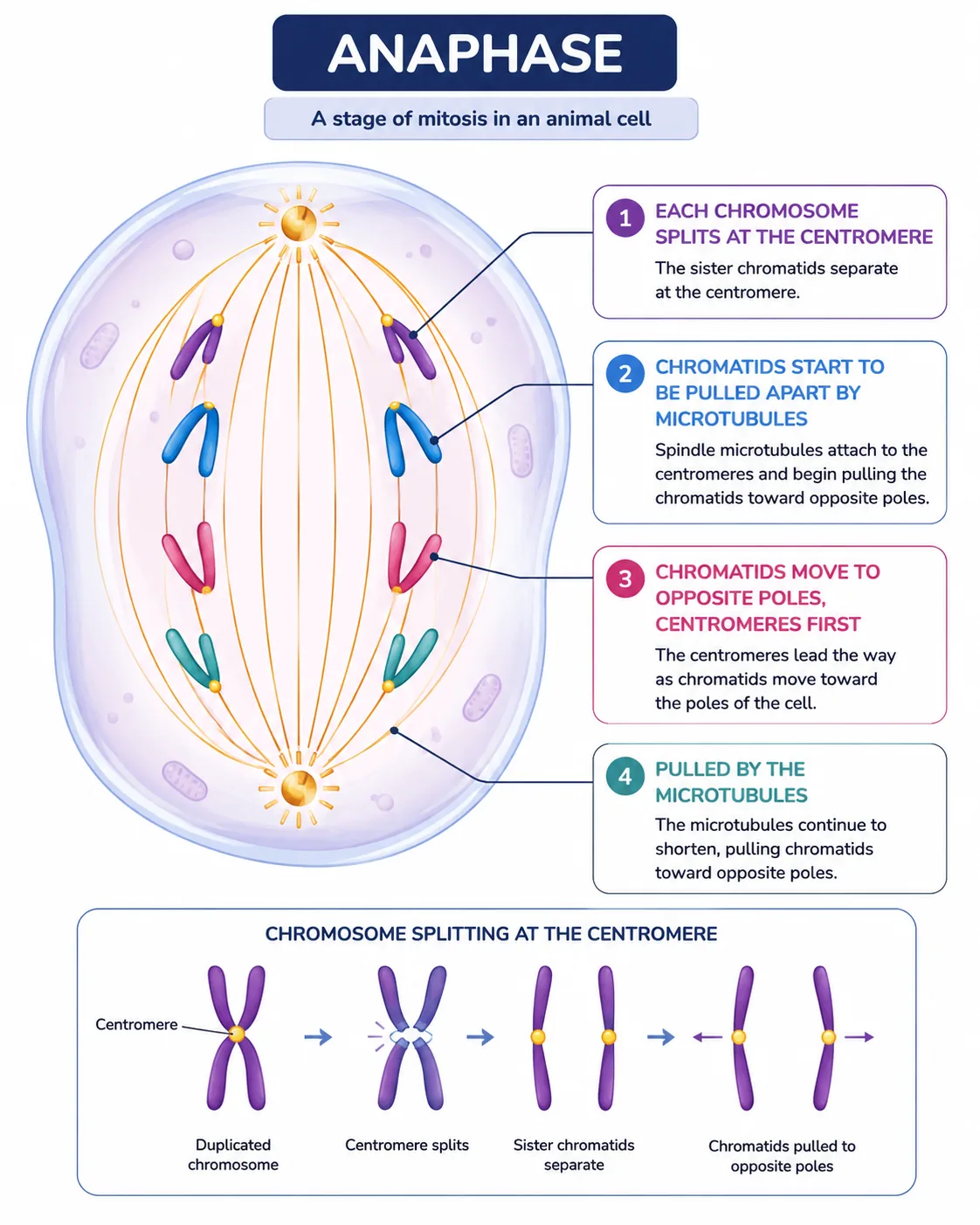
Describe what happens to the chromosomes during anaphase. [2]2 marks
Spindle fibres contract/shorten [1]; the chromatids are pulled apart to opposite poles of the cell [1].
In a root tip, 200 cells were counted. 24 cells were in mitosis. Calculate the mitotic index. [2]2 marks
24 / 200 [1] x 100 = 12% [1].
Section 7 of 8Key terms
| Term | Meaning |
|---|---|
| Mitosis | Cell division that produces two genetically identical daughter cells. |
| Chromosome | A coiled length of DNA carrying many genes. |
| Chromatid | One of the two identical copies of a replicated chromosome. |
| Cell cycle | The series of stages a cell passes through between divisions. |
| Diploid | Having two sets of chromosomes, one from each parent. |
| Cytokinesis | Division of the cytoplasm to form two cells. |
| Clone | A genetically identical copy. |
| Spindle fibre | A protein fibre that moves chromosomes during division. |