4.2.3Ecology and the Environment
Transfers Along a Food Chain
5 min read 6 parts Lesson 7 of 12 1 quiz
Section 1 of 6Energy entering and moving along a food chain


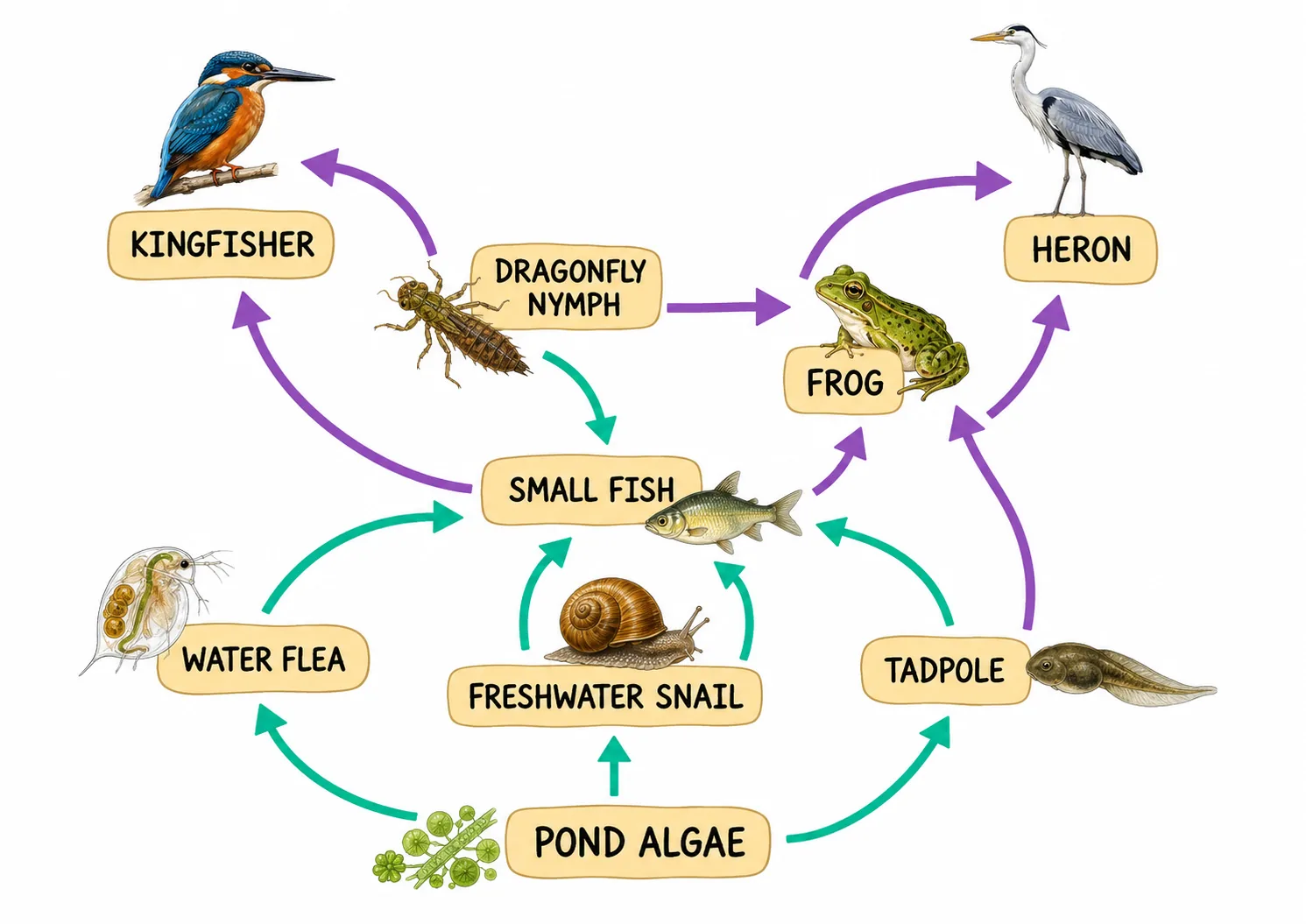
1Light energy
- Light energy Sunlight is the source of energy for almost all food chains.
2Producers
- Producers Producers use photosynthesis to convert light energy into chemical energy stored in carbon-containing compounds in their biomass.
3Primary consumers
- Primary consumers They eat producers, break down the carbon compounds and use the energy and substances to build new biomass in their own tissues.
4Higher consumers
- Higher consumers Secondary and tertiary consumers repeat the process at each trophic level.
Section 2 of 6Why energy is lost between trophic levels

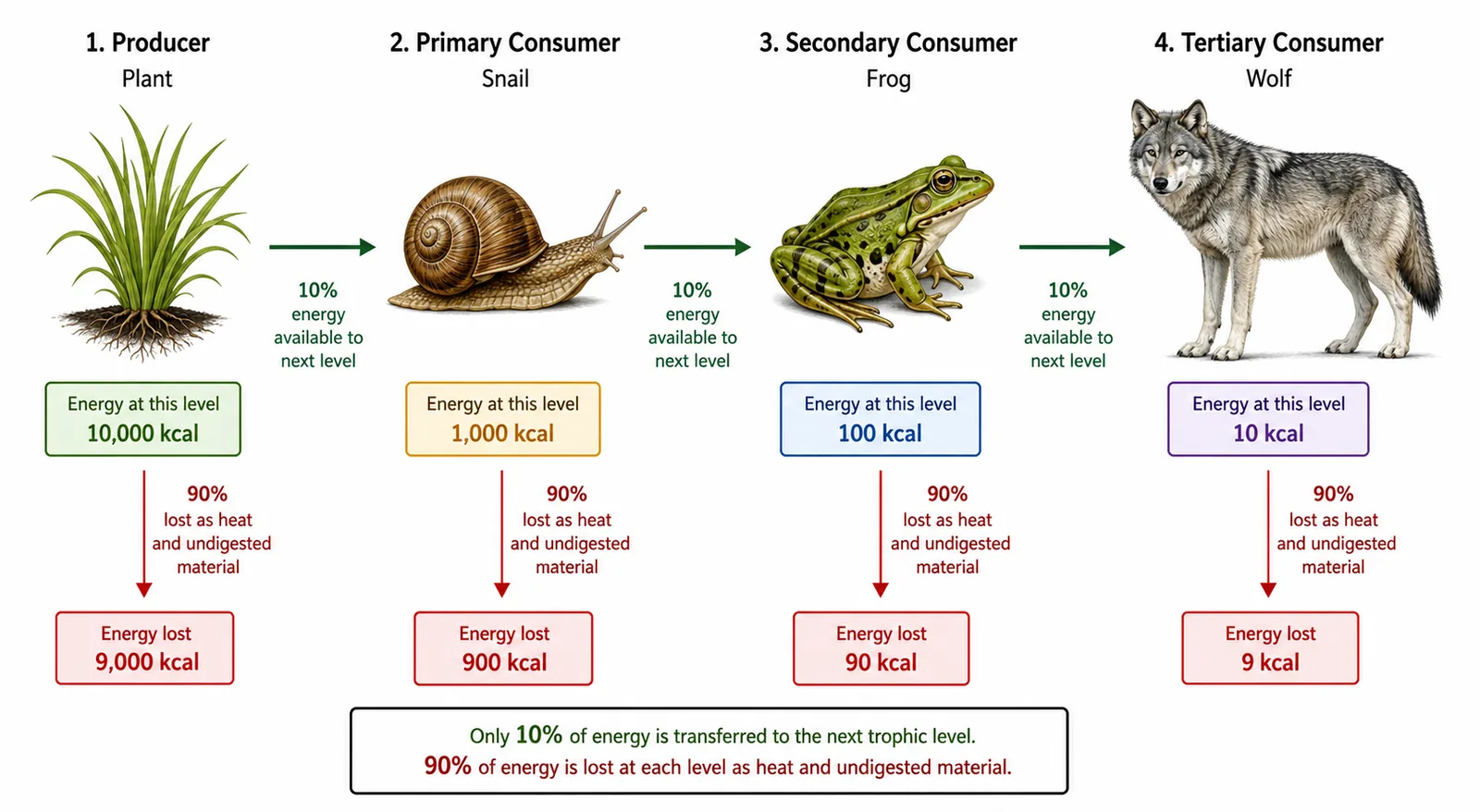
Only about 10% passes on
Uneaten parts
- Uneaten parts Predators rarely eat everything.
- Bones, fur, teeth and claws hold energy that never reaches the consumer.
Egestion
- Egestion Not everything eaten is digested and absorbed.
- Material that is hard to digest, such as plant fibre, is egested as faeces.
Respiration
- Respiration Energy is released by respiration to power movement and keep warm, and ends up as heat in the surroundings.
Excretion
- Excretion Energy is lost in waste products such as urea.
Death and decay
- Death and decay Energy in dead organisms goes to decomposers instead of to the next consumer.
Section 3 of 6Consequences
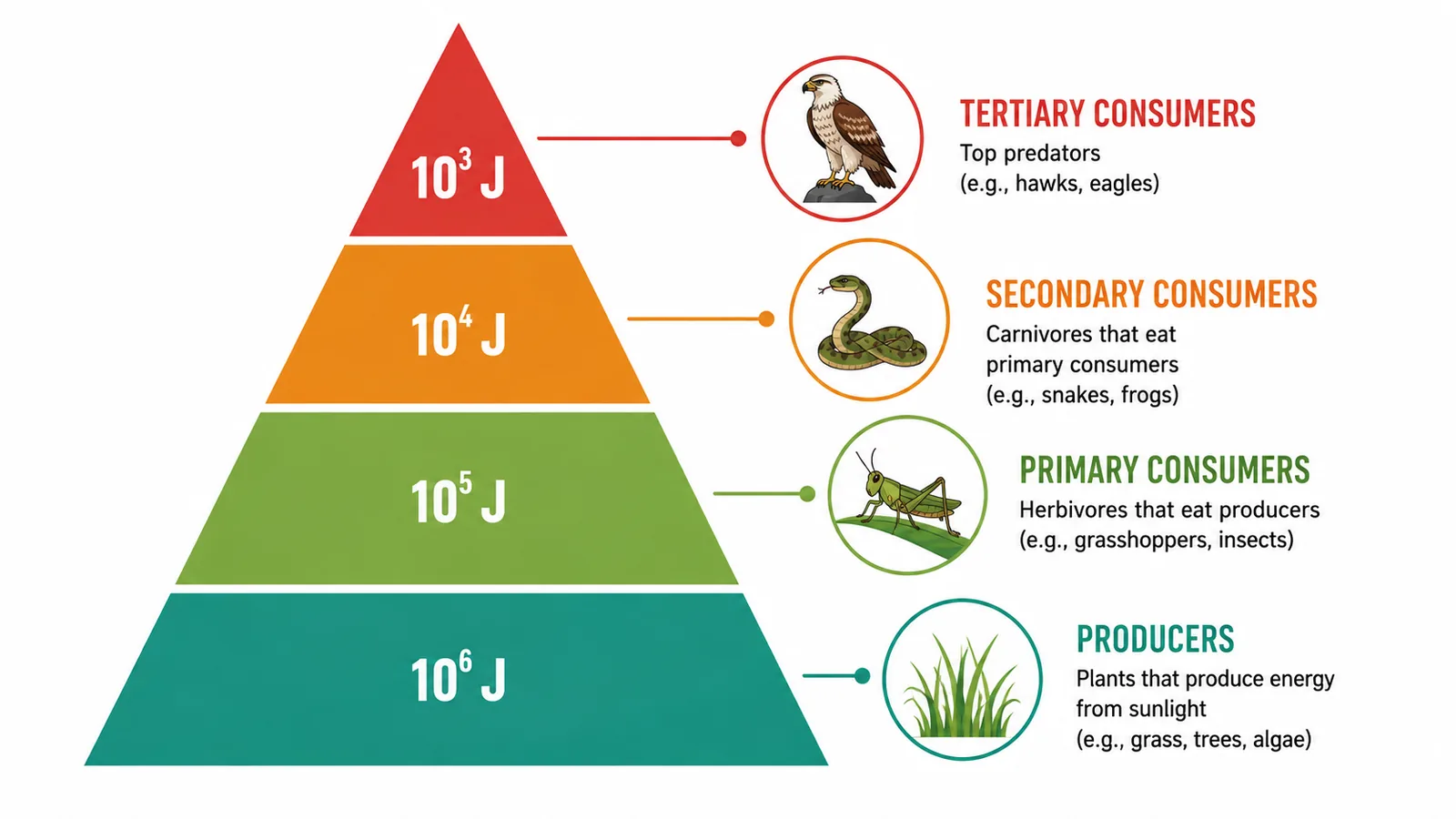
Short food chains
- Short food chains Only around 10% of the energy available at one trophic level becomes biomass at the next.
- After four or five levels there is too little left to support another.
Pyramids
- Pyramids Pyramids of biomass get narrower towards the top for the same reason.
Section 4 of 6Calculating the efficiency of transfer

1
Use: percentage efficiency = (biomass in the higher trophic level ÷ biomass in the lower trophic level) × 100.
2
Worked example: clover has 1450 kg of biomass and the snails that eat it have 160 kg.
3
Divide the higher level by the lower level: 160 ÷ 1450 = 0.1103.
4
Multiply by 100: 11.03, which is 11.0% to 3 significant figures.
5
Always check which level is on top of the fraction: the level that gains energy goes on top.
Section 5 of 6Key terms
| Term | Meaning |
|---|---|
| Trophic level | The position of an organism in a food chain. |
| Producer | An organism that makes its own food by photosynthesis, the first trophic level. |
| Consumer | An organism that obtains energy by eating other organisms. |
| Biomass | The mass of living material, which stores chemical energy. |
| Egestion | The removal of undigested food as faeces. |
| Efficiency | The percentage of energy or biomass passed from one trophic level to the next. |
Section 6 of 6Exam technique
1
Saying energy is 'used up' or 'destroyed'; it is transferred to the surroundings, mostly as heat.
2
Dividing the lower level by the higher level in an efficiency calculation.
3
Confusing egestion (undigested food leaving the gut) with excretion (waste made by cells, such as urea).
4
Forgetting to give the answer to the number of significant figures requested.
5
Writing that food chains are short because animals run out of food, instead of explaining the energy lost at each level.