5.3.2Use of Biological Resources
Manufacturing Human Insulin
5 min read 6 parts Lesson 13 of 15 Unit quiz
Section 1 of 6Making insulin by genetic engineering


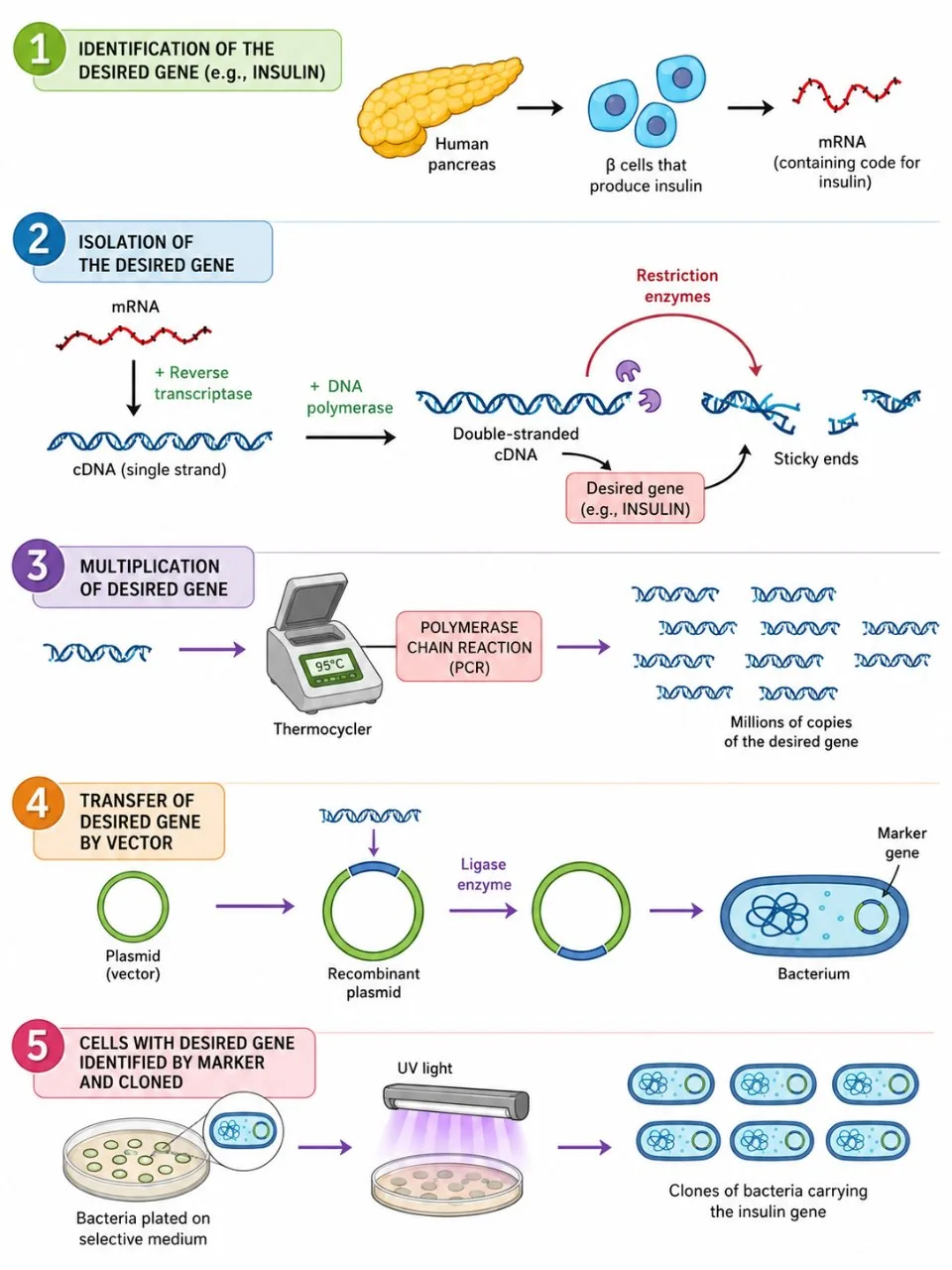


1
Locate the gene for insulin on a human chromosome.
2
Cut the gene out using a restriction enzyme. The enzyme leaves short stretches of unpaired bases called sticky ends.
3
Cut open a bacterial plasmid, a small ring of DNA, with the same restriction enzyme so that it has matching sticky ends.
4
Mix the gene with the plasmids. DNA ligase joins the sticky ends together, forming a recombinant plasmid.
5
Insert the recombinant plasmid into bacterial cells.
6
Grow the bacteria in a fermenter. As they divide, the plasmid is copied and every new cell contains the insulin gene.
7
The bacteria make human insulin, which is collected and purified for use by people with diabetes.
Section 2 of 6The tools used
| Tool | Role |
|---|---|
| Restriction enzyme | Cuts DNA at a specific sequence, leaving sticky ends |
| DNA ligase | Joins DNA pieces with matching sticky ends into one molecule |
| Plasmid (vector) | Carries the gene into the bacterial cell and is copied when the bacterium divides |
| Fermenter | Provides controlled conditions for rapid growth of large numbers of bacteria |
Section 3 of 6Why this is better than the older method
Source of insulin
- Source of insulin Insulin used to be extracted from the pancreases of pigs and cattle,
- which gave a protein slightly different from human insulin and was limited by how many animals were available.
Genetically engineered insulin
- Genetically engineered insulin The bacteria make exactly the human form of the protein,
- so it works well in the patient and is unlikely to cause an immune response.
- Production can be scaled up in fermenters to meet the demand from the growing number of people with diabetes.
Section 4 of 6Why bacteria are ideal


Use of bacteria
Same genetic code
- Same genetic code All organisms use the same genetic code, so bacteria can read the human gene and make the same protein.
Plasmids
- Plasmids Plasmids are separate from the main chromosome and easy to remove, alter and put back.
Fast reproduction
- Fast reproduction Bacteria multiply rapidly, giving a large amount of insulin in a short time.
Few ethical concerns
- Few ethical concerns Unlike animals, bacteria cannot feel pain or distress, so there are fewer ethical objections.
Section 5 of 6Key terms

| Term | Meaning |
|---|---|
| Genetic engineering | Transferring a gene from one organism into another so it makes a new protein. |
| Restriction enzyme | An enzyme that cuts DNA at specific base sequences. |
| Sticky ends | Short unpaired sections of DNA left by a cut that can join to matching ends. |
| DNA ligase | An enzyme that joins pieces of DNA together. |
| Recombinant plasmid | A plasmid containing a gene from another organism. |
| Plasmid | A small circular piece of DNA found in bacteria. |
Section 6 of 6Exam technique
1
Mixing up the two enzymesrestriction enzymes cut, ligase joins.
2
Saying the plasmid is cut by a different enzyme from the gene — the same one must be used so the sticky ends match.
3
Writing that bacteria are cut open to insert the gene — the gene goes in via the plasmid.
4
Saying insulin comes from the bacteria's own DNA — the gene is human; the bacteria only copy and express it.