Section 1 of 7What combustion is
Burning in oxygen
- Burning in oxygen Combustion is the chemical name for burning: a substance reacts with oxygen and forms oxides.
- Because the substance gains oxygen, combustion is also an example of oxidation.
Energy change
- Energy change Combustion releases heat and often light, so it is always an exothermic reaction.
- The energy given out is why combustion is so useful for fuels.
Section 2 of 7Three combustion reactions to know
| Element | Observations | Equation |
|---|---|---|
| Magnesium | Burns with an intense white flame and leaves a white powder, magnesium oxide. | 2Mg(s) + O2(g) → 2MgO(s) |
| Hydrogen | Burns, releasing heat; the product is water, which condenses on a cold surface. | 2H2(g) + O2(g) → 2H2O(g) |
| Sulfur | Burns with a blue flame to give a colourless, choking, poisonous gas, sulfur dioxide. | S(s) + O2(g) → SO2(g) |
Section 3 of 7Burning fossil fuels
What fuels are
- What fuels are A fuel is a substance that releases useful heat energy when it burns.
- Fossil fuels such as coal, oil and natural gas contain carbon and hydrogen, with small amounts of sulfur.
Pollution
- Pollution Burning fossil fuels releases carbon dioxide,
- which contributes to global warming,
- and sulfur dioxide and oxides of nitrogen,
- which cause acid rain.
- Supplies are finite because fossil fuels take millions of years to form.
Uses
- Uses Petrol and diesel power road vehicles, kerosene fuels aircraft, coal is burned in power stations and natural gas,
- which is mainly methane, CH4, is used for heating and cooking.
Section 4 of 7Complete and incomplete combustion
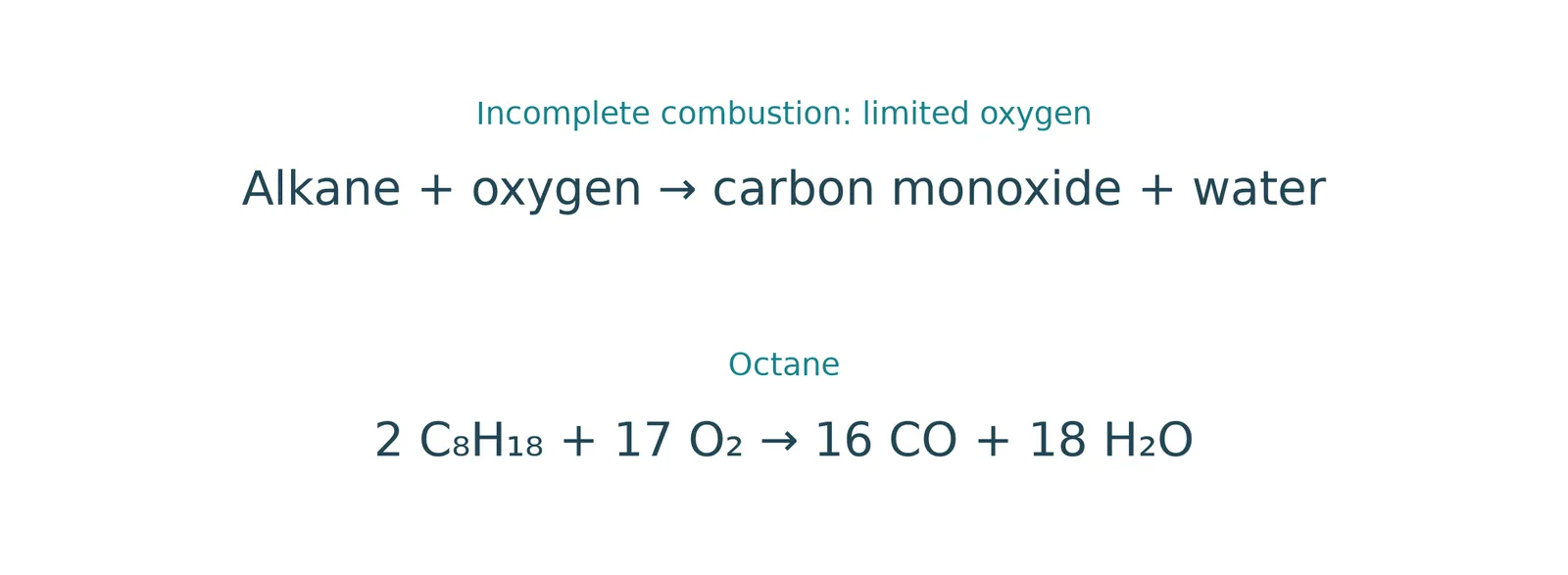

Hydrocarbon + oxygen
Complete combustion
- Complete combustion Happens when there is plenty of oxygen.
- The products are carbon dioxide and water, for example C3H8 + 5O2 → 3CO2 + 4H2O.
Incomplete combustion
- Incomplete combustion Happens when oxygen is limited, for instance in faulty boilers, stoves and car engines.
- The products include water plus carbon monoxide and carbon (soot), with some unburnt fuel.
Predicting the products
- Predicting the products Look at the fuel's elements and the oxygen supply: carbon becomes CO2 (or CO or C), hydrogen becomes H2O and sulfur becomes SO2.
Section 5 of 7Why carbon monoxide is dangerous
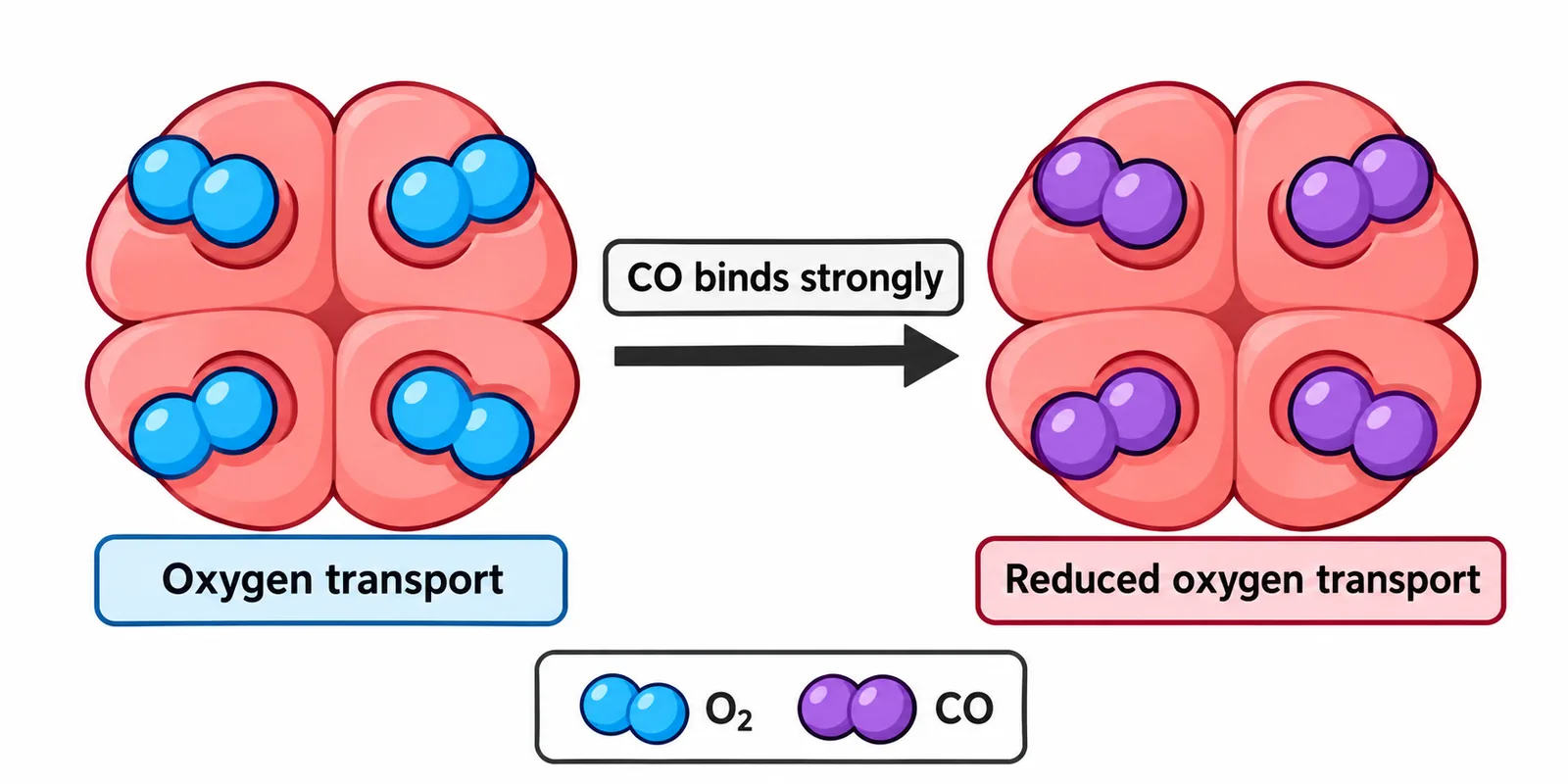
1Cannot be detected
- Cannot be detected Carbon monoxide is colourless, odourless and tasteless, so a person breathes it in without noticing.
2Absorbed by the blood
- Absorbed by the blood It passes from the lungs into red blood cells.
3Binds to haemoglobin
- Binds to haemoglobin It binds to haemoglobin much more strongly than oxygen does, forming stable carboxyhaemoglobin.
4Oxygen transport falls
- Oxygen transport falls Less oxygen reaches the tissues, causing headaches, dizziness and nausea, and in high concentrations unconsciousness and death.
Section 6 of 7Key terms
| Term | Meaning |
|---|---|
| Combustion | Burning: a reaction of a substance with oxygen that releases heat. |
| Exothermic | A reaction that transfers energy to the surroundings, usually raising the temperature. |
| Oxide | A compound of an element with oxygen. |
| Hydrocarbon | A compound containing only hydrogen and carbon. |
| Carboxyhaemoglobin | The stable compound formed when carbon monoxide binds to haemoglobin. |
Section 7 of 7Exam technique
1
Describing combustion as 'using up' oxygen with no product. Burning forms oxides, and the total mass is conserved.
2
Saying incomplete combustion makes only carbon monoxide. Soot (carbon) and water are formed as well.
3
Writing hydrogen's equation as H + O → HO. Both hydrogen and oxygen are diatomic: 2H2 + O2 → 2H2O.
4
Claiming carbon monoxide is dangerous because it is acidic or smelly. The danger is that it blocks oxygen transport, and it cannot be detected by the senses.