2.4.1Structure and Functions in Living Organisms: Part 1
Diffusion, Osmosis and Active Transport
10 min read 8 parts Lesson 14 of 36 1 quiz
Section 1 of 8Diffusion, Osmosis and Active Transport



Essential knowledge
Diffusion in biology
Diffusion in biology particles move randomly, so there is a net movement from high to low concentration until evenly spread. Examples: oxygen and carbon dioxide exchange in alveoli and leaves; digested food diffusing into villi. No energy from respiration is needed.
Factors that influence diffusion
(1) surface area to volume ratio – a larger surface area gives faster diffusion; (2) distance – thinner surfaces give faster diffusion; (3) temperature – particles have more kinetic energy; (4) concentration gradient – a steeper gradient gives a faster rate.
- Agar cubes stained with indicator show smaller cubes are coloured throughout faster.
Water
Water water is the solvent in which most reactions in cells occur. It dissolves and transports substances (e.g. in blood plasma, xylem and phloem), allows digestion (enzymes act on dissolved food) and carries wastes such as urea out in urine.
Osmosis
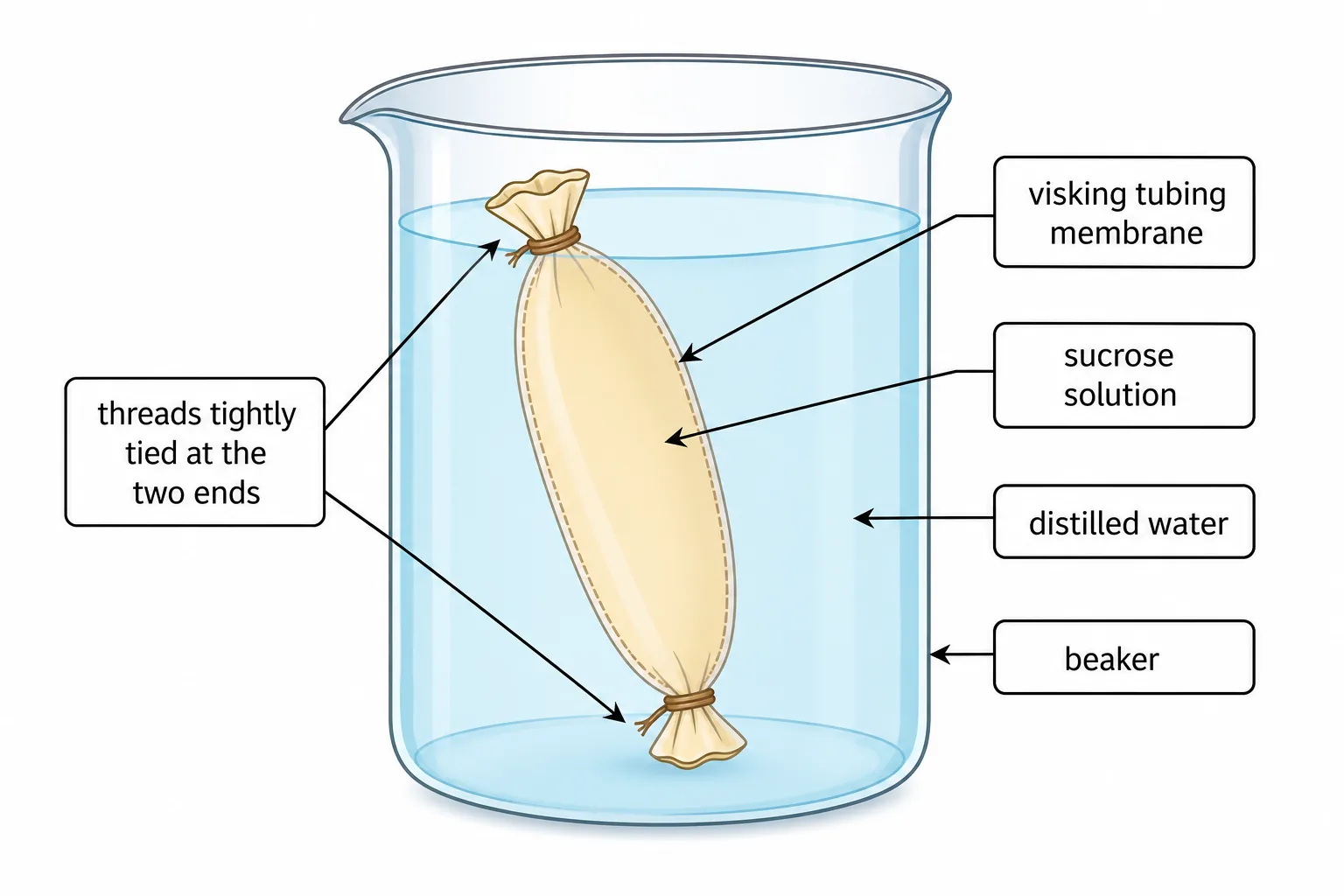
Osmosis water moves from a dilute solution (high water potential) to a concentrated solution (low water potential) through a partially permeable membrane. Solute molecules such as sucrose are too large to pass through.
Osmosis experiments
Visking tubing filled with sucrose solution placed in water swells and liquid rises up an attached capillary tube as water enters. Potato cylinders in solutions of different concentration gain mass in dilute solutions and lose mass in concentrated ones.
Osmosis in plants
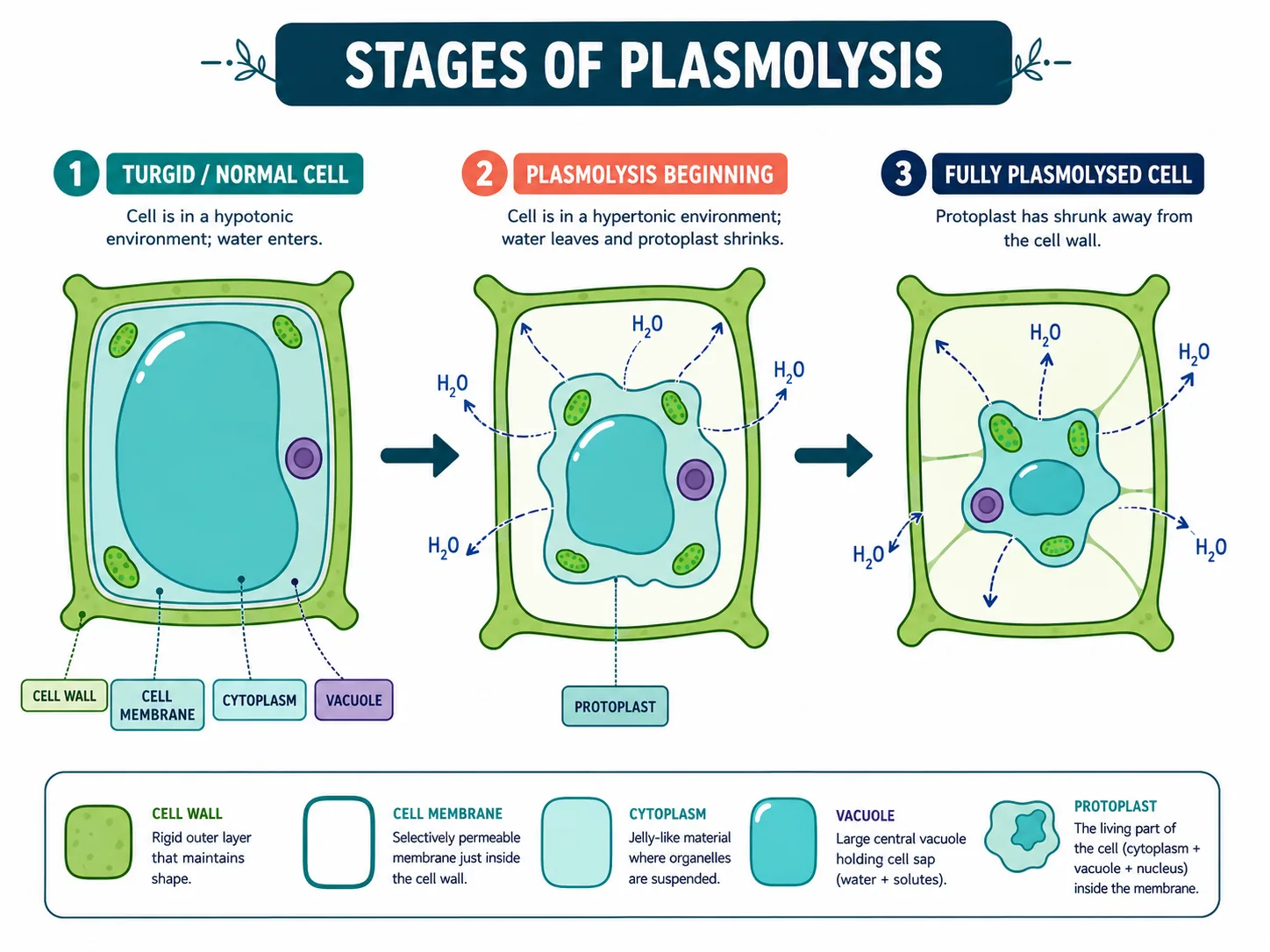
Osmosis in plants in water, plant cells take in water and the vacuole swells, pushing the membrane against the wall – the cell becomes turgid.
- Turgor pressure supports leaves and stems.
- In a concentrated solution, cells lose water and become flaccid;
- the membrane may pull away from the wall (plasmolysis) and the plant wilts.
Osmosis in animals
Osmosis in animals red blood cells have no cell wall. In pure water they take in water and burst; in concentrated solutions they lose water and shrink (crenate). This is why blood plasma must be kept at the correct concentration (osmoregulation by the kidneys).
Active transport
Active transport used when a cell needs to absorb substances that are at lower concentration outside than inside, e.g. mineral ions (nitrate) into root hair cells from soil, and glucose from the gut into villi epithelial cells. It requires energy (ATP) from respiration, so it stops if oxygen or glucose is lacking.
Proteins and active transport
Proteins and active transport carrier proteins in the cell membrane bind a specific ion or molecule on one side, then use energy to change shape and release it on the other side. Cells doing lots of active transport have many mitochondria.
Dynamic equilibrium
When tissue and solution have the same water potential there is no change in mass, but water molecules still cross the membrane in both directions at equal rates; there is no net movement.
More active transport sites
Glucose is actively reabsorbed from the kidney tubule back into the blood, as well as being absorbed by villus cells in the ileum and ions being taken up by root hair cells.
Section 2 of 8Process & sequence
- Cut equal-sized cylinders of potato with a cork borer and trim to the same length.
- Blot dry and record the initial mass of each cylinder.
- Place one cylinder into each of a range of sucrose solutions (e.g. 0.0 to 1.0 mol/dm3).
- Leave for the same time (e.g. 30 minutes) at the same temperature.
- Remove, blot dry gently and record the final mass.
- Calculate percentage change in mass = (final − initial) / initial × 100.
- Plot % change against concentration;
- where the line crosses zero, the tissue has the same water potential as the solution.
Osmosis into a plant cellwrite these steps in this order; each step is a marking point.
- Cell placed in pure water
- Water potential higher outside cell
- Water enters by osmosis
- Vacuole swells
- Membrane presses on cell wall
- Cell becomes turgid
Section 3 of 8Compare
| Feature | Diffusion | Osmosis | Active transport |
|---|---|---|---|
| Substance moved | Any particles (gases, solutes) | Water only | Ions and molecules (e.g. glucose, mineral ions) |
| Direction | Down concentration gradient | High to low water potential | Against concentration gradient |
| Energy from respiration? | No (passive) | No (passive) | Yes (ATP) |
| Membrane needed? | No | Yes, partially permeable | Yes, with carrier proteins |
| Example | O2 into alveolar capillaries | Water into root hair cells | Mineral ions into root hair cells |
Only active transport can move substances against their gradient.
| Solution outside cell | Animal cell (red blood cell) | Plant cell |
|---|---|---|
| More dilute (higher water potential) | Gains water, swells, may burst (lysis) | Gains water, becomes turgid; wall prevents bursting |
| Same water potential | No net change | No net change (flaccid-ish) |
| More concentrated (lower water potential) | Loses water, shrinks and crenates | Loses water, becomes flaccid then plasmolysed |
Section 4 of 8Worked examples
1−12%
A potato cylinder of mass 2.50 g was placed in sucrose solution and its mass became 2.20 g. Calculate the percentage change in mass and explain the result.
- % change = (2.20 − 2.50) / 2.50 × 100 = −0.30/2.50 × 100 = −12%.
- The solution had a lower water potential than the potato cells,
- so water left the cells by osmosis through their partially permeable membranes, reducing the mass.
2Explain why root hair cells need many mitochondria.
- Root hair cells absorb mineral ions from the soil, where ions are usually at a lower concentration than in the cell.
- This requires active transport against the concentration gradient, which uses energy released by aerobic respiration in mitochondria.
- More mitochondria release more energy for carrier proteins.
Section 5 of 8Keep going
Diffusion, Osmosis & Active Transport IGCSE Biology 0610: what to do next
These Diffusion, Osmosis & Active Transport IGCSE Biology 0610 notes covered the key ideas, worked examples and exam technique for this topic. Check your Diffusion, Osmosis & Active Transport IGCSE Biology 0610 understanding with the practice questions below, then reread any Diffusion, Osmosis & Active Transport IGCSE Biology 0610 point you were unsure about before moving on.
Diffusion, Osmosis & Active Transport IGCSE Biology 0610: revision checklist
- Revise the main Diffusion, Osmosis & Active Transport IGCSE Biology 0610 definitions until you can write them from memory.
- Practise Diffusion, Osmosis & Active Transport IGCSE Biology 0610 exam questions under timed conditions.
- Link each Diffusion, Osmosis & Active Transport IGCSE Biology 0610 idea to a diagram or a worked example.
- List the common Diffusion, Osmosis & Active Transport IGCSE Biology 0610 mistakes and how to avoid them.
- Explain one Diffusion, Osmosis & Active Transport IGCSE Biology 0610 idea out loud as if teaching a friend.
- Practice: Diffusion, Osmosis & Active Transport IGCSE Biology 0610 practice questions
- Previous lesson: 1.2 Cell Structure & Size of Specimens — Notes
- Next lesson: 1.4 Biological Molecules — Notes
- Course: Cambridge IGCSE Biology 0610 — all units
- Official syllabus: Cambridge IGCSE Biology 0610 syllabus
Section 6 of 8Key terms
Section 7 of 8Command terms
Command terms
State / Name
Give a short answer only; no explanation is needed (1 mark = 1 fact).
Define
Give the precise meaning. Learn the syllabus definitions word-for-word: every keyword in the definition is a marking point.
Describe
Say what happens / what the data show, with key features and figures. Do not give reasons.
Explain
Give reasonswhat happens AND why/how, linked with “because”, “so”, “therefore”.
Suggest
Apply knowledge to an unfamiliar situation; any sensible, scientifically-based answer can score.
Compare
Give similarities AND differences, each as a direct comparison (“X is … whereas Y is …”).
Outline
Set out the main points briefly.
Calculate
Work out from given facts; show working, give the unit and the requested significant figures.
Identify
Name/select from given information.
Predict
Give an expected result without a full justification.
Evaluate
Judge the importance or quality of the evidence/method, with reasons.
Section 8 of 8Exam technique
Keywords the mark scheme looks for in this lesson
Keywords the mark scheme looks for in this lesson
Diffusion · Concentration gradient · Kinetic energy · Partially permeable membrane · Osmosis · Water potential · Turgor pressure · Plasmolysis · Active transport · Carrier protein
Learn each definition in the Key words tab exactly; a missing keyword in a definition usually loses the mark.
How to get full marks (examiner guidance)
How to get full marks (examiner guidance)
Use the exact scientific term
“osmosis” must mention a partially permeable membrane and water potential gradient; “diffusion” must mention net movement down a concentration gradient.
Write “rate of … increases”, not “… increases” (e.g. rate of diffusion, rate of photosynthesis).
Say “concentration gradient”, never just “gradient”.
Name the type
“aerobic/anaerobic respiration”, not just “respiration”; respiration releases energy — never “produces/creates energy”.
Enzymes are not “killed” and are not “used up”
Enzymes are not “killed” and are not “used up” they are denatured (active site changes shape) at high temperature/extreme pH; low temperature only reduces kinetic energy.
Antibodies have a shape complementary to the antigen — not “the same shape”.
Particle/ion answers
Particle/ion answers say “particles/molecules/ions”, not “it”; give units with every numerical answer and use the significant figures asked for.
Compare = a similarity AND a difference; describe = what happens; explain = why it happens.
Repeats let you identify anomalies and calculate a mean — they do not make an experiment “valid”.