2.4.2Structure and Functions in Living Organisms: Part 1
Factors Affecting the Rate of Movement of Substances
5 min read 7 parts Lesson 15 of 36 1 quiz
Section 1 of 7Four factors




Rate of diffusion
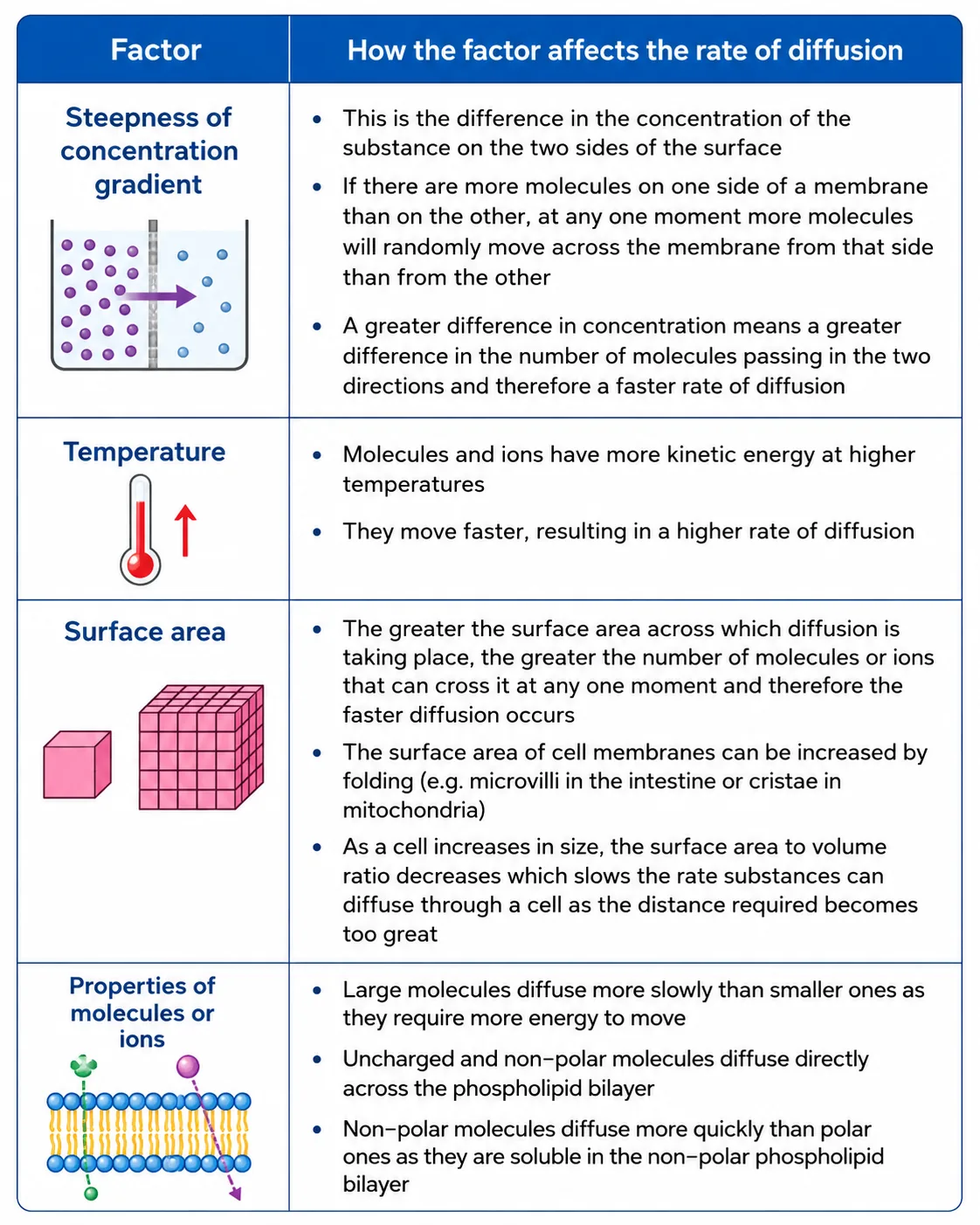
Concentration gradient
- Concentration gradient The bigger the difference in concentration between two regions, the faster the net movement.
- More particles randomly strike the membrane on the side with the higher concentration.
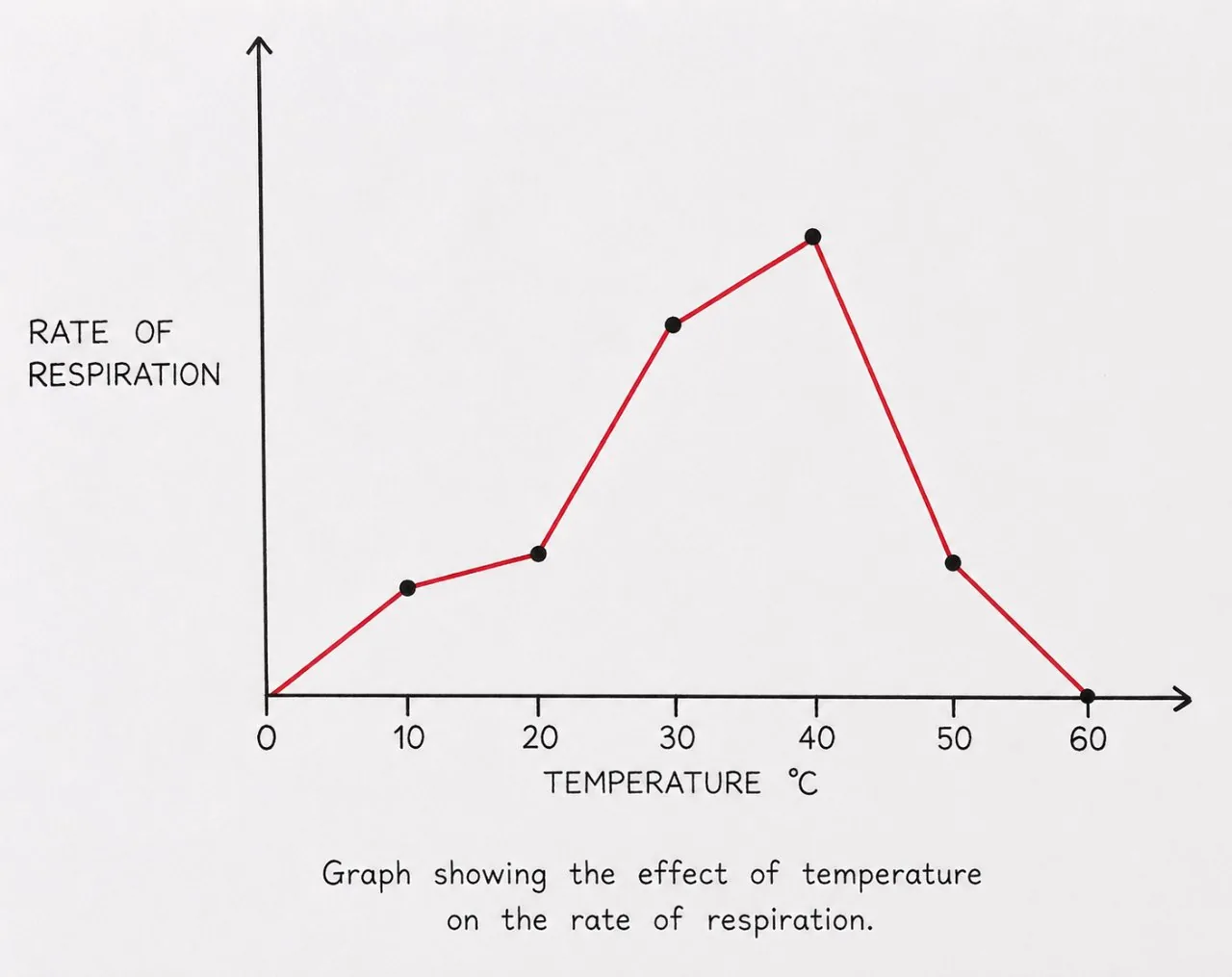
Temperature
- Temperature At a higher temperature particles have more kinetic energy and move faster, so they cross the membrane more quickly and more often.
Diffusion distance
- Diffusion distance The shorter the distance particles have to travel, the quicker the substance arrives.
Surface area to volume ratio
- Surface area to volume ratio A larger surface area compared with volume lets more particles cross at once and means the substance has a shorter way to reach all of the cell.
Section 2 of 7Why size matters

1Organism or cell gets bigger
- Organism or cell gets bigger Volume grows faster than surface area.
2Ratio falls
- Ratio falls There is less surface available for every unit of volume.
3Diffusion alone is too slow
- Diffusion alone is too slow Oxygen and nutrients cannot reach the centre fast enough, and waste cannot leave quickly enough.
4Exchange surfaces evolve
- Exchange surfaces evolve Large organisms develop specialised surfaces that increase surface area and speed up transport.
Section 3 of 7Calculating surface area to volume ratio
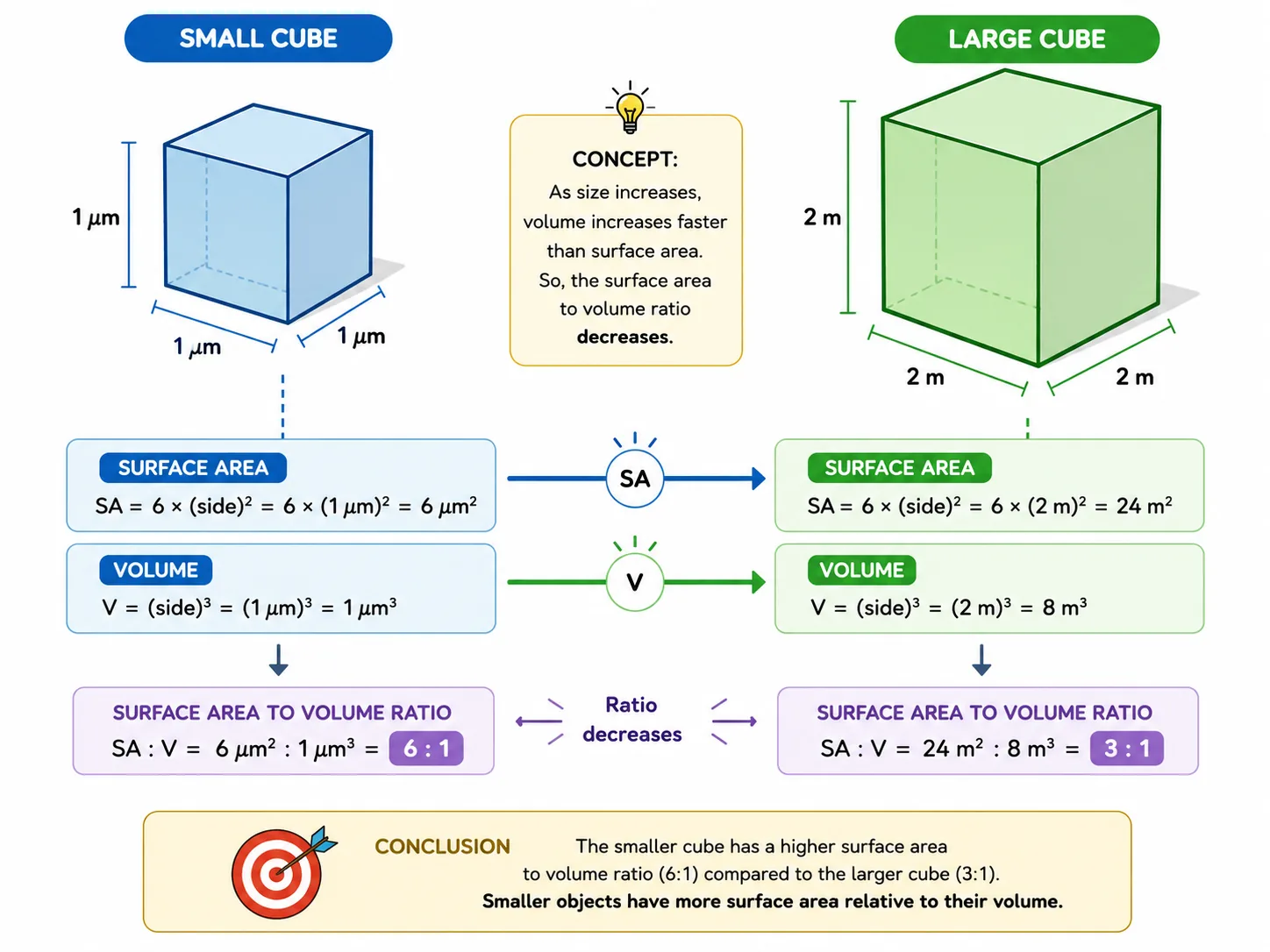


| Cube side length (cm) | Surface area (cm2) | Volume (cm3) | SA : V |
|---|---|---|---|
| 1 | 6 × 1 × 1 = 6 | 1 × 1 × 1 = 1 | 6 : 1 |
| 2 | 6 × 2 × 2 = 24 | 2 × 2 × 2 = 8 | 3 : 1 |
| 3 | 6 × 3 × 3 = 54 | 3 × 3 × 3 = 27 | 2 : 1 |
| 4 | 6 × 4 × 4 = 96 | 4 × 4 × 4 = 64 | 1.5 : 1 |
Section 4 of 7Adaptations that maximise exchange

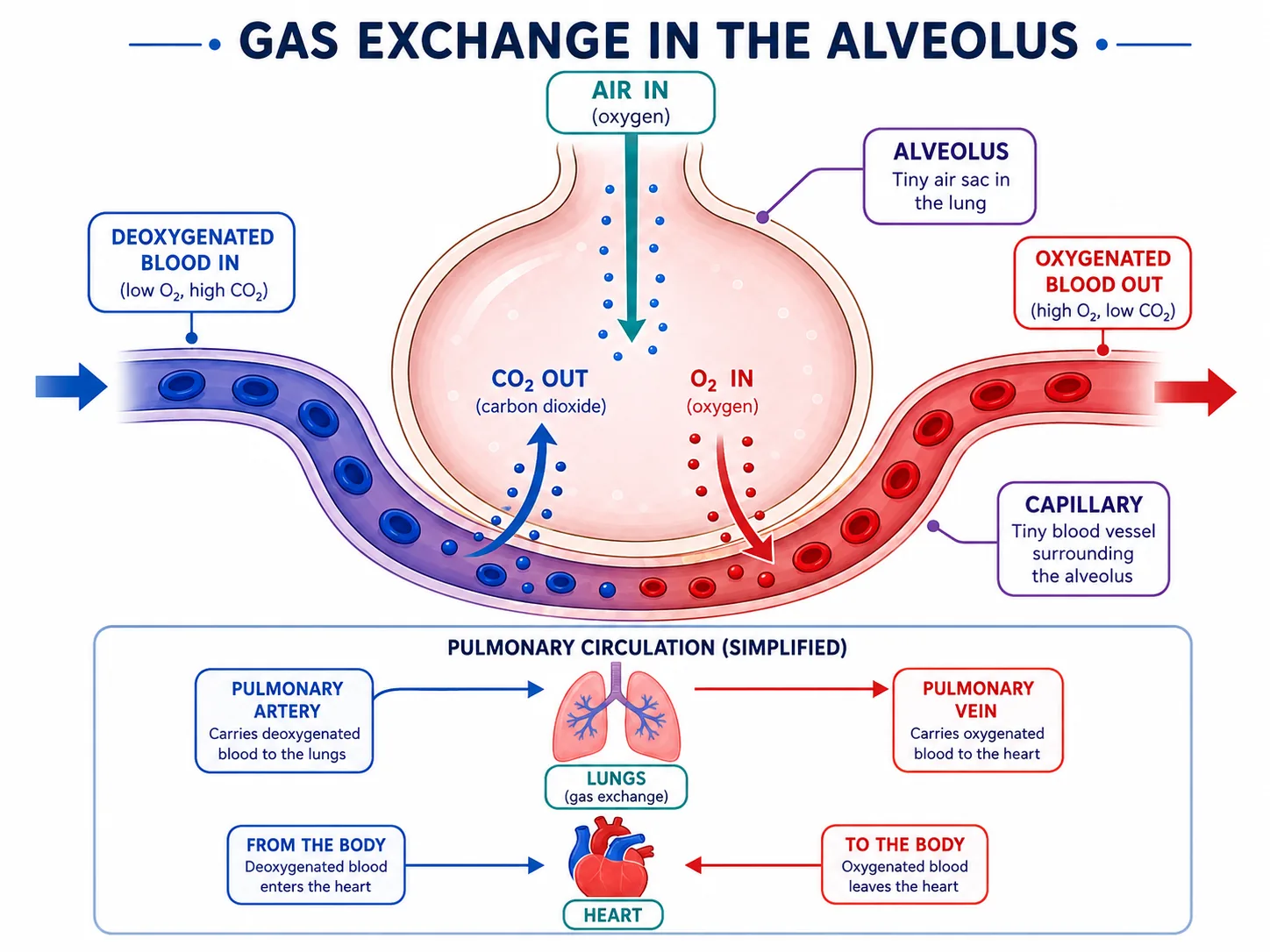
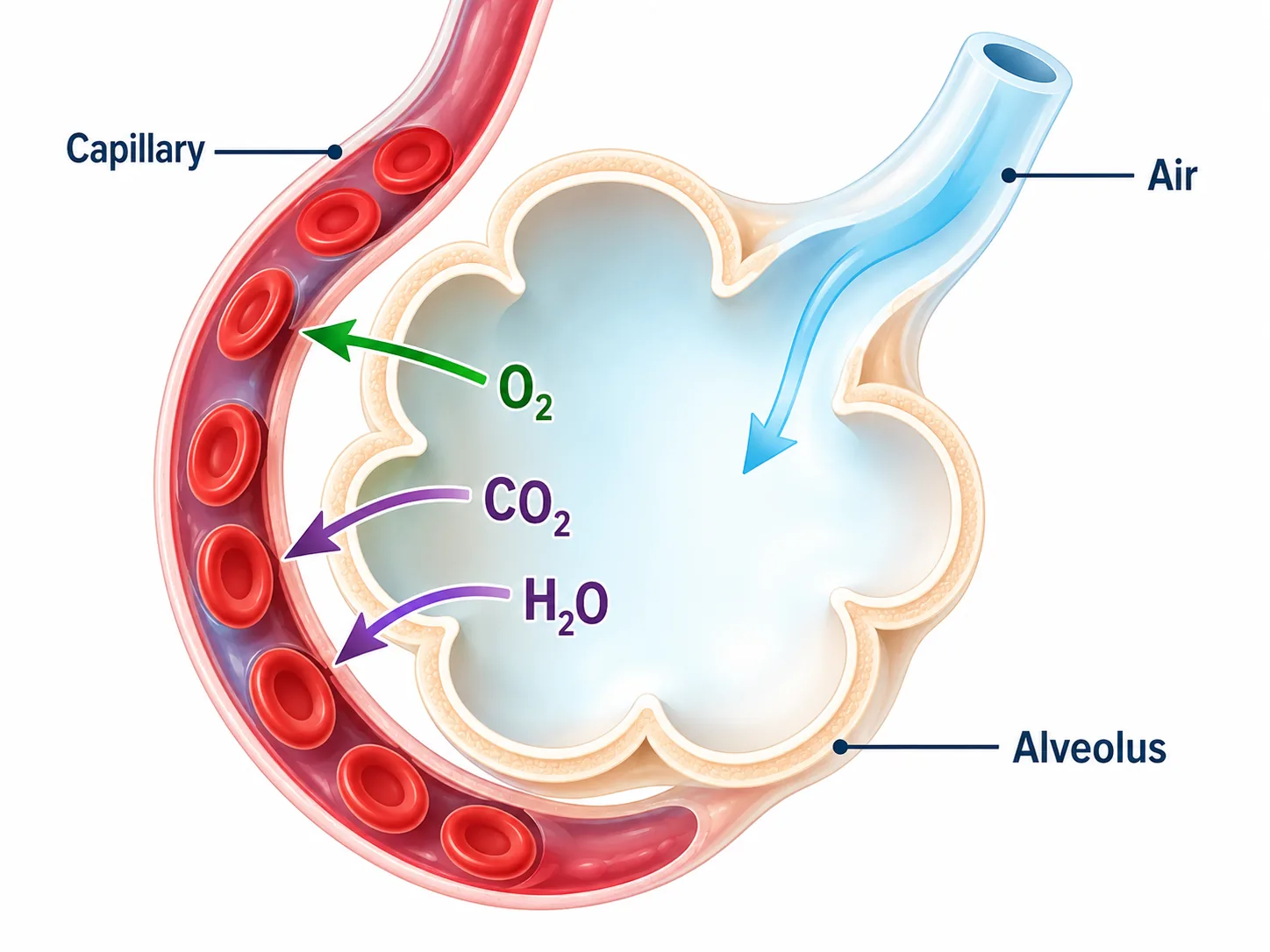


Alveoli in the lungs
- Alveoli in the lungs The walls of the alveoli and the capillaries are only one cell thick,
- giving a very short diffusion distance for oxygen and carbon dioxide.
- A rich blood supply keeps the concentration gradient steep by carrying oxygen away and bringing carbon dioxide in.
Villi in the small intestine
- Villi in the small intestine The folded lining and finger-like villi greatly increase the surface area available to absorb the products of digestion.
Root hair cells
- Root hair cells Long thin extensions of the root cell increase the surface area for absorbing water and mineral ions from the soil.
Section 5 of 7Using the ideas in an exam
1
Name the factor being changed and say whether it raises or lowers the rate of diffusion.
2
Link the factor to particle behaviour, such as more kinetic energy or more collisions with the membrane.
3
State the result in terms of the rate or the time taken, using data from the question where it is given.
4
If asked to plan an investigation, change one factor, keep the others constant and measure the rate of diffusion in a repeatable way.
Section 6 of 7Key terms
| Term | Meaning |
|---|---|
| Diffusion | The net movement of particles from a region of higher concentration to a region of lower concentration. |
| Concentration gradient | The difference in concentration between two regions. |
| Diffusion distance | How far the particles have to travel. |
| Surface area to volume ratio | The surface area of an object divided by its volume. |
| Exchange surface | A specialised surface where substances move between an organism and its environment. |
Section 7 of 7Exam technique
1
Saying that a larger organism has a larger surface area to volume ratio. As size increases the ratio falls.
2
Forgetting that a cube has six faces when calculating surface area. Find the area of one face and multiply by six.
3
Writing that diffusion needs energy from the cell. It is passive and relies on the random movement of particles.
4
Describing the concentration gradient as the 'amount' of a substance rather than the difference in concentration between two regions.