2.2.3Reproduction and Inheritance
Key Terms in Genetics
5 min read 7 parts Lesson 16 of 29 Unit quiz
Section 1 of 7Genes and alleles
Gene
- Gene A gene is a short section of a DNA molecule that carries the code for making one protein.
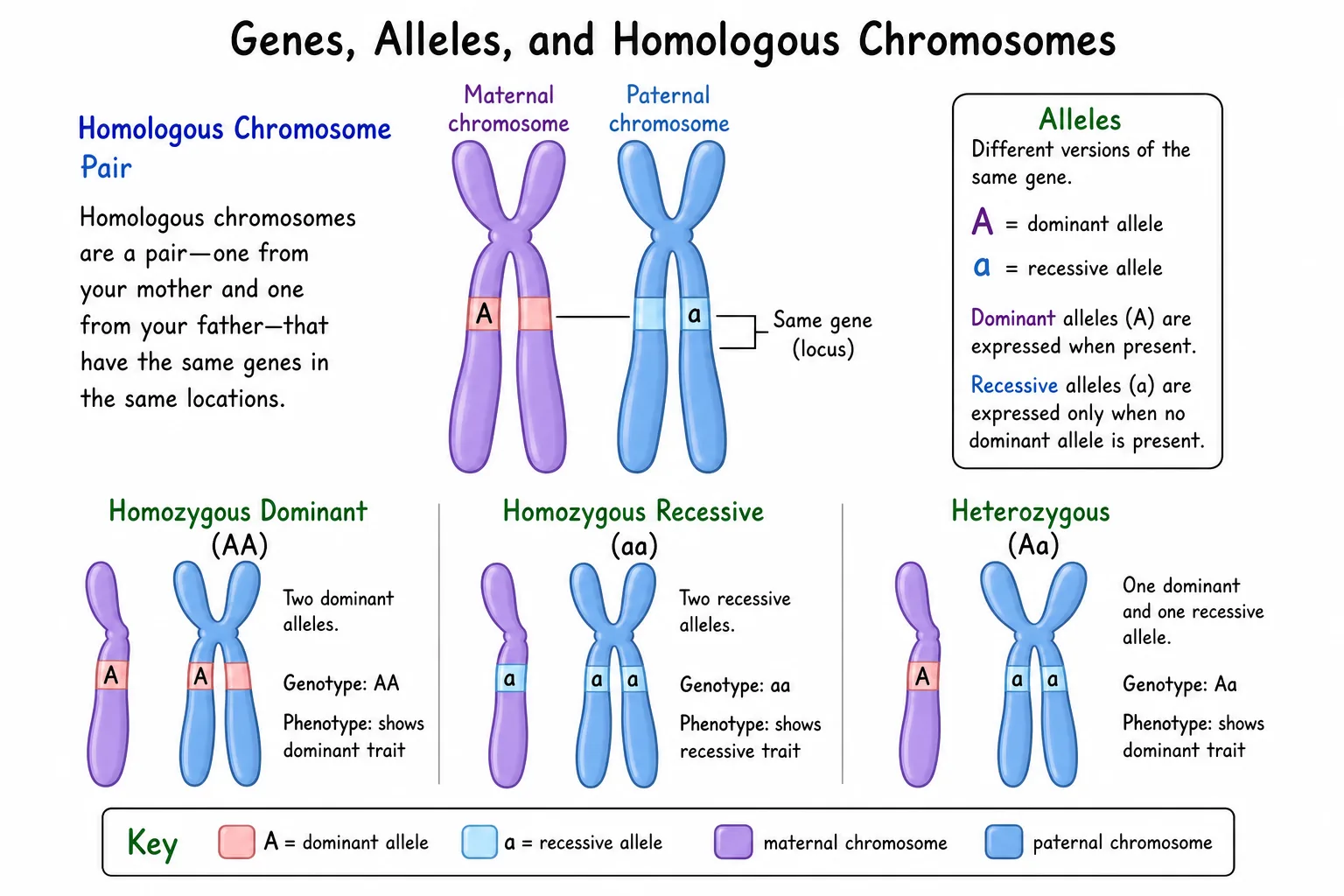
- Genes sit at fixed positions on chromosomes, so every human has two copies of each gene, one inherited from each parent.
Allele
- Allele An allele is one particular version of a gene.
- Different alleles of the same gene give different forms of a characteristic, such as tall or short stems in a pea plant.
- Alleles are written as single letters, for example B and b.
Two alleles per gene
- Two alleles per gene Because chromosomes come in pairs, each body cell carries exactly two alleles for a gene.
- They may be identical or different.
Section 2 of 7Dominant and recessive alleles

Which allele is shown?
Dominant allele
- Dominant allele A dominant allele affects the phenotype even when only one copy is present.
- It is written as a capital letter, such as T.
Recessive allele
- Recessive allele A recessive allele only affects the phenotype when there is no dominant allele, that is, when two copies are present.
- It is written as the lower-case version of the same letter, such as t.
Masking
- Masking If a dominant and a recessive allele are present together, the dominant allele hides the effect of the recessive one,
- although the recessive allele is still there and can be passed on.
Choosing letters
- Choosing letters Pick a letter whose capital and lower-case forms look clearly different, such as A/a or D/d.
- Avoid C/c or S/s, which are easy to confuse.
Section 3 of 7Genotype and phenotype
Genotype
- Genotype The genotype is the combination of alleles an organism has for a gene, written as two letters such as TT, Tt or tt.
- You cannot see a genotype; it has to be worked out from breeding results or tests.
Phenotype
- Phenotype The phenotype is the observable characteristic that results from the genotype working together with the environment, for example tall stems or the ability to taste a bitter chemical.
Same phenotype, different genotype
- Same phenotype, different genotype Two organisms can look identical but have different genotypes.
- In a dominant-recessive pair, both TT and Tt show the dominant phenotype.
Section 4 of 7Homozygous and heterozygous


| Term | Meaning | Example genotype |
|---|---|---|
| Homozygous dominant | Two identical dominant alleles | TT |
| Homozygous recessive | Two identical recessive alleles | tt |
| Heterozygous | Two different alleles, one dominant and one recessive | Tt |
Section 5 of 7Worked example: tasting a bitter chemical
1
Suppose the ability to taste a bitter chemical is controlled by one gene. T (taster) is dominant and t (non-taster) is recessive.
2
A person with genotype TT is homozygous dominant, so their phenotype is taster.
3
A person with genotype Tt is heterozygous. The dominant allele masks the recessive one, so they are also a taster.
4
A person with genotype tt is homozygous recessive. With no dominant allele present, they are a non-taster.
5
In an exam you may be given an unfamiliar characteristic, so learn the relationships between the terms rather than memorising this example.
Section 6 of 7Key terms
| Term | Meaning |
|---|---|
| Gene | A section of DNA that codes for a protein and so controls a characteristic. |
| Allele | A different version of the same gene. |
| Genotype | The combination of alleles an organism has for a particular gene. |
| Phenotype | The observable characteristics of an organism. |
| Dominant | An allele that is expressed in the phenotype even if only one copy is present. |
| Recessive | An allele that is only expressed when two copies are present. |
| Homozygous | Having two identical alleles of a gene. |
| Heterozygous | Having two different alleles of a gene. |
Section 7 of 7Exam technique
1
Using 'gene' and 'allele' as if they mean the same thing: a gene is the section of DNA, while alleles are the different versions of it.
2
Thinking a dominant allele is always the more common one or the 'stronger' one; dominant only describes how it is expressed when paired with another allele.
3
Writing that Tt is a 'recessive' organism; Tt is heterozygous and shows the dominant phenotype.
4
Mixing up genotype and phenotypea genotype is letters such as Tt, a phenotype is a description such as 'taster'.
5
Using letters like Cc or Ss in a genetic diagram, which makes it unclear which allele is dominant.