The Nature and Variety of Living Organisms
Characteristics of living organisms — Edexcel Linear - OL Revision Notes & Topical Questions
5 min read 14 parts Lesson 3 of 4 Unit quiz
Features of Eukaryotes and Prokaryotes — EDEXCEL LINEAR - OL notes: Compare animals, plants, fungi, protoctists and prokaryotes by their cell structure, nutrition and carbohydrate storage, and identify pathogens and viruses.Living organisms are grouped by the features they share:…
- saprobionts
- Worked example 1
- Worked example 2
- Worked example 3
- Worked example 4
- Worked example 5
Part 1 of 7Eukaryotes and prokaryotes
Living organisms are grouped by the features they share: plants, animals, fungi, protoctists and prokaryotes. The first four are eukaryotes: their cells contain a nucleus with a distinct membrane, and they may be single-celled or multicellular. Both animal and plant cells seen under a light microscope show a membrane-bound nucleus.
Prokaryotes (for example bacteria) are always single-celled, their cells do not contain a nucleus, and their genetic material lies free in the cytoplasm as a single, circular chromosome of DNA. Prokaryotic cells are also substantially smaller than eukaryotic cells.
Part 2 of 7Comparing animals, plants and fungi
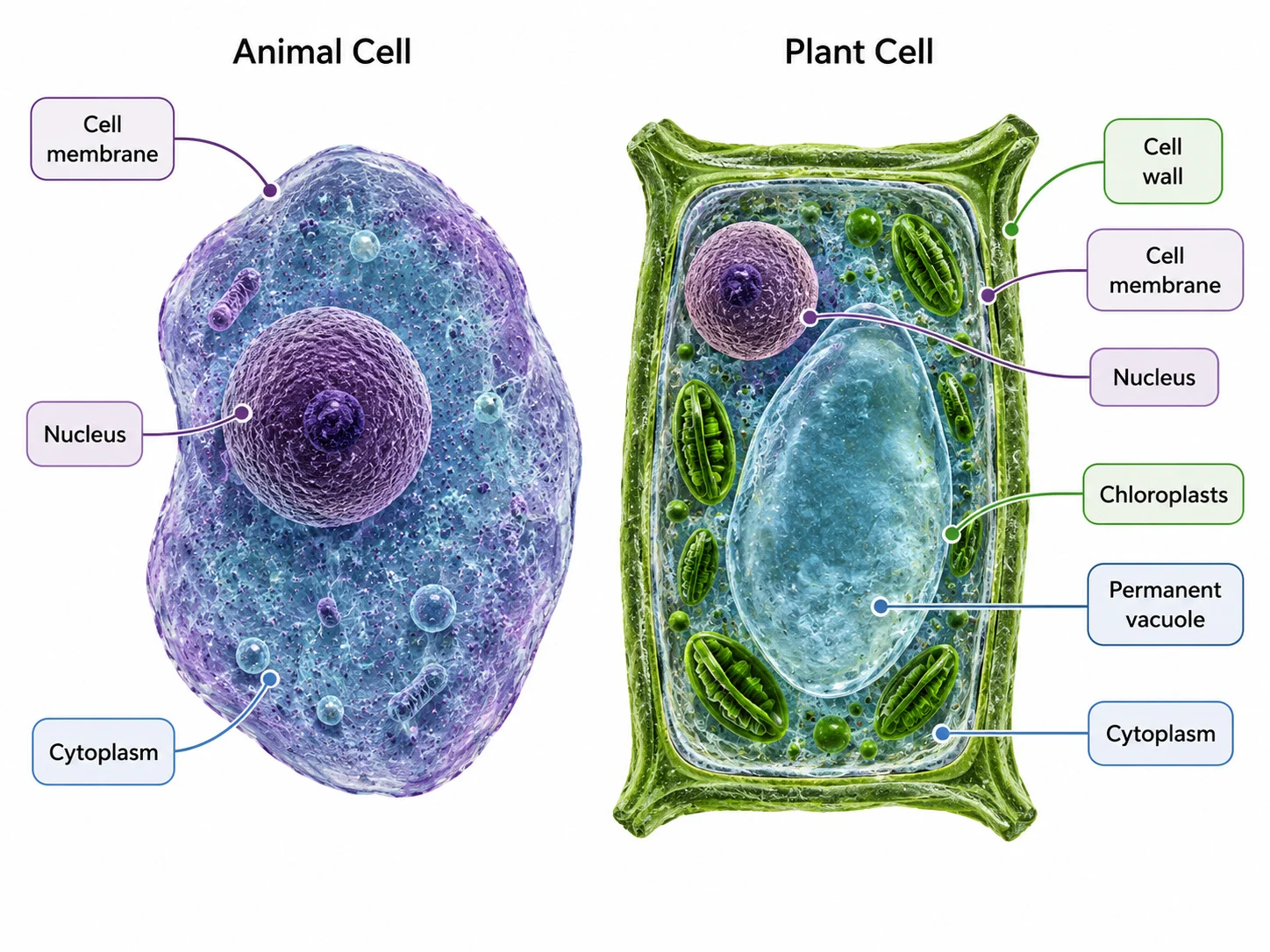
| Feature | Animals | Plants | Fungi |
|---|---|---|---|
| Cells | Multicellular | Multicellular | Usually multicellular (Mucor); some single-celled (yeast) |
| Nucleus | Yes, with membrane | Yes, with membrane | Yes, with membrane |
| Cell wall | None | Cellulose | Chitin |
| Chloroplasts | No | Yes | No |
| Nutrition | Feed on organic substances made by others | Photosynthesis | Feed on dead or living organic matter (saprotrophic) |
| Carbohydrate store | Glycogen | Starch or sucrose | Glycogen |
| Nervous coordination | Usually yes | No | No |
Examples of fungi include moulds, mushrooms and yeasts. Multicellular fungi are made of thread-like hyphae that contain many nuclei and form a network called a mycelium.
Part 3 of 7Protoctists
The protoctists are a very diverse group with features that differ from the other three eukaryotic groups. Examples: Amoeba, Paramecium, Plasmodium and Chlorella.
Part 4 of 7Prokaryotes and their cell components
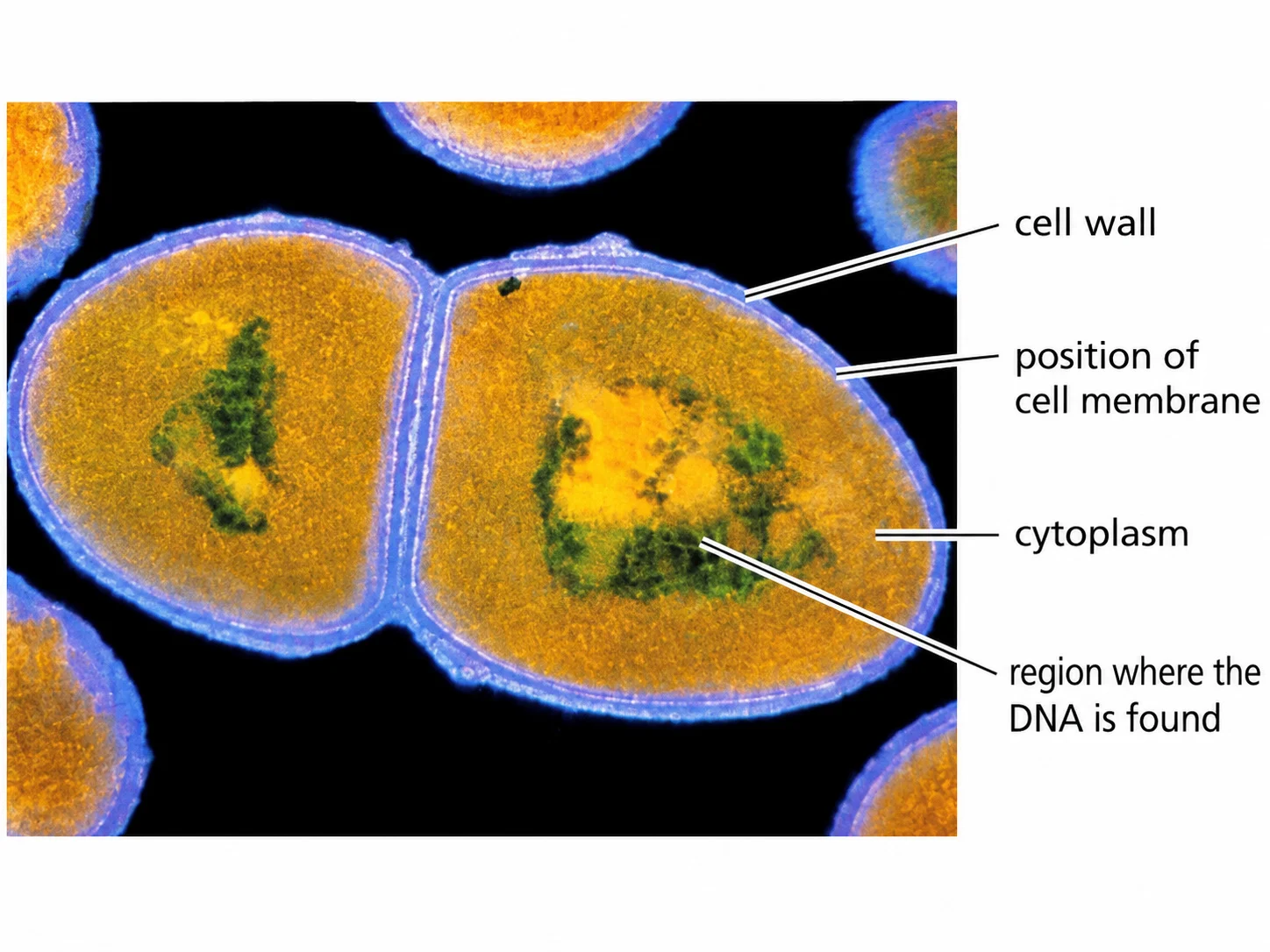
Bacteria have a cell wall, cell membrane, cytoplasm, plasmids and circular DNA. Most feed on other living or dead organisms. If they feed on dead organic matter they are known as saprobionts or decomposers. Compared with eukaryotic cells, a bacterium lacks a nucleus and membrane-bound organelles and has plasmids as well as its main chromosome.
Part 5 of 7Pathogens and viruses
A pathogen is an organism that causes disease in another organism. Groups that include pathogens are bacteria, fungi, protoctists and viruses. Pathogenic bacteria do not always infect the cells of hosts; they can remain within body cavities or spaces. Example: Pneumococcus, a spherical bacterium, causes pneumonia.
Viruses are small particles, always smaller than bacteria; they are parasitic and can only reproduce inside living cells; they infect every type of living organism; they have no cellular structure but a protein coat and contain one type of nucleic acid, either DNA or RNA.
Part 6 of 7Using the comparison in exam questions
Exam questions often give a list of features and ask you to identify the group, or give a table with blanks to complete.
For example, an organism with thread-like hyphae, a chitin wall and no chloroplasts is a fungus; a single-celled organism with a circular chromosome and no nucleus is a bacterium. Remember too that the size order from largest to smallest is: eukaryotic cells, then bacteria, then viruses, so a virus is never a cell and is always smaller than a bacterium.
Part 7 of 7Worked examples
State two ways in which a plant cell differs from an animal cell. [2]2 marks
A plant cell has a cellulose cell wall and chloroplasts; an animal cell has neither.
Give two features that fungi and animals have in common and one that distinguishes them. [3]3 marks
Both are eukaryotes with a membrane-bound nucleus and both store carbohydrate as glycogen; fungal cells have chitin cell walls, whereas animal cells have no cell wall.
Describe the genetic material of a bacterial cell. [2]2 marks
A single circular chromosome of DNA lying in the cytoplasm (not in a nucleus), often with small plasmids.
Explain why viruses are not classed as living cells. [2]2 marks
They have no cellular structure, only a protein coat and one type of nucleic acid, and they can only reproduce inside the cells of a living host.
Name the structure formed by the hyphae of a multicellular fungus. [1]1 mark
The mycelium.
Key terms
| Term | Meaning |
|---|---|
| Eukaryote | An organism whose cells have a nucleus surrounded by a membrane. |
| Prokaryote | A single-celled organism whose cells have no nucleus; DNA is a circular chromosome in the cytoplasm. |
| Hyphae | Thread-like structures that make up the body of a multicellular fungus. |
| Mycelium | The network of hyphae of a fungus. |
| Saprobiont | An organism that feeds on dead organic matter; a decomposer. |
| Pathogen | An organism that causes disease in another organism. |
| Virus | A tiny non-cellular particle with a protein coat and DNA or RNA that reproduces only inside living cells. |
Avoid these mistakes
Last updated:
\n