Use of Biological Resources
Food production — Edexcel Linear - OL Revision Notes & Topical Questions
10 min read 12 parts Lesson 5 of 8 Unit quiz
Using Microorganisms: Yeast, Yoghurt and Industrial Fermenters — EDEXCEL LINEAR - OL notes: Explain how yeast makes bread and how to investigate its fermentation, how Lactobacillus makes yoghurt, and how fermenters control conditions.Microorganisms can be used to make foods.
- Worked example 1
- Worked example 2
- Worked example 3
- Worked example 4
- Pasteurisation
- Mycoprotein
Section 1 of 12Yeast and bread making
Microorganisms can be used to make foods.
Putting the stages in order for an exam: flour starch is broken down to sugars by yeast enzymes; yeast respires aerobically, using up oxygen; it then respires anaerobically; ethanol and carbon dioxide are made; carbon dioxide inflates the dough; baking evaporates ethanol and kills the yeast. The word equation for fermentation is glucose to ethanol plus carbon dioxide (with a small release of energy), and it is called anaerobic because no oxygen is used.
Section 2 of 12Practical: anaerobic respiration in yeast
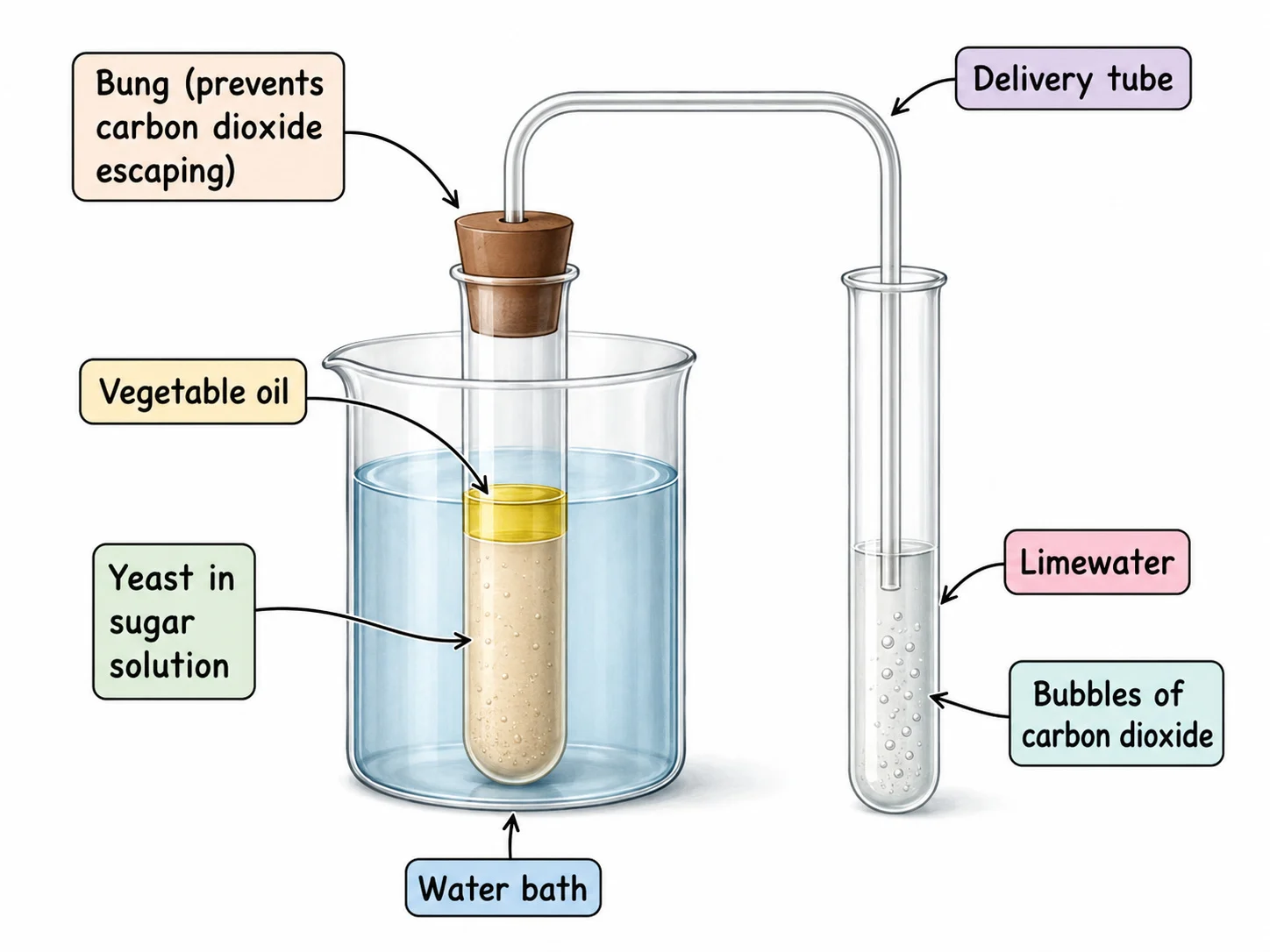
Anaerobic respiration in yeast is called fermentation (glucose to ethanol and carbon dioxide). It is important in bread and alcoholic drinks. To investigate temperature:
More bubbles per minute means a faster rate. The rate rises towards the optimum temperature because enzyme activity increases, but beyond the optimum the enzymes denature and carbon dioxide production slows and stops. CORMS: change temperature; same yeast species; repeat at each temperature; measure bubbles in a set time; standardise sugar concentration, volume and pH and the mass of yeast.
Section 3 of 12Bacteria and yoghurt
Bacteria are useful because they make complex molecules and reproduce rapidly. Yoghurt is made using Lactobacillus:
The lower pH also prevents growth of harmful microorganisms, so yoghurt keeps longer than milk.
Why both heat treatments?
- but if the milk were not cooled to 40 to 45°C before adding the culture it would kill Lactobacillus too.
Section 4 of 12Industrial fermenters
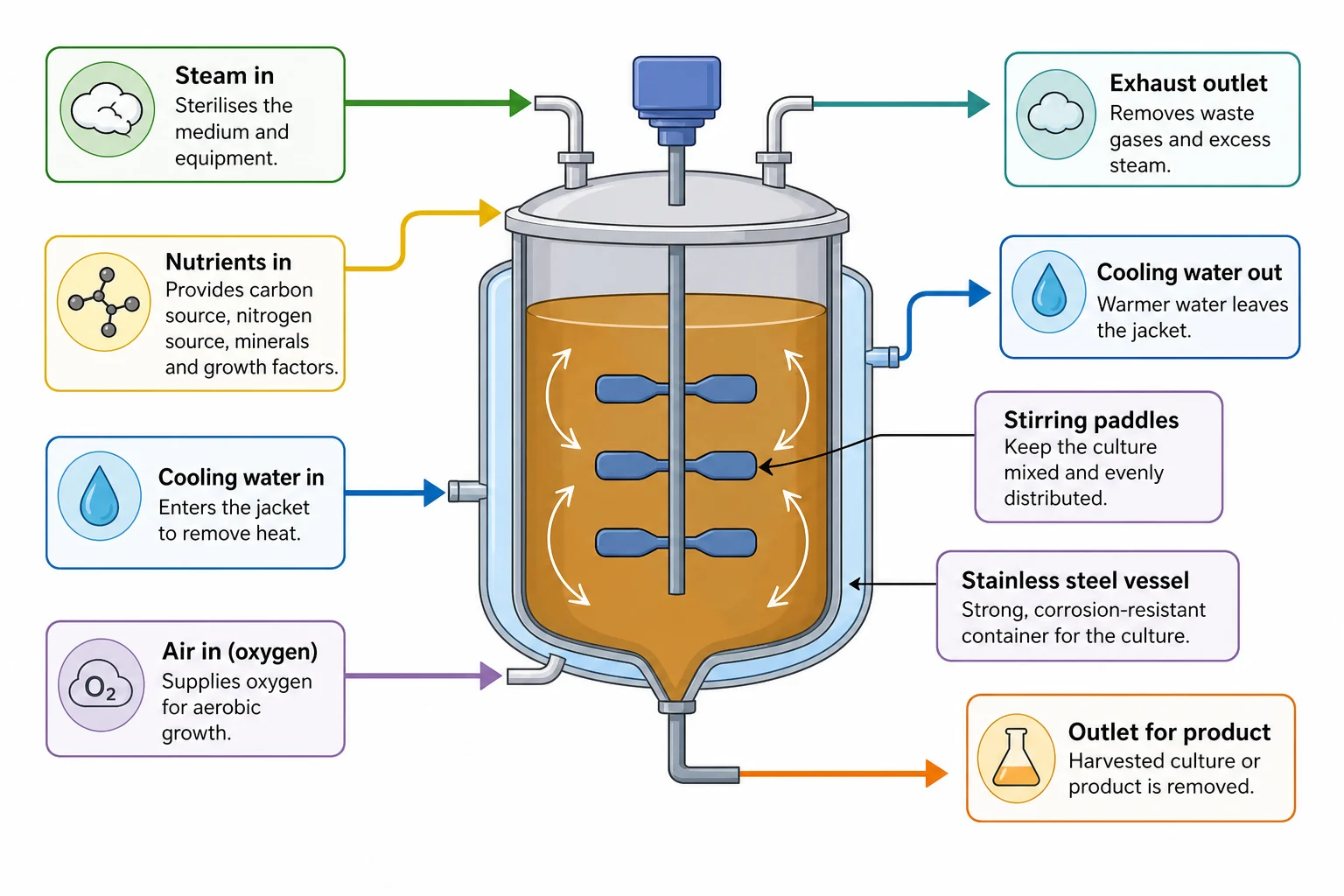
Fermenters are large containers for culturing bacteria and fungi, used for yoghurt, mycoprotein and antibiotics such as penicillin, and for GM microorganisms. Conditions can be controlled to give large quantities of the right organism.
| Condition | Why and how |
|---|---|
| Aseptic precautions | Steam cleaning kills contaminants so only the wanted microorganism grows |
| Nutrients | Supply respiration substrates and building materials for growth and reproduction |
| Temperature | Probe and water jacket keep the optimum for enzymes |
| pH | Monitored with a probe and adjusted with acid or alkali |
| Oxygen | Supplied for aerobic respiration |
| Agitation | Paddles mix microorganisms, nutrients, oxygen, temperature and pH evenly |
Section 5 of 12Worked examples
Explain why bread dough rises. [3]3 marks
Yeast respires anaerobically, producing carbon dioxide, which is trapped in the dough and expands it.
In the yeast investigation, why is oil added? [1]1 mark
To exclude oxygen so only anaerobic respiration occurs.
Explain why yoghurt lasts longer than milk. [2]2 marks
Lactic acid lowers the pH, which prevents the growth of harmful microorganisms.
Give two reasons a fermenter is stirred and cooled by a water jacket. [2]2 marks
Stirring distributes nutrients, oxygen and heat evenly; the jacket keeps the optimum temperature for enzymes.
Section 6 of 12Pesticides and biological control
Pesticides are chemicals that kill unwanted species and so reduce damage and competition: insecticides (insects), herbicides (weeds) and fungicides (fungi).
| Pesticides | Biological control |
|---|---|
| Cheap, easy to get; immediate effect; kill the entire pest population | Natural, no pollution; no resistance; targets a specific species; long-lasting, no repeat application |
| Pests can become resistant; non-specific so may kill bees; persistent and can build up in food chains (bioaccumulation); need repeating | Slow; cannot kill all pests; the control species may eat other organisms, fail to adapt or move away, or become a pest itself |
Section 7 of 12Fish farming
Most fish are still caught wild, but overfishing has reduced stocks. Fish farms raise many fish in a small space and let farmers use selective breeding, protect fish from predators, control water quality (wild fish may contain pollutants such as mercury) and control feeding. It can be labour intensive and costly. Methods that ensure high yield:
| Method | Explanation |
|---|---|
| Water quality | Water filtered to remove waste and harmful bacteria, and kept oxygen rich |
| Intraspecific predation | Fish separated by size and age so they do not eat each other |
| Interspecific predation | Species separated with fences, nets and tanks |
| Disease control | Antibiotics and small numbers limit spread |
| Waste removal | Filtering and cleaning nets and tanks |
| Feeding | Nutritious food, often in small amounts so fish do not overeat or eat each other |
| Selective breeding | Fish separated by sex so only fast-growing fish breed |
Section 8 of 12Selective breeding, genetic modification and cloning in outline
Fertilisers add key nutrients so crops grow larger and healthier. Selective breeding chooses individuals with desirable characteristics, and breeds them for many generations; in animals it is the same process. Genetic modification: restriction enzymes cut the required gene from DNA; the human insulin gene is put into bacteria, which then make insulin that is collected and purified to treat diabetes. GM plants have foreign genes giving pest resistance, herbicide resistance, improved nutrition or drought tolerance; an organism with new genetic material is a GMO. Cloning: clones are produced by mitosis so they have the same DNA as the source cell; Dolly (1996) was the first mammal cloned from an adult cell by nuclear transfer.
Section 9 of 12Cloning methods compared
Plants clone easily because many plant cells can differentiate into any cell type throughout life, so a tiny explant grown in vitro can regenerate a whole plant. In animals only embryonic stem cells can do this, so mammals are cloned by nuclear transfer.
| Feature | Micropropagation (plants) | Nuclear transfer (mammals) |
|---|---|---|
| Starting material | Explant such as a shoot tip | Diploid nucleus from an adult body cell |
| Conditions | Sterile nutrient agar with hormones | Egg stimulated by electric shock; embryo in surrogate |
| Output | Thousands quickly | Very few; low success rate |
| Identical to | The parent plant | The animal that donated the nucleus |
Advantages of cloning
- many offspring with known desirable traits, can help conservation, copies of transgenic animals.
- Disadvantages: no genetic variation so all are equally vulnerable to disease;
- sterile conditions and skills needed;
- contamination can ruin a batch;
- low success rate in animals, health problems and ethical objections.
Section 10 of 12Worked examples
Give two advantages and two disadvantages of using pesticides. [4]4 marks
Advantages: immediate effect; kills the whole pest population. Disadvantages: pests become resistant; kills beneficial organisms such as bees.
Explain how fish farmers reduce intraspecific predation. [2]2 marks
They separate fish by size and age so larger fish cannot eat smaller ones.
Why are cloned animals vulnerable to the same disease? [2]2 marks
They have identical genes so no variation in resistance.
Describe how Dolly the sheep was produced. [4]4 marks
The nucleus was removed from an egg; the nucleus of an adult body cell was inserted; an electric shock made it divide into an embryo; the embryo was placed in a surrogate mother.
Section 11 of 12Key terms
| Term | Meaning |
|---|---|
| Fermentation | Anaerobic respiration in yeast making ethanol and carbon dioxide. |
| Lactobacillus | Bacterium that turns lactose into lactic acid to make yoghurt. |
| Pasteurisation | Heating milk to kill unwanted bacteria. |
| Fermenter | Vessel for culturing microorganisms in large amounts. |
| Aseptic | Free from contaminating microorganisms. |
| Mycoprotein | Protein food made from fungus grown in a fermenter. |
| Term | Meaning |
|---|---|
| Pesticide | Chemical that kills pests. |
| Biological control | Using a natural predator or parasite to reduce a pest. |
| Bioaccumulation | Build-up of persistent chemicals up a food chain. |
| Transgenic | Containing a gene from a different species. |
| Clone | Genetically identical organism. |
| Explant | Small piece of plant tissue used to start a culture. |
Section 12 of 12Exam technique
Last updated:
\n