Use of Biological Resources
Food production — Edexcel Linear - OL Revision Notes & Topical Questions
10 min read 12 parts Lesson 5 of 8 Unit quiz
Using Microorganisms: Yeast, Yoghurt and Industrial Fermenters — EDEXCEL LINEAR - OL notes: Explain how yeast makes bread and how to investigate its fermentation, how Lactobacillus makes yoghurt, and how fermenters control conditions.Microorganisms can be used to make foods.
- Worked example 1
- Worked example 2
- Worked example 3
- Worked example 4
- Pasteurisation
- Mycoprotein
Part 1 of 5Yeast and bread making
Microorganisms can be used to make foods.
Putting the stages in order for an exam: flour starch is broken down to sugars by yeast enzymes; yeast respires aerobically, using up oxygen; it then respires anaerobically; ethanol and carbon dioxide are made; carbon dioxide inflates the dough; baking evaporates ethanol and kills the yeast. The word equation for fermentation is glucose to ethanol plus carbon dioxide (with a small release of energy), and it is called anaerobic because no oxygen is used.
Part 2 of 5Practical: anaerobic respiration in yeast
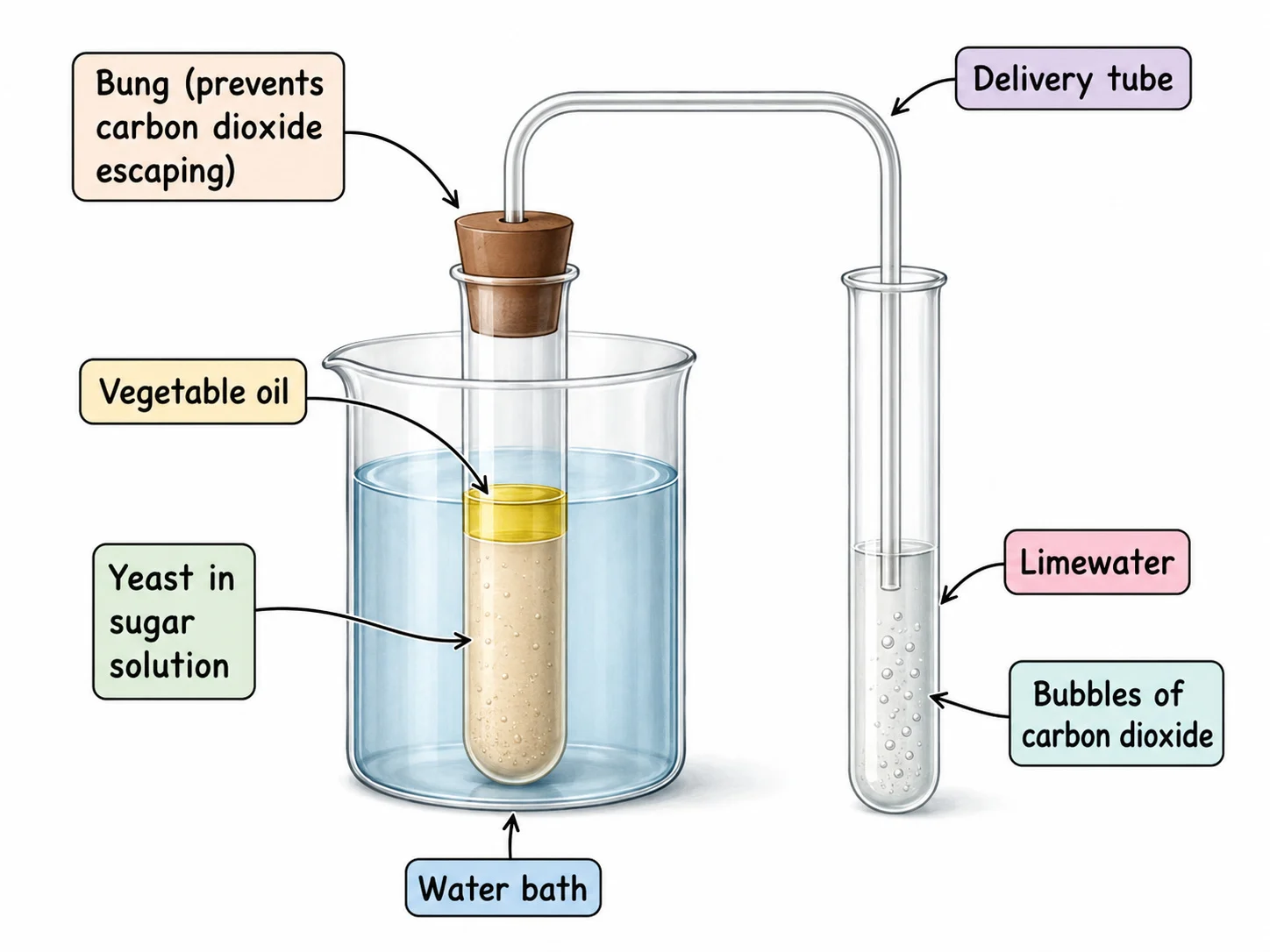
Anaerobic respiration in yeast is called fermentation (glucose to ethanol and carbon dioxide). It is important in bread and alcoholic drinks. To investigate temperature:
More bubbles per minute means a faster rate. The rate rises towards the optimum temperature because enzyme activity increases, but beyond the optimum the enzymes denature and carbon dioxide production slows and stops. CORMS: change temperature; same yeast species; repeat at each temperature; measure bubbles in a set time; standardise sugar concentration, volume and pH and the mass of yeast.
Part 3 of 5Bacteria and yoghurt
Bacteria are useful because they make complex molecules and reproduce rapidly. Yoghurt is made using Lactobacillus:
The lower pH also prevents growth of harmful microorganisms, so yoghurt keeps longer than milk.
Why both heat treatments?
- but if the milk were not cooled to 40 to 45°C before adding the culture it would kill Lactobacillus too.
Part 4 of 5Industrial fermenters
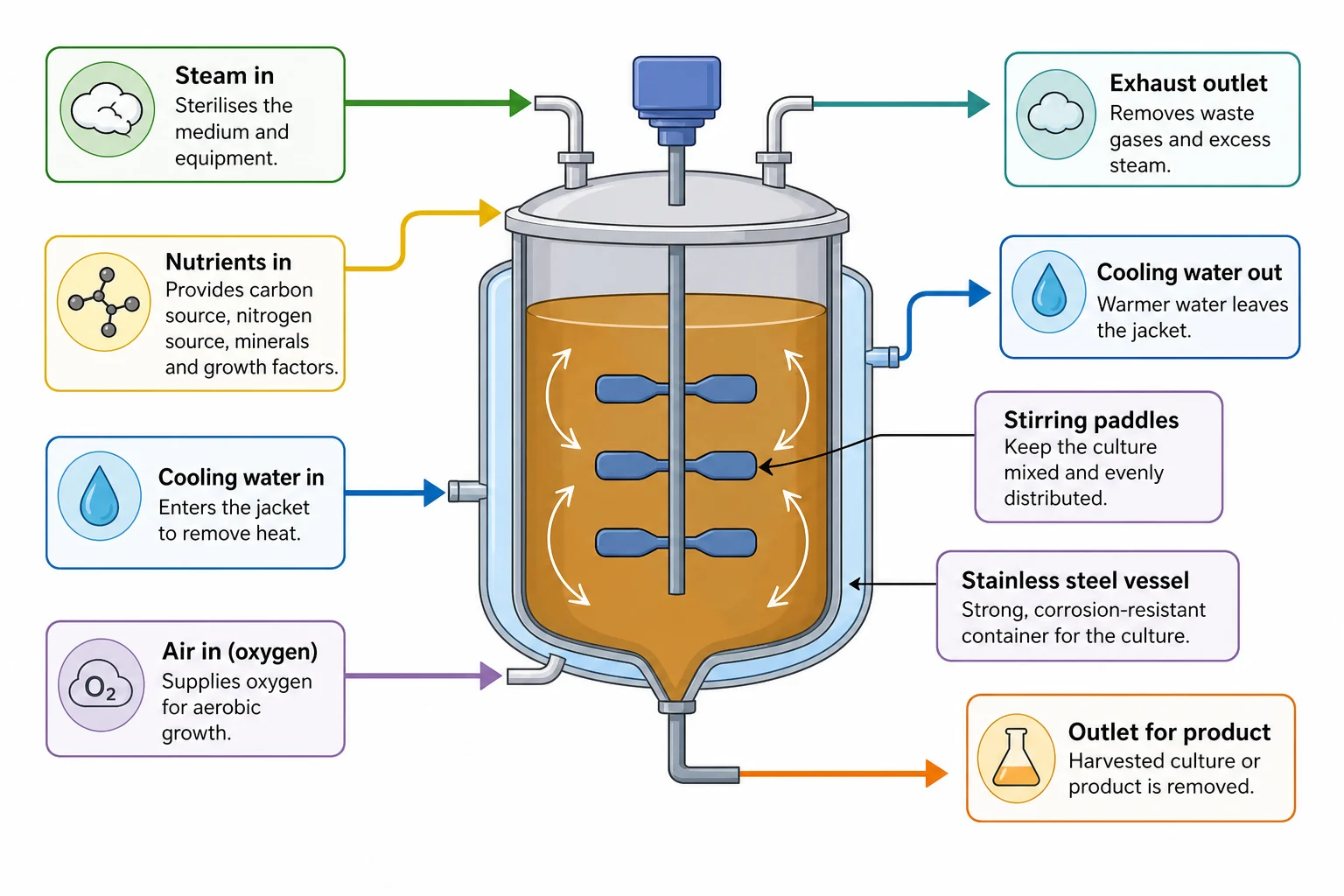
Fermenters are large containers for culturing bacteria and fungi, used for yoghurt, mycoprotein and antibiotics such as penicillin, and for GM microorganisms. Conditions can be controlled to give large quantities of the right organism.
| Condition | Why and how |
|---|---|
| Aseptic precautions | Steam cleaning kills contaminants so only the wanted microorganism grows |
| Nutrients | Supply respiration substrates and building materials for growth and reproduction |
| Temperature | Probe and water jacket keep the optimum for enzymes |
| pH | Monitored with a probe and adjusted with acid or alkali |
| Oxygen | Supplied for aerobic respiration |
| Agitation | Paddles mix microorganisms, nutrients, oxygen, temperature and pH evenly |
Part 5 of 5Worked examples
Explain why bread dough rises. [3]3 marks
Yeast respires anaerobically, producing carbon dioxide, which is trapped in the dough and expands it.
In the yeast investigation, why is oil added? [1]1 mark
To exclude oxygen so only anaerobic respiration occurs.
Explain why yoghurt lasts longer than milk. [2]2 marks
Lactic acid lowers the pH, which prevents the growth of harmful microorganisms.
Give two reasons a fermenter is stirred and cooled by a water jacket. [2]2 marks
Stirring distributes nutrients, oxygen and heat evenly; the jacket keeps the optimum temperature for enzymes.
Key terms
| Term | Meaning |
|---|---|
| Fermentation | Anaerobic respiration in yeast making ethanol and carbon dioxide. |
| Lactobacillus | Bacterium that turns lactose into lactic acid to make yoghurt. |
| Pasteurisation | Heating milk to kill unwanted bacteria. |
| Fermenter | Vessel for culturing microorganisms in large amounts. |
| Aseptic | Free from contaminating microorganisms. |
| Mycoprotein | Protein food made from fungus grown in a fermenter. |
Avoid these mistakes
Last updated:
\n